
A practical guide for general contractors and subcontractors.
Commercial construction leads come from a short list of places: past clients, GC bid lists, public procurement portals, planning and permit records, project databases, direct outreach, and your own website. This guide walks through each one, how to qualify what you find, and a weekly routine a small team can keep.
By the end, you will have a repeatable way to build a pipeline of projects your company can actually win, without buying a contact list.

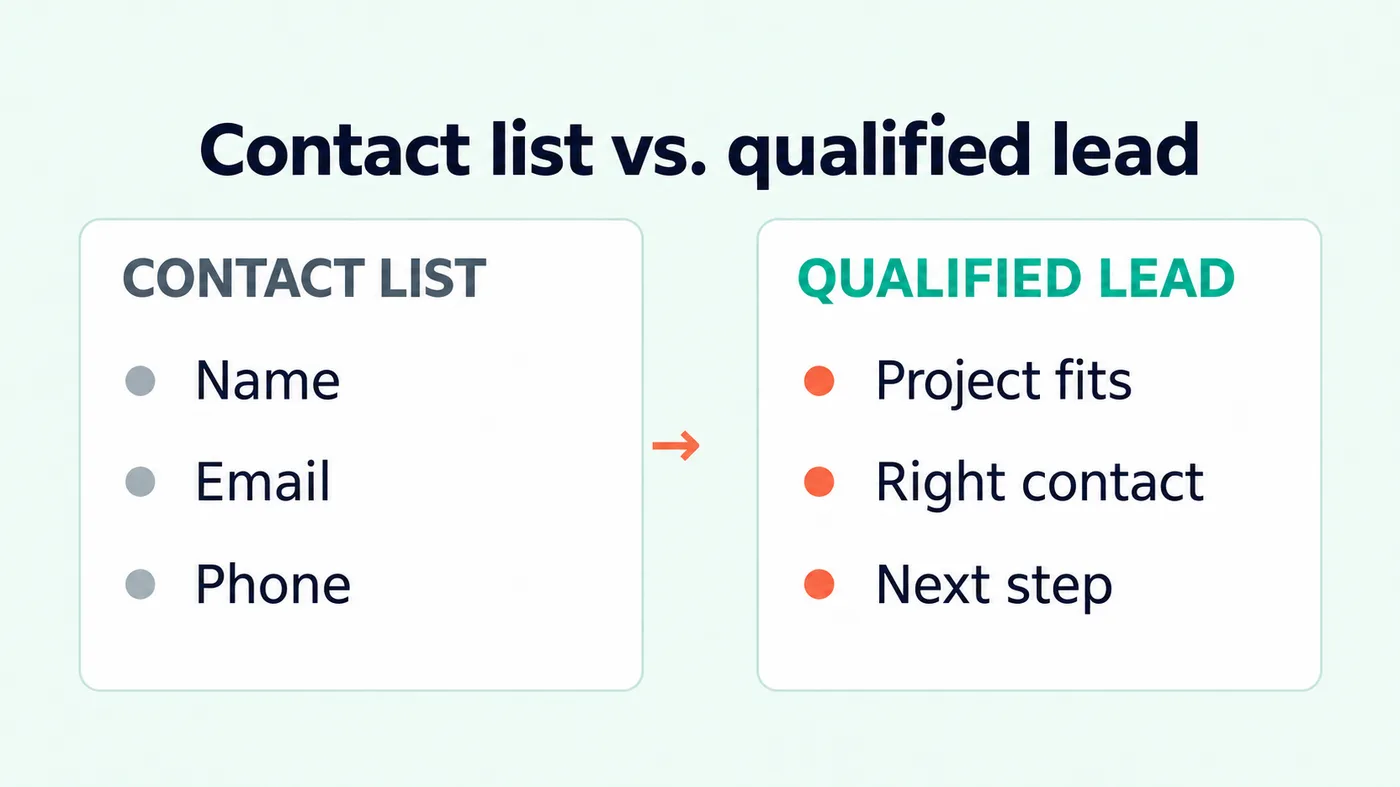
A name and an email address are data. A real commercial construction lead has a reason to call, a potential fit, and a next step. It might be a developer who just received zoning approval, a property manager planning renovations across several locations, a general contractor building a bid list, or a past client whose capital plan is starting again.
We have worked with contractors who had plenty of contacts but almost no usable pipeline. Their CRM was full. Their estimators were busy. The problem was that nobody could answer three basic questions:
- Which opportunities are worth pursuing?
- Who needs to hear from us?
- What are we doing next?
Everything that follows is built to answer those three questions.
Want someone to run this for you?
IdealRev builds and runs the lead generation and business development system for commercial construction companies: target accounts, outreach, follow-up, and the pipeline to track it.
The Short Answer: Where Do Commercial Construction Leads Come From?
Commercial construction leads usually come from one of seven places:
- Past clients and referral partners
- General contractor bid lists and prequalification systems
- Public procurement portals and agency capital plans
- Planning, zoning, permit, and property records
- Commercial construction project databases and bid platforms
- Direct outreach to owners, developers, property managers, architects, and GCs
- Your website, search visibility, project content, and social presence
The best lead system uses more than one source. A bid platform can show you what is active now. Early project research can show you what may be built next year. Relationships, referrals, and useful content keep your company visible between those two points.
First, Decide What Counts as a Good Lead
If you chase every project that appears in your market, you will bury your estimating team and still wonder why the win rate is low.
Before looking for more leads, write down what a qualified opportunity looks like for your company:
- Project type
- Typical contract value or trade package value
- Geographic range
- Delivery method
- Public or private work
- Ground-up, renovation, service, or maintenance
- Owner and client types
- Bonding, licensing, safety, certification, and insurance requirements
- Crew availability and realistic start dates
- Gross-margin requirements
A lead is not qualified because the project exists. It is qualified because the project fits your company and there is a realistic path to the work.
We use five questions before a contractor spends serious time on an opportunity:
- Does the project match the work we actually want?
- Do we know who is involved in the decision?
- Can we meet the schedule, staffing, bonding, and qualification requirements?
- Do we have a reason to believe we can compete beyond price?
- Is there a clear next action and somebody responsible for it?
If the answer to most of those questions is no, you probably have project information, not a real lead.
1. Start With Past Clients Before Looking for Strangers
The easiest commercial construction lead is usually connected to work you have already completed.
Past clients already know whether your team communicated, handled problems, protected the schedule, and finished the job. That makes the next conversation much easier than introducing yourself to someone who has never heard your name.
Do not send a generic email asking whether they have “anything coming up.” Give them a reason to answer.
Try something like:
Hey Mark, we were reviewing the closeout from the Commerce Drive project and wanted to check in. Are there any renovations, maintenance projects, or capital improvements planned for the next six to twelve months that we should keep on our radar?
Set a follow-up schedule for clients, architects, owner’s representatives, property managers, and GCs you have worked with. Some should hear from you quarterly. Others may only need a useful check-in twice a year.
The important part is that the follow-up does not depend on somebody remembering to do it.
2. Build a Referral Network Around the People Who Hear About Projects Early
Commercial projects usually leave clues long before a public bid appears.
Architects hear about feasibility studies and early designs. Engineers hear about infrastructure and system upgrades. Commercial brokers know when a tenant is searching for space. Lenders, surety agents, suppliers, equipment vendors, and property managers often hear about expansion or renovation plans before a contractor is selected.
These people do not need a long sales pitch. They need to understand what work fits your company well enough to recognize an opportunity when they hear one.
Be specific:
We are looking for occupied healthcare renovations between $500,000 and $5 million within two hours of Richmond.
That is easier to remember than:
We do commercial construction and would appreciate any referrals.
When somebody makes an introduction, close the loop. Tell them you followed up. Thank them. If the lead turns into work, let them know. People keep referring contractors who make them look good.
3. Get on General Contractor Bid Lists Before the Invitation Goes Out
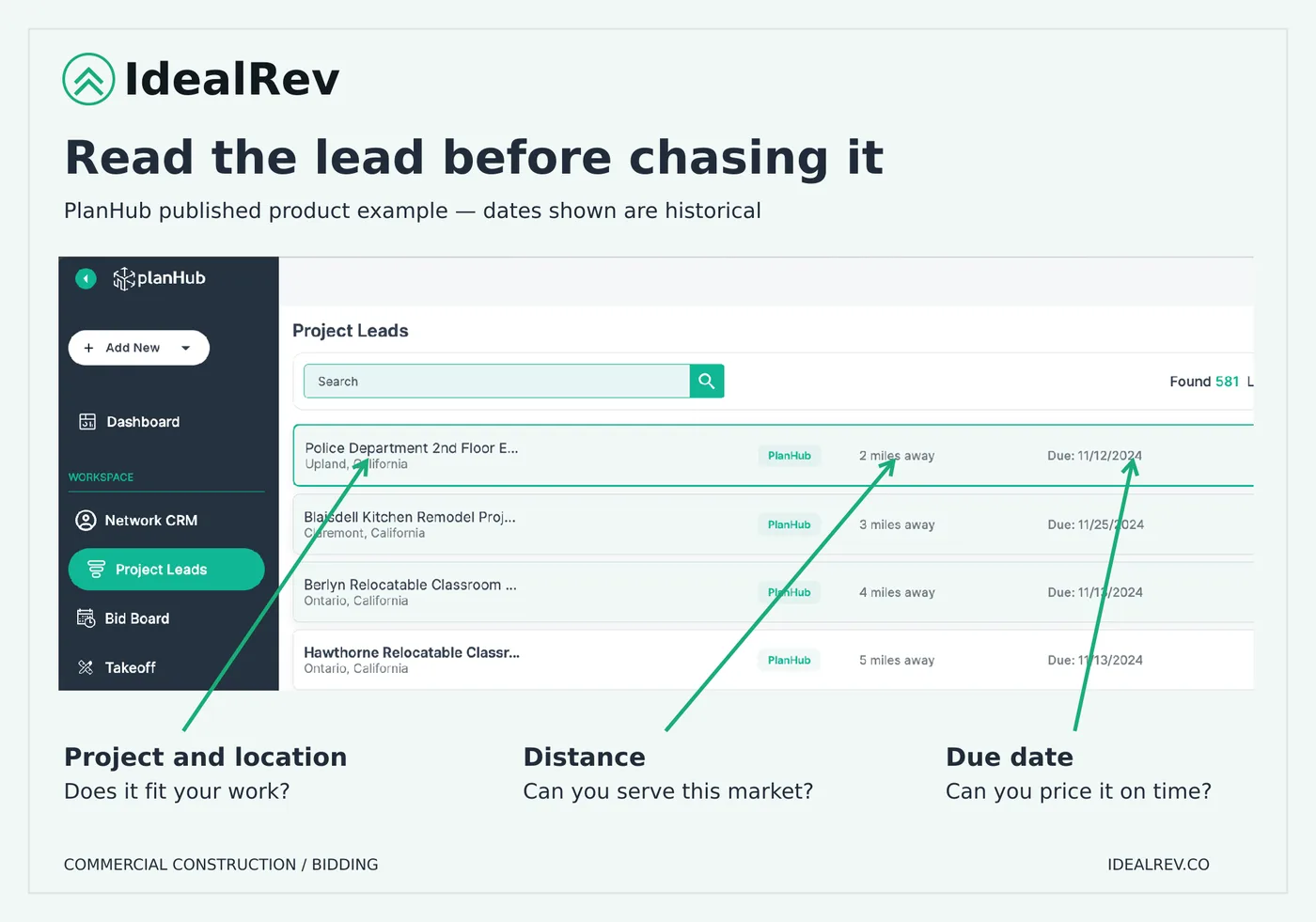
What this looks like in practice: A bid list is not a mailing list. Estimators usually protect it because every extra bidder creates follow-up and leveling work. Give them a reason to trust that you will price the right scope, meet the deadline, ask useful questions and communicate early if you cannot bid. After prequalification, ask which estimator owns your trade and what upcoming work matches your crew. Then record that person, the markets they cover and the date you should follow up.
For subcontractors, getting on the right GC bid lists can create a steady flow of commercial construction opportunities. The mistake is waiting until bid week to introduce the company.
Start by identifying general contractors that regularly build the type, size, and location of work you want. Review their active projects, markets, and subcontractor requirements. Then complete the prequalification process before asking for an invitation.
Have the basic information ready:
- Company overview and trade coverage
- Service area
- License and insurance information
- Bonding capacity, when applicable
- Safety record and EMR
- Relevant project experience
- Typical project or package size
- Certifications
- Key estimating and operations contacts
- Current capacity
After submitting the paperwork, call the estimating or preconstruction team. Do not ask to be added to every project. Ask how they build bid lists, what work they have coming up, and what they need to see from a new trade partner.
If you need help with the conversation, use our construction cold-calling guide and scripts. The goal is not to pressure somebody into sending an ITB. The goal is to understand the process and earn the chance to price the right job.
4. Use Public Bid Portals, Capital Plans, and Agency Websites
Public work is easier to find than private work because the opportunities must be advertised. The challenge is knowing where each agency publishes them and staying organized across multiple portals.
Depending on the work you pursue, check:
- State procurement portals
- City and county procurement pages
- School district and university procurement sites
- Housing, transportation, utility, and airport authority websites
- State capital improvement plans
- Federal opportunities on SAM.gov
- Federal subcontracting resources available through the U.S. Small Business Administration
Do not wait for the final solicitation. Watch capital plans, board agendas, funding approvals, procurement forecasts, and pre-solicitation notices. Those sources can show you the project before the bid documents are finished.
Create saved searches when the portal allows it. Track the agency, project, anticipated procurement date, delivery method, incumbent contractor, design team, pre-bid date, and required certifications in your CRM.
5. Track Permits, Planning Meetings, Zoning Cases, and Property Activity
What this looks like in practice: Build a short watch list instead of trying to monitor an entire region. Choose the municipalities, owners and project types that fit your business. Review new records weekly and capture four facts: the project address, current stage, applicant or owner, and the next public milestone. Those four facts are usually enough to identify the right architect, developer, property manager or likely GC and make a relevant call.
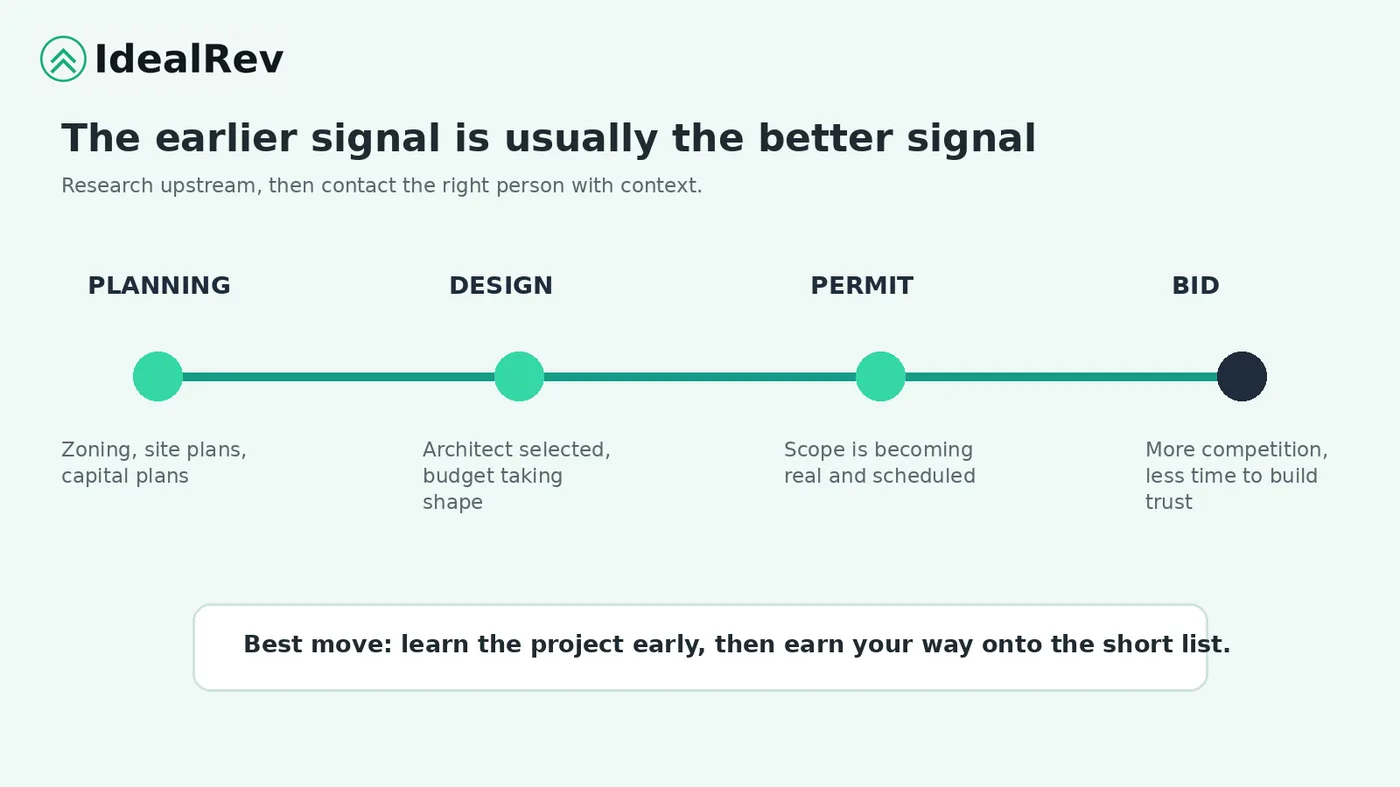
If you want to find private commercial construction projects before they go to bid, move upstream.
Planning and zoning agendas can reveal rezonings, conditional-use permits, site plans, and proposed developments. Building permits show projects that are becoming real. Property records can help identify the ownership entity. Commercial real estate news can reveal acquisitions, leases, expansions, and redevelopment plans.
Useful places to watch include:
- City and county planning commission agendas
- Zoning applications and site-plan review portals
- Building permit databases
- Economic development announcements
- Commercial real estate publications
- Property sales and leasing announcements
- Architect and engineering firm project updates
- Owner capital plans and investor presentations
The information alone does not win the job. It gives you a reason to start the right conversation earlier.
For example, do not call a developer and say you found their name in a database. Call with context:
I saw the planning submission for the West Broad redevelopment. We have completed three occupied retail renovations with similar phasing and wanted to ask how you are approaching contractor selection.
That sounds like a contractor who did the homework, not somebody reading down a purchased list.
6. Use Bid Sites and Project Databases With a Clear Purpose
What this looks like in practice: Run a 30-day test before treating any paid database as permanent overhead. Save a narrow search, assign one person to review it, and tag every opportunity by source. At the end of the test, count qualified projects, real conversations, bid invitations and awards. A platform that produces hundreds of alerts but no fit is not giving you more leads; it is giving your team more sorting.
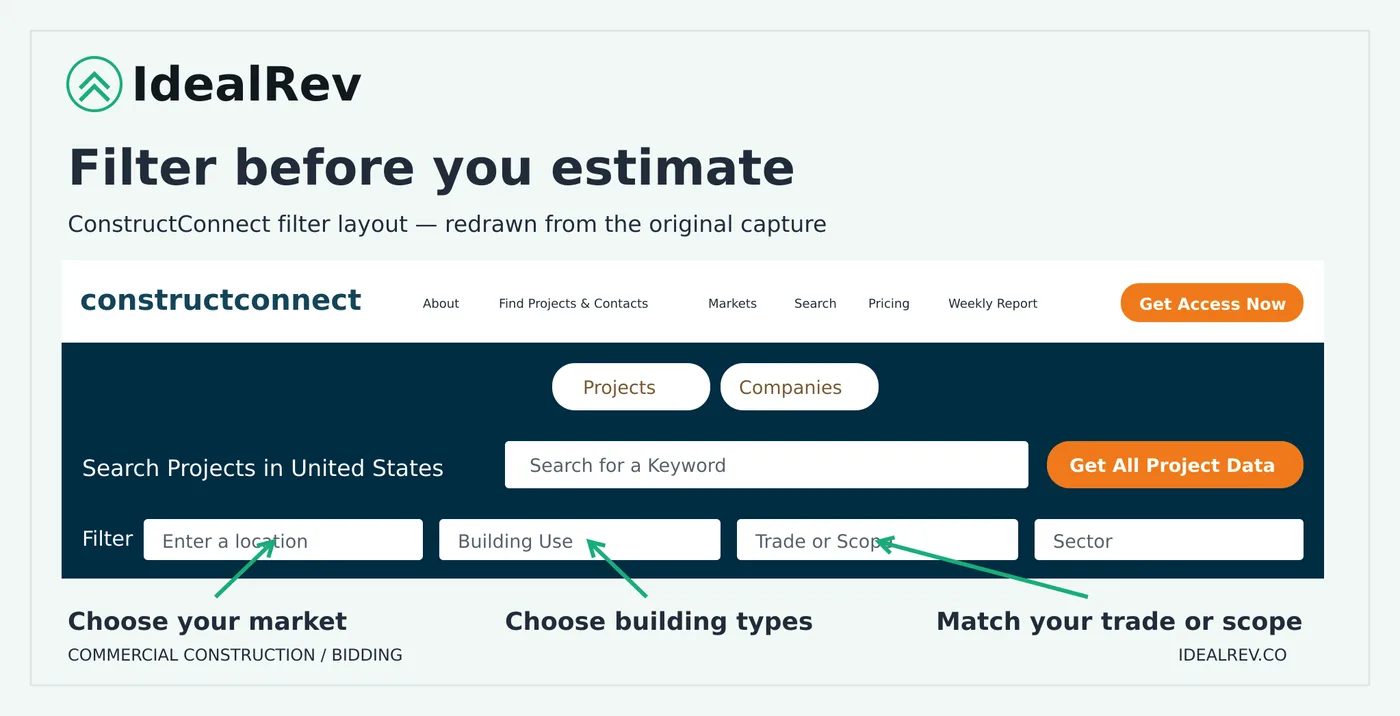
Commercial construction databases can save a lot of research time. They can also flood your inbox with projects your company would never pursue.
Platforms such as ConstructConnect, Dodge Construction Network, BuildingConnected, PlanHub, and public procurement aggregators serve different purposes. Some are strongest at early-stage project intelligence. Some are built around active invitations to bid. Others are better for public solicitations or subcontractor bid management.
Before paying for a platform, answer these questions:
- Do we need early planning-stage leads or active bids?
- Are we looking for private work, public work, or both?
- Does the platform cover our geography and project types?
- Can we filter by trade, project size, stage, owner, and bid date?
- Does it identify the owner, architect, GC, or bidding contractors?
- Who on our team will review the alerts and act on them?
- How many qualified opportunities would justify the cost?
Our guide to the best commercial construction bid sites compares the main options and explains which type of contractor each one fits.
The platform is only the starting point. A project alert still needs to be qualified, researched, assigned, and followed up.
7. Build a Target Account List Instead of Buying a Generic Contact List
There is nothing wrong with using data tools to find contact information. The problem starts when the list becomes the strategy.
A useful target account list is built around companies that match your market:
- Owners with facilities in your service area
- Developers building the project types you know
- Property management firms with the right portfolio
- General contractors active in your trade and geography
- Architects and engineers connected to relevant projects
- Public agencies with recurring capital work
Start with 25 to 100 accounts, depending on your team’s capacity. For each account, identify the people connected to construction decisions. That may include a facilities director, development manager, capital projects leader, property manager, preconstruction manager, estimator, or project executive.
Then add the reason for outreach. A company opening new locations is worth contacting. So is a property owner with an aging portfolio, a GC entering your market, or an architect designing a project in your niche.
Without that context, you are still working from a cold list. With it, you have a focused group of accounts and a reason to talk.
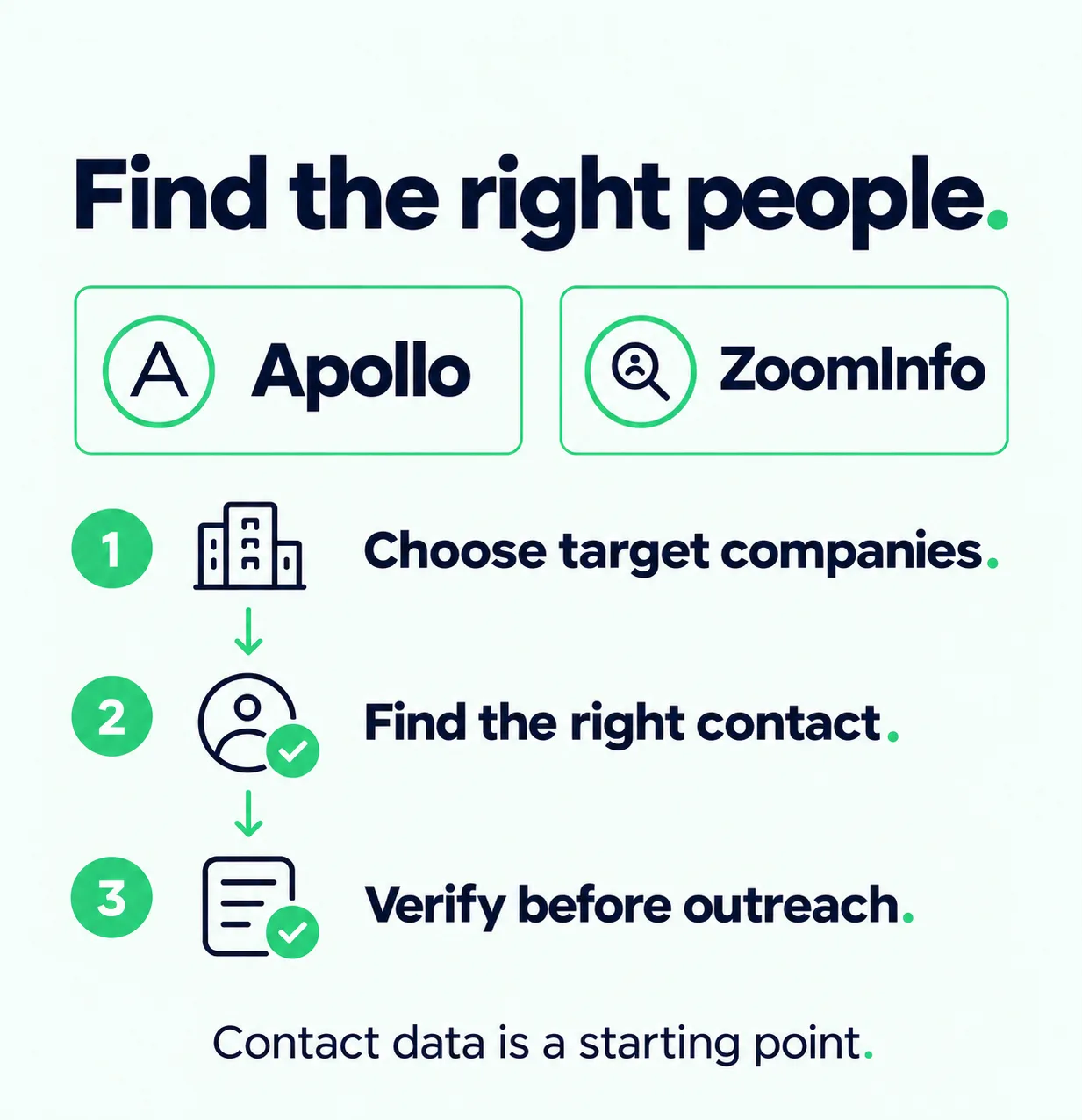
Where Apollo and ZoomInfo fit
Once you know which accounts you want, a contact data tool turns hours of research into minutes. Two of the most common in construction business development are Apollo and ZoomInfo.
Apollo is the easier place to start. It has a free tier and self-serve paid plans billed per seat, and it bundles contact data with email sequences, a dialer and basic buying signals such as hiring and funding news. For an owner who handles business development personally, or a team of one or two, it covers most of what you need: find the facilities director at a regional health system, verify the email, and add that person to a short, project-specific sequence.
ZoomInfo is the heavier tool. It is sold on annual contracts that often run into five figures, and its strength is depth at larger organizations: org charts, direct dials, company hierarchies and intent data that flags when an account is researching a topic. It makes more sense for a GC or specialty contractor with a dedicated BD team chasing national accounts, multi-site brands or large developers.
Whichever one you choose, use it to work your account list, not to replace it:
- Search inside your target accounts. Exporting an entire industry code and calling it a pipeline is just buying a list with extra steps.
- Filter by the titles that touch construction decisions: facilities, capital projects, real estate, development, preconstruction and estimating.
- Use company signals as your reason to reach out. A new facilities hire, a funding round or a new-location announcement is a better opener than your company history.
- Verify before you send. Project managers and estimators change firms often, and a high bounce rate hurts every email your domain sends afterward.
- Keep sequences small. Forty researched contacts with a project-specific message will outperform an export of 4,000.
- Read the contract. ZoomInfo renews automatically with a strict cancellation window, and Apollo credits go quickly when you reveal phone numbers.
Neither tool can tell you which building is going up next year. They tell you who to call once you know why you are calling. Pair them with the project signals from Sections 4 through 6, and log every contact in your CRM so the research is not lost when someone leaves.
8. Make Direct Outreach About the Project, Not Your Company
Most contractor outreach starts with a paragraph about the contractor. The year it was founded, the services it offers, and the promise to deliver quality work safely and on time.
The buyer already assumes you believe your company is good. What they need to know is why you are contacting them now.
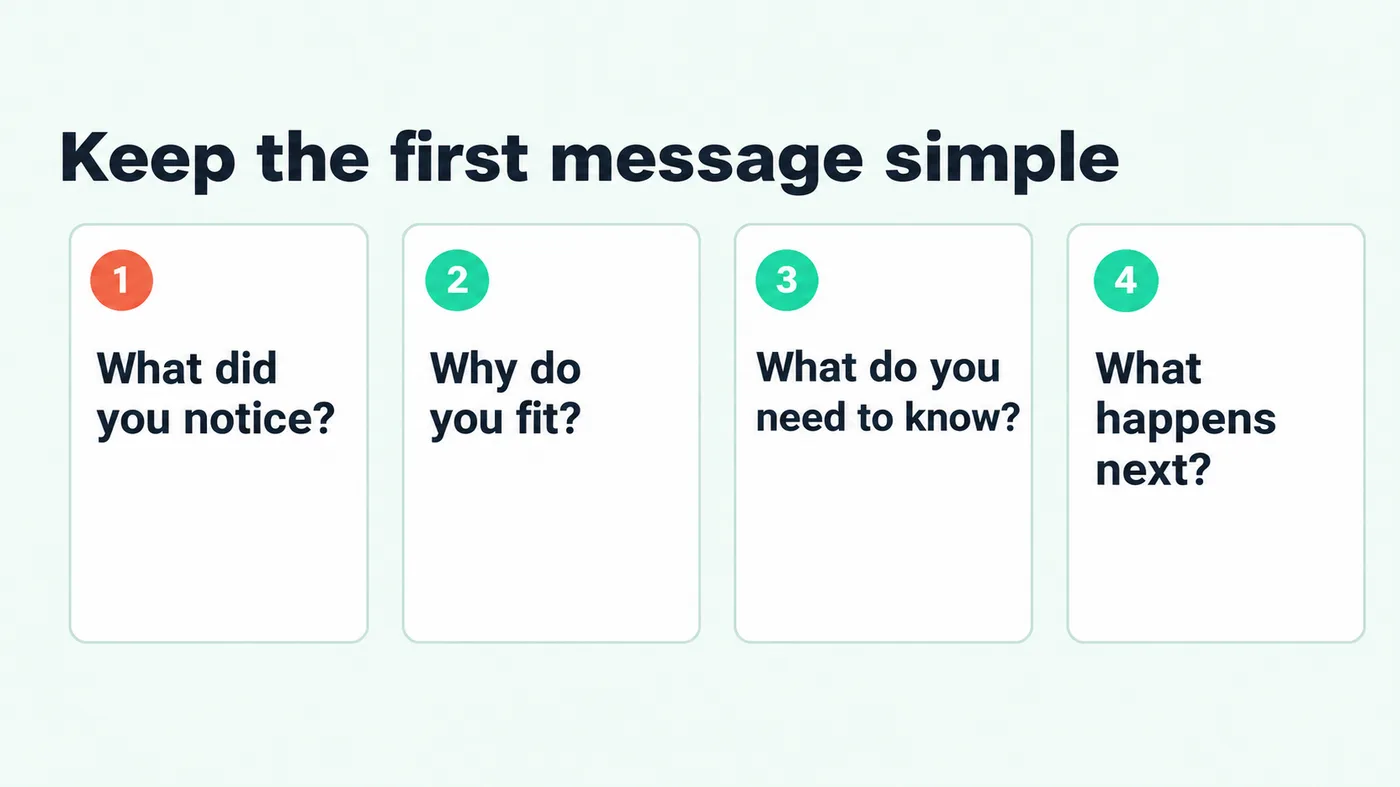
A better message has four parts:
- What you noticed
- Why it fits your experience
- One useful question
- A small next step
Example for an owner or developer:
Hi Sarah, I saw the approval for the two-building medical office project in Chesterfield. We recently completed a similar occupied healthcare project and dealt with the same access and phasing issues. Have you selected the GC yet, or are you still talking with contractors?
Example for a GC estimator:
Hi Mike, I saw your team is bidding the Franklin County operations building. We cover Division 9 work throughout that region and have a crew opening in January. Are you still adding bidders for that package?
Keep the first message short. If they are interested, there will be time for the capability statement and project sheet later.
Short on time to research accounts and follow up?
That is the part most contractors drop first. Our team does the account research, outreach, and follow-up every week so your estimators only see opportunities worth pricing.
9. Use Your Website to Prove You Belong on the List
Commercial construction leads rarely come from a website form alone. That does not mean the website is unimportant.
After receiving your email, meeting you at an event, or seeing your name on a bidder list, people look up the company. They want to confirm that you do the work you said you do.
Make that easy. Your website should clearly show:
- The type of contractor you are
- The markets and project types you serve
- Where you work
- Relevant project experience
- Project size and scope
- Safety, bonding, licensing, and certifications where appropriate
- The people behind the company
- A phone number and clear way to contact the right person
Project pages should explain more than the building name. Include the client type, market, delivery method, scope, size, schedule, constraints, and what your team actually handled.
If your website needs work, start with our review of commercial construction websites that help contractors win work.
10. Create Content That Supports a Real Sales Conversation
Content should make business development easier. It should give your team something useful to send before or after a conversation.
Good commercial construction content includes:
- Detailed project case studies
- Lessons learned from a difficult scope
- Short videos explaining how your team handled a field problem
- Market-specific checklists
- Procurement or preconstruction guidance
- Photos that show the process, not only the finished building
- Owner and client questions your team answers repeatedly
The goal is not to post every day. The goal is to show the right buyer that your team understands the work.
A strong case study can support outreach for years. A project manager can send it to a prospect. An estimator can include it with a qualification package. A business-development person can use it as the reason for a follow-up.
For the larger strategy, see our guide to commercial construction marketing that actually wins work.
11. Use LinkedIn to Watch Accounts and Stay Familiar
LinkedIn works best in commercial construction when it supports relationships that already matter.
Follow the companies and people on your target list. Pay attention to project announcements, promotions, expansions, hiring, awards, and new-market activity. Those updates create natural reasons to reach out.
Do not make every comment or message a pitch. Congratulate people. Ask a real question. Share a relevant lesson. Stay visible long enough that your name is familiar when an opportunity comes up.
Your company page should show real work, active jobs, project teams, client problems your company solved, and the types of projects you want more of. A feed full of holiday graphics and stock images does not help a buyer understand your experience.
12. Turn Events and Associations Into Follow-Up, Not Just Attendance
Industry events can produce good commercial construction leads, but rarely because somebody handed over a contract at lunch.
Before the event, review the attendee, sponsor, and speaker lists. Identify the companies you want to meet. After a conversation, record what you learned and set the next step before the details disappear.
The follow-up should reference the conversation:
Good meeting you at the AGC breakfast. You mentioned the hospital renovation program may move into design this winter. I wanted to send over the occupied-renovation project we discussed and see if it would make sense to reconnect in December.
That is far more useful than adding the person to a generic newsletter and hoping they remember you.
13. Follow Up Until There Is a Real Outcome
What this looks like in practice: Use follow-up reasons tied to the project: a planning meeting, permit update, design milestone, prequalification deadline, addendum, site walk or expected award date. “Just checking in” makes the recipient do the work. A useful follow-up explains why the timing matters and asks one question the buyer can answer quickly.
Commercial construction sales cycles are long. A good lead can go quiet for months because funding, design, permitting, or internal approvals are still moving.
One unanswered email does not mean the opportunity is dead. It usually means the timing is wrong or the message did not give the person a reason to respond.

Match the rhythm to the stage
A lead in planning and a bid due Friday should not get the same follow-up schedule.
- Early stage (planning, zoning, design): every four to six weeks, timed to public milestones such as a hearing, a design-team selection or a funding vote.
- Active pursuit (prequalification, bid list, ITB): weekly, sometimes more often, until the bidder list is set or the bid is in.
- Bid submitted: short and specific. See the post-bid steps below.
- Nurture (good account, no project yet): quarterly, with something useful attached.
A six-week sequence for a new project lead
Most replies come after the second or third touch, not the first. A simple sequence mixes channels so you reach people both on the job site and at their desk:
- Day 1: Call, then send a short email that names the project signal and asks one question.
- Day 3: Reply on the same thread with one new detail, such as a photo or a one-line summary of a similar job.
- Day 8: Call again. If you get voicemail, keep it under 20 seconds and say the project name early.
- Day 14: Connect on LinkedIn or comment on something they actually posted. No pitch.
- Day 21: Send something they can use: a case study on a similar occupied renovation, a sample phasing plan or a note on current lead times for long-lead equipment.
- Day 35 to 42: Close the loop politely and set the next date.
That last message does more work than people expect. It gives the buyer an easy way to answer and keeps the door open:
Sounds like the timing may not be right yet. I will check back when the site plan goes before the planning commission in March, unless someone else on your team is handling contractor selection.
Replace “just checking in” with a reason
If a follow-up could be sent to any project in the country, the recipient will treat it that way. Compare these two:
Weak: “Just checking in to see if there are any updates on the project.”
Better: “The county posted Addendum 2 this morning with the revised door hardware schedule. Is the bid date still the 14th, or do you expect it to move?”
The second one shows you read the documents, and it asks a question the estimator can answer in ten seconds.
Follow up after the bid, win or lose
This is where many contractors go quiet, and it is often where the next job gets decided.
- Within 48 hours: Confirm the bid was received and ask whether any scope items need clarification.
- Before the award date: Ask where the decision stands and offer a short scope review call.
- If you win: Thank the people who helped, including whoever made the introduction.
- If you lose: Ask for a five-minute debrief. Where did your number land? Was there a scope gap? Who was selected? Record the answers in your CRM.
A GC estimator who tells you that you were four percent high on electrical is giving you information no database can sell you.
Know when to pause or pass
Following up until there is a real outcome does not mean following up forever. A clear no is worth more than six months of maybe.
- Pause when the project stalls on funding, design or approvals. Move it to nurture and tie the next date to the next milestone.
- Pass when the qualification questions from the start of this guide no longer check out. Log the reason so nobody chases it again next year.
- Stop when the buyer tells you to. Ask whether there is a better time or a better person, record it and move on.
Put it in the CRM
Every active lead should have:
- An owner inside your company
- A current stage
- The people involved
- The last meaningful interaction
- The next action
- A specific follow-up date
This is where a CRM becomes useful. It does not need to be complicated. It needs to show what the team is pursuing, who has been contacted, what has been bid, and what needs attention next.
Our construction CRM guide compares the main options by company type. If your team already uses HubSpot, our HubSpot construction CRM setup guide explains how to configure it around accounts, contacts, projects, bids, and follow-up.
What Works Differently for General Contractors and Subcontractors?
The basic system is the same, but the buyer and timing change.
For general contractors
General contractors should focus on owners, developers, property managers, architects, engineers, public agencies, and owner’s representatives. The best time to build the relationship is often during planning, budgeting, or design, before the contractor list is final.
Useful lead signals include land activity, capital plans, expansions, lease announcements, design contracts, planning cases, and early permit activity.
For subcontractors
Subcontractors should focus on the GCs, construction managers, estimators, and preconstruction teams that control bid lists. They also benefit from tracking projects early enough to identify which GCs may pursue them.
Useful lead signals include prequalification requests, bidder-list activity, active ITBs, plan-room postings, GC market announcements, and project-specific outreach.
The biggest mistake for both groups is entering the process after the buyer has already decided who belongs on the short list.
How to Get Free Commercial Construction Leads
Free does not mean effortless. It means you are trading research and follow-up time for subscription cost.
Good free sources include:
- Past clients and referral partners
- Public procurement websites
- Planning and zoning agendas
- Building permit portals
- Economic development announcements
- Agency capital improvement plans
- GC subcontractor registration pages
- Architect, developer, and owner websites
- LinkedIn company and personnel updates
- Free tiers or trials from bid platforms
- SAM.gov and SBA subcontracting resources for federal work
Choose a manageable set of sources and check them consistently. Ten focused searches every week will usually produce more value than bookmarking fifty websites nobody reviews.
How to Qualify a Commercial Construction Lead Before You Bid
More leads are not useful if they produce more unpaid estimating.
Before committing resources, confirm:
- Project fit
- Scope fit
- Location
- Budget or likely contract value
- Funding status
- Project stage
- Decision process
- Known competitors or incumbent
- Schedule
- Bonding and insurance requirements
- Relationship strength
- Probability of award
- Estimated cost to pursue
Then decide whether to pursue, nurture, monitor, or pass.
The full process continues in our guide to the construction sales process from lead to awarded project. If the opportunity is ready to price, use our guide on how to bid and win commercial construction jobs.
A Simple Weekly Commercial Lead Generation Routine
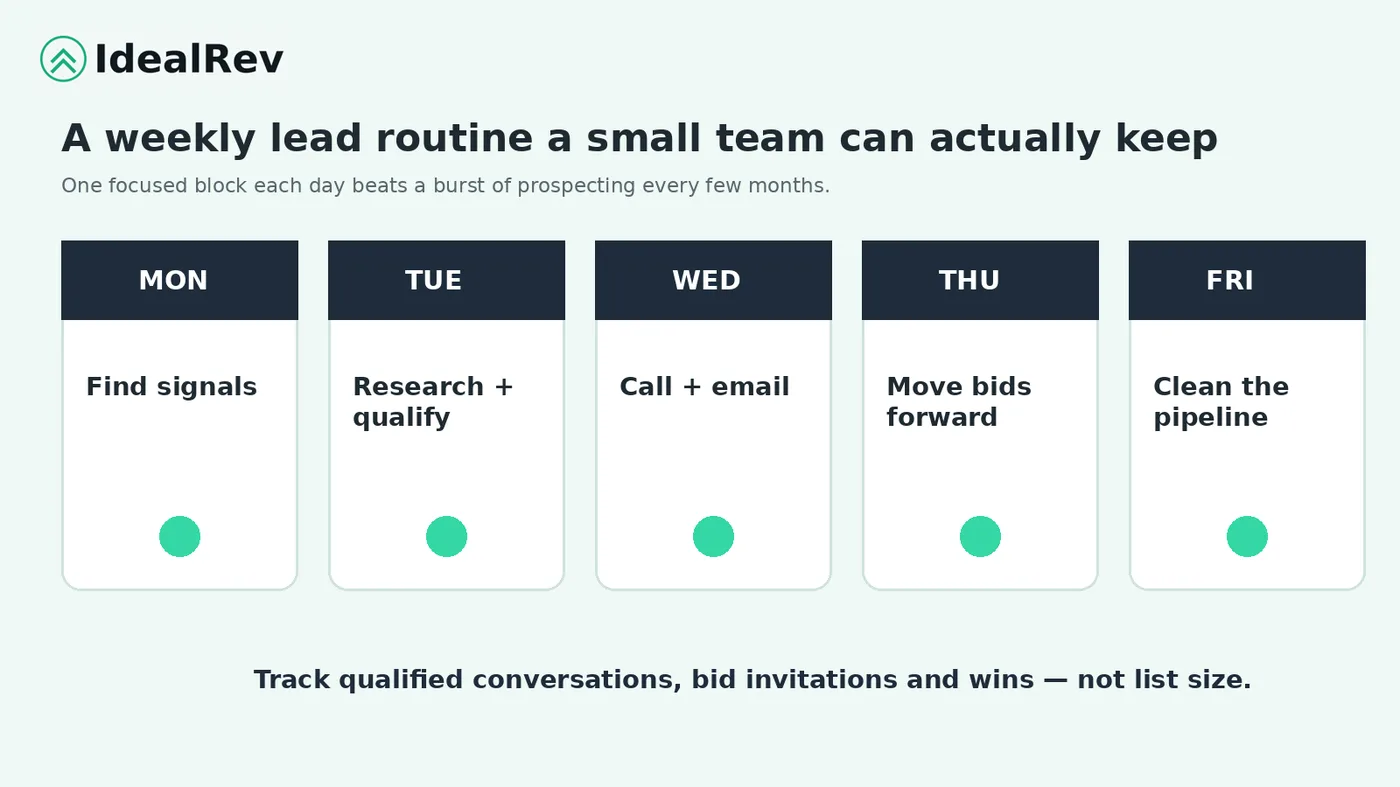
You do not need a large business-development team to start. You need a repeatable schedule.
Monday: Review new project signals
Check saved searches, bid alerts, public portals, permits, planning agendas, and target-account news. Add only relevant opportunities to the pipeline.
Tuesday: Research and qualify
Identify the owner, design team, likely GCs, decision-makers, schedule, and fit. Decide whether the opportunity deserves active pursuit.
Wednesday: Make contact
Call or email the right people with a project-specific reason. Complete prequalification requirements where needed.
Thursday: Follow up on active pursuits and bids
Move every open opportunity forward. Ask about contractor selection, bid-list status, missing information, award timing, or the next decision.
Friday: Clean the pipeline
Update stages, close dead opportunities, schedule the next action, and review which lead sources produced real conversations.
The routine can be completed by an owner, estimator, coordinator, or business-development person. The title matters less than clear ownership.
What to Track
Do not judge lead generation by the number of contacts collected.
Track:
- New qualified opportunities
- Decision-maker conversations
- Meetings
- Prequalification approvals
- Bid invitations
- Bids submitted
- Pursue rate
- Win rate
- Average project or package value
- Days from first contact to bid
- Days from bid to award
- Revenue and gross profit won by lead source
This shows where real work comes from. It also exposes sources that produce activity without producing suitable projects.
Common Mistakes That Kill Commercial Construction Lead Generation
Buying a list and blasting everybody

The message has no context, the targeting is weak, and the follow-up usually stops after one or two emails.
Treating every project listing as a lead
A listing becomes a lead after you confirm fit, contacts, timing, and a path to the work.
Waiting until bid day to build the relationship
By then, the bidder list may already be set and the people who shaped the project have been talking for months.
Sending the same capability statement to every buyer
A developer, property manager, public agency, and GC estimator do not care about the same things. Use the proof that fits the buyer and project.
Measuring activity instead of progress
Calls and emails matter, but conversations, invitations, meetings, and qualified pursuits tell you whether the system is working.
Failing to set the next action
If nobody owns the follow-up date, the opportunity will disappear under the next round of bids and project problems.
Frequently Asked Questions
What is the best way to get commercial construction leads?
The best system combines early project research, relationships, direct outreach, relevant bid platforms, and consistent follow-up. The right mix depends on whether you are a GC, subcontractor, supplier, or construction service provider.
Where can subcontractors find commercial projects to bid on?
Subcontractors can find projects through GC bid lists, BuildingConnected and similar bid networks, commercial project databases, public procurement portals, local plan rooms, pre-bid meetings, and direct relationships with estimating and preconstruction teams.
How do I get on a general contractor’s bid list?
Target GCs that build the work you want, complete their prequalification requirements, provide relevant project experience and safety information, and speak with the estimating team before asking for an invitation. Ask how they select bidders and which upcoming projects fit your trade.
How do I find private commercial construction projects?
Watch planning and zoning cases, site-plan applications, building permits, property transactions, commercial real estate news, design-firm announcements, and early-stage project databases. Use that information to contact the owner, developer, architect, or likely GC before the project reaches a crowded bid stage.
Are commercial construction lead services worth it?
They can be when the platform covers your geography, trades, project types, and preferred stage. The value depends on whether your team consistently qualifies and follows up on the information. Track qualified opportunities and awarded gross profit, not the number of alerts.
Can commercial contractors get leads through SEO?
Yes, especially when the website has strong service, market, location, and project pages. SEO also helps buyers verify the company after a referral or outreach message. For commercial work, search visibility usually supports a larger relationship and sales process rather than replacing it.
How long does commercial construction lead generation take?
Some bid invitations can appear immediately. New relationships and private negotiated work often take months or longer. The timeline depends on project stage, procurement method, buyer, market, and whether the contractor already has relevant relationships.
Build a Pipeline You Can Actually Work
The goal is not to fill a spreadsheet with more names. It is to create a manageable pipeline of projects and accounts your company has a realistic chance of winning.
Start with the work you want. Watch the places where that work first becomes visible. Contact the right people with a real reason. Keep the follow-up organized. Track what turns into conversations, bids, and awarded work.
That is slower than buying a list and sending 5,000 emails. It also produces a pipeline your estimators and operations team can actually use.
If your team knows what it wants to pursue but does not have the time or process to research accounts, reach decision-makers, and keep up with follow-up, IdealRev’s commercial construction lead generation team can build and run the system with you.
Want help building that pipeline?
Tell us what work you want more of. We will walk through where those projects first become visible, who you should be talking to, and what a weekly lead system looks like for your company.