
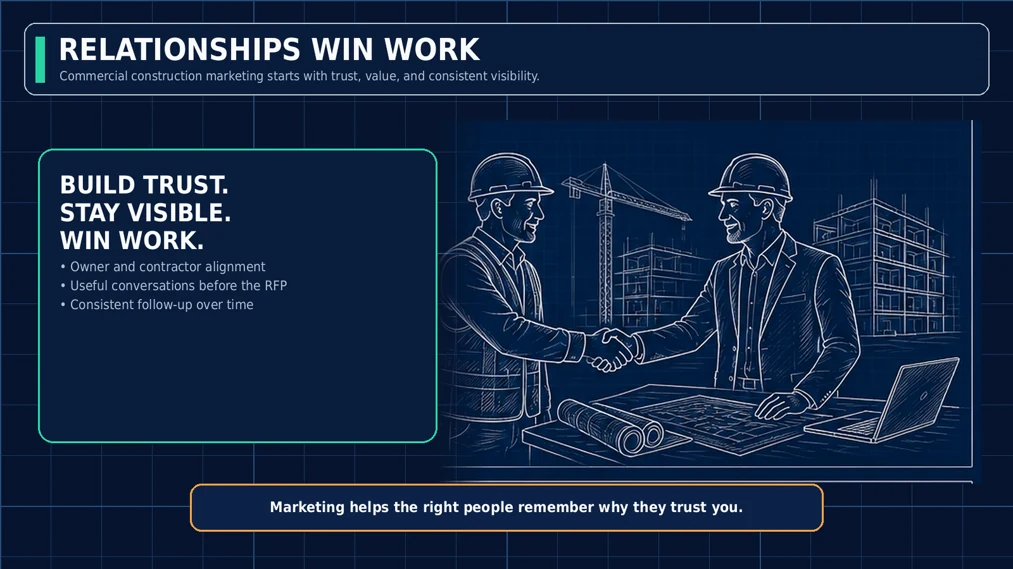
A contractor’s guide to building relationships, staying visible, and creating a more predictable commercial construction pipeline.
Most commercial contractors don’t lose work because they build poorly.
They lose because they show up too late.
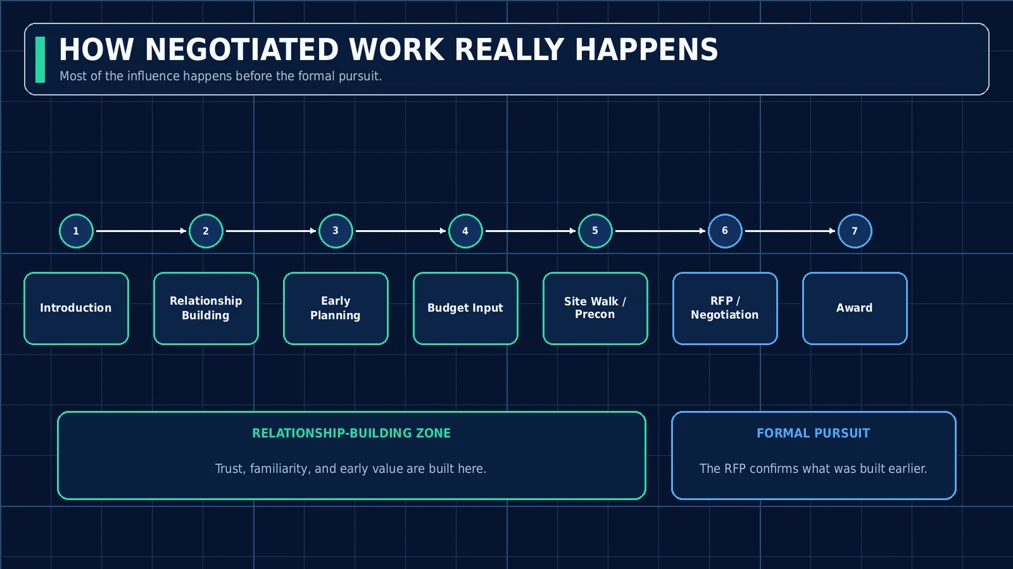
By the time an RFP is released, or a project hits the bid board, a surprising amount has already happened. The owner may already know who they trust. The architect may already have recommended a few contractors. Preconstruction conversations may have been happening for months.
In many cases, the shortlist is already taking shape before procurement even begins.
And yet most commercial contractor marketing advice still sounds like this:
- Build a better website.
- Post more on social media.
- Run Google Ads.
- Send an email newsletter.
None of those things are bad.
They just aren’t what drives most commercial construction sales.
Commercial construction is still a relationship business.
Companies with predictable backlogs usually do three things exceptionally well:
- They build relationships long before a project exists.
- They stay visible even when there isn’t an active pursuit.
- They follow up long after everyone else stops.
Because work in this industry typically flows like this:
Relationships → Conversations → Opportunities → Contracts
Once you understand that, marketing starts to look very different.
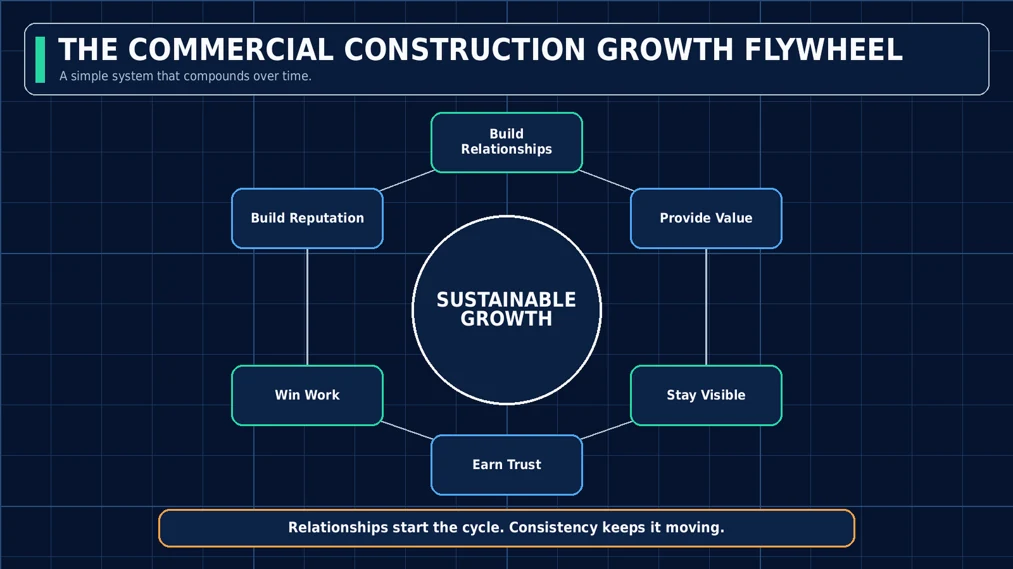
What Actually Wins Work in Commercial Construction?
Most contractors think marketing means social media posts, sponsorships, ads, or a new website.
Those things can help.
But they aren’t the foundation.
They’re amplifiers.
If the underlying relationships aren’t there, none of those tactics move the needle in a meaningful way.
What drives revenue in commercial construction is much simpler — and much harder to stay consistent with:
Building relationships with the right people and staying in front of them over time.
Stay in Front of the Right People
Developers, owners, architects, engineers, and representatives already have people they trust.
A developer building their fifth medical office building rarely starts from scratch. They call the architect they’ve used before. That architect recommends contractors they’ve had good experiences with. By the time drawings hit the street, the shortlist may already be down to three or four teams.
If your company isn’t part of those conversations, you’re competing from behind.
Be Useful Before There’s an Opportunity
Most people reach out when they need something.
The contractors consistently winning negotiated work stay in touch when they don’t.
That might look like:
- Sharing lessons learned from a recently completed project.
- Offering conceptual budgeting during early planning.
- Introducing a developer to a trusted consultant.
- Sending a relevant market update.
- Inviting a client to tour a recently completed project.
Nobody remembers another “just checking in” email.
People remember useful.
Follow Up More Than Feels Comfortable
Most contractors reach out once or twice and stop.
Meanwhile, the project goes to the company that stayed visible.
Commercial construction sales cycles are long. Six to eighteen months isn’t unusual for negotiated work. Some relationships take years to turn into projects.
Projects get delayed. Financing changes. Priorities shift.
Consistent follow-up is how you stay in the conversation when timing finally lines up.
Build a Reputation That Travels Without You
Owners ask architects.
Architects ask owners.
Developers ask people they trust.
General contractors ask other general contractors.
People talk constantly in this industry.
Your reputation is being built in rooms you’re not in.
Marketing can reinforce that reputation.
It can’t fix a bad one.
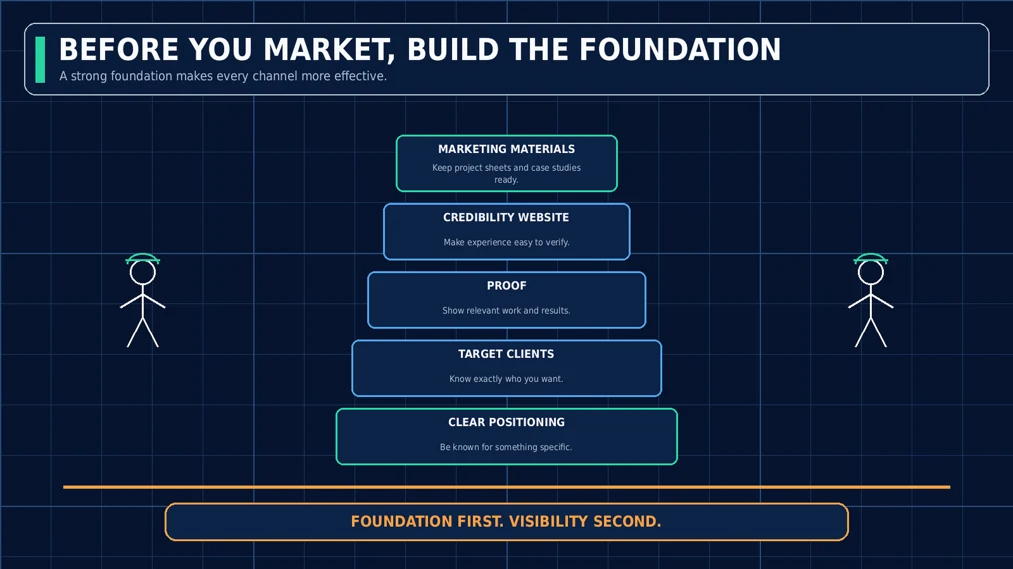
The Commercial Construction Marketing Foundation
Before investing heavily in commercial construction company marketing, make sure the fundamentals are in place.
More visibility doesn’t help if, once someone looks you up, nothing stands out.
Clear Positioning in the Market
If you do “a little bit of everything,” you’re hard to remember.
The contractors consistently getting invited to projects are usually known for something specific.
Healthcare. Industrial. K-12. Higher education. Mission critical. Tenant interiors. Manufacturing.
When someone hears:
“We need a contractor for a healthcare renovation.”
or
“We need a Design-Builder for a student housing project.”
your name should either come to mind immediately or it shouldn’t.
Clear positioning makes every marketing effort more effective.
A Website That Builds Confidence
Very few owners hire a contractor because of a website.
They absolutely eliminate contractors because of one.
When someone hears your company’s name, one of the first things they do is look you up.
They’re asking:
- Have these people built projects like mine?
- Do they work in my market?
- Are they active?
- Do they look organized?
- Would I trust them with my project?
According to B2B buying research, most buyers conduct significant online research before ever contacting a company. Your website is often one of the first places prospective clients evaluate your experience and credibility.
If those answers aren’t obvious within a few minutes, you’ve already lost ground. (We cover how to build a construction website that wins work in a separate guide.)
Real Marketing Materials
At some point, someone will ask for additional information.
That usually means:
- A capabilities statement
- Project sheets
- Team resumes
- Relevant experience
- Safety statistics
- Case studies
The best contractors make it easy for owners to understand:
- What they do
- Who they work for
- What markets they serve
- Why they’re qualified
If your marketing materials were thrown together the night before a meeting, people can tell.
Proof You’ve Done It Before
People don’t hire you for what you say.
They hire you for what you’ve already done.
That means:
- Professional project photography
- Relevant case studies
- Recognizable clients
- Detailed project descriptions
- Testimonials that say something meaningful
Stock photos don’t build confidence.
Real projects do.
Know Exactly Who You’re Trying to Work With
Too many contractors chase every opportunity.
The companies that grow consistently know exactly who they want to work with.
That includes:
- Client type
- Project size
- Geographic market
- Industry sector
- Delivery method
That clarity shapes every marketing decision.
The Marketing Channels That Actually Produce Work
Not all commercial construction marketing ideas produce the same results.
Some consistently generate revenue.
Others primarily reinforce credibility.
The table below reflects what we typically see across commercial construction.
The ranges below are directional, not guarantees. “Time to results” may mean qualified traffic, stronger engagement, new conversations, or influenced pipeline — not necessarily a signed contract. Results vary based on the exact campaign, your business model, market demand, deal size, procurement process, and sales cycle.
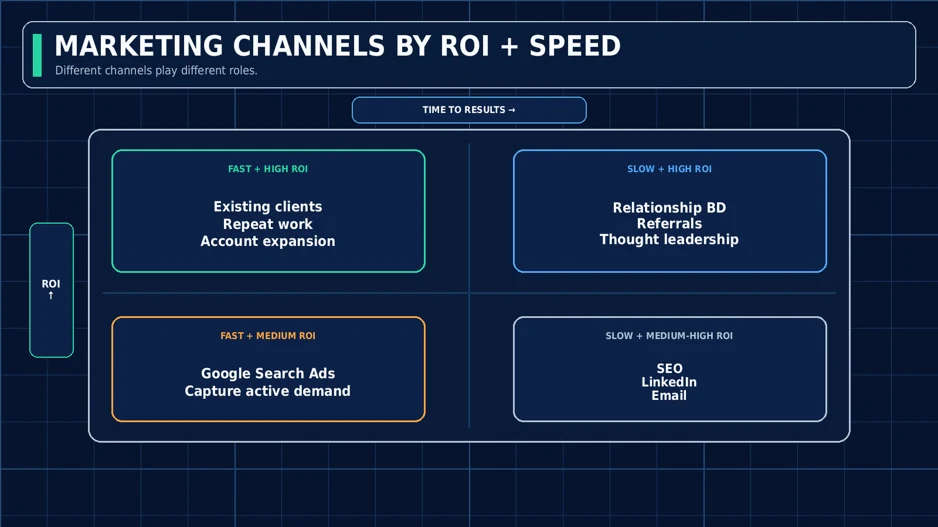
| Marketing Activity | Typical ROI | Typical Time to Meaningful Results | Primary Role |
|---|---|---|---|
| Existing Client Marketing | Very High | Immediate–3 Months | Repeat work and expansion |
| Relationship-Based Business Development | Very High | 6–18 Months | Create pipeline before procurement |
| Referral Networks | Very High | 6–24 Months | Transfer trust through known partners |
| Website and Content | High | 3–12 Months | Validate credibility and support decisions |
| Medium–High | 3–12 Months | Build familiarity between meetings | |
| Thought Leadership | High | 6–18 Months | Demonstrate expertise and point of view |
| Industry Events | High | 6–24 Months | Create face-to-face relationship momentum |
| Email Marketing | Medium | 3–6 Months | Nurture clients, prospects, and partners |
| Google Search Ads | Medium | 1–3 Months | Capture existing, high-intent demand |
| Paid Social / Awareness Ads | Medium | 3–12 Months | Build awareness with target accounts |
| SEO Content | High | 6–18 Months | Compound qualified visibility over time |
Marketing Timelines Follow the Sales Cycle
A channel can generate attention quickly and still take months — or years — to influence revenue. Commercial construction is a high-trust, high-consideration sale, and the timeline usually expands as the deal becomes larger, less urgent, more complex, or more dependent on financing and formal procurement.
An urgent service need may move from search to phone call in days. A small renovation may require several months of budgeting and approvals. A ground-up project or institutional capital program can take a year or more to move from early planning to award. Awareness campaigns are even harder to judge by immediate leads because their job is to make the company familiar before a need becomes active.
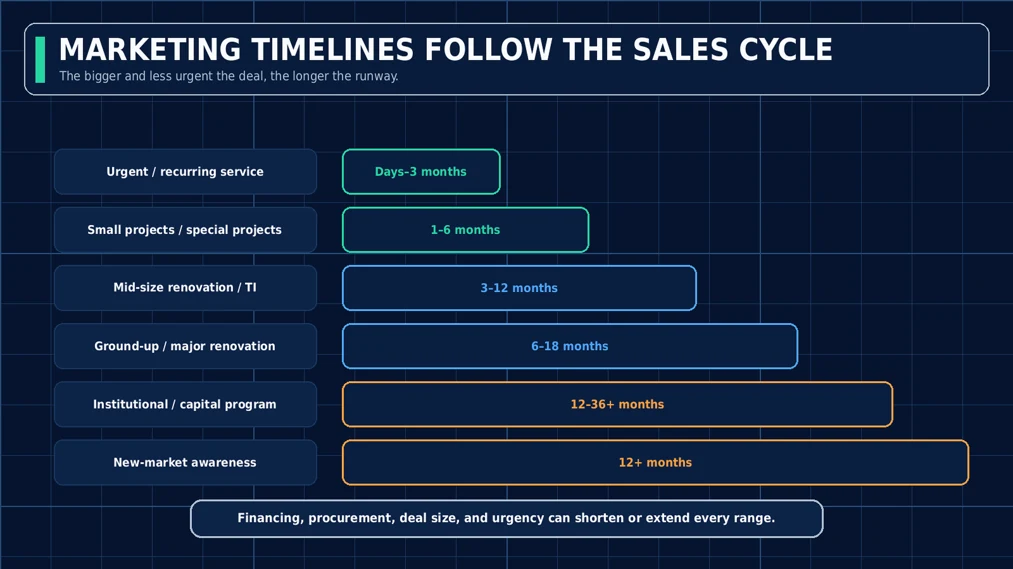
The practical takeaway: match the campaign to the sales cycle. Use high-intent channels to capture active demand, but use relationships, content, events, email, and paid social to stay visible through the much longer period before a decision is ready to be made.
1. Relationship-Based Business Development
This is still the highest ROI marketing activity for most commercial contractors because major projects are usually influenced long before formal procurement begins. Owners, developers, architects, engineers, and owner’s representatives want to work with people they trust, and that trust is built through repeated conversations over time — not a single proposal submission.
Relationship-based business development is not just lunches, golf outings, or showing up at networking events. Done well, it is a disciplined process of identifying the right accounts, understanding what they are planning, staying close to the people who influence decisions, and providing value before there is anything to chase.
What this looks like in practice:
- Build a target account list of owners, developers, architects, and consultants in the markets you want to grow.
- Schedule regular owner and architect check-ins that focus on upcoming needs, lessons learned, budget concerns, and market conditions.
- Invite prospects to tour recently completed projects so they can see your work, your team, and your process in person.
- Offer early input during planning, such as rough order-of-magnitude budgets, schedule considerations, logistics concerns, or delivery method guidance.
- Use a CRM to track relationship history, follow-up dates, known opportunities, decision-makers, and personal notes that help make future outreach more relevant.
The mistake many contractors make is treating business development as a burst of activity when backlog gets light. By then, it is usually too late. The most effective contractors stay visible when they are busy, follow up when there is no immediate opportunity, and continue investing in relationships during strong markets.
A good measure of success is not only how many meetings were held, but whether those meetings are creating better intelligence: upcoming projects, decision timelines, budget concerns, preferred delivery methods, and people who can influence the shortlist.
2. Existing Client Marketing
Your existing clients are usually the easiest people to win work from because they already know your team, your communication style, and your ability to deliver. If the project went well, you should not have to reintroduce your company every time they have another need.
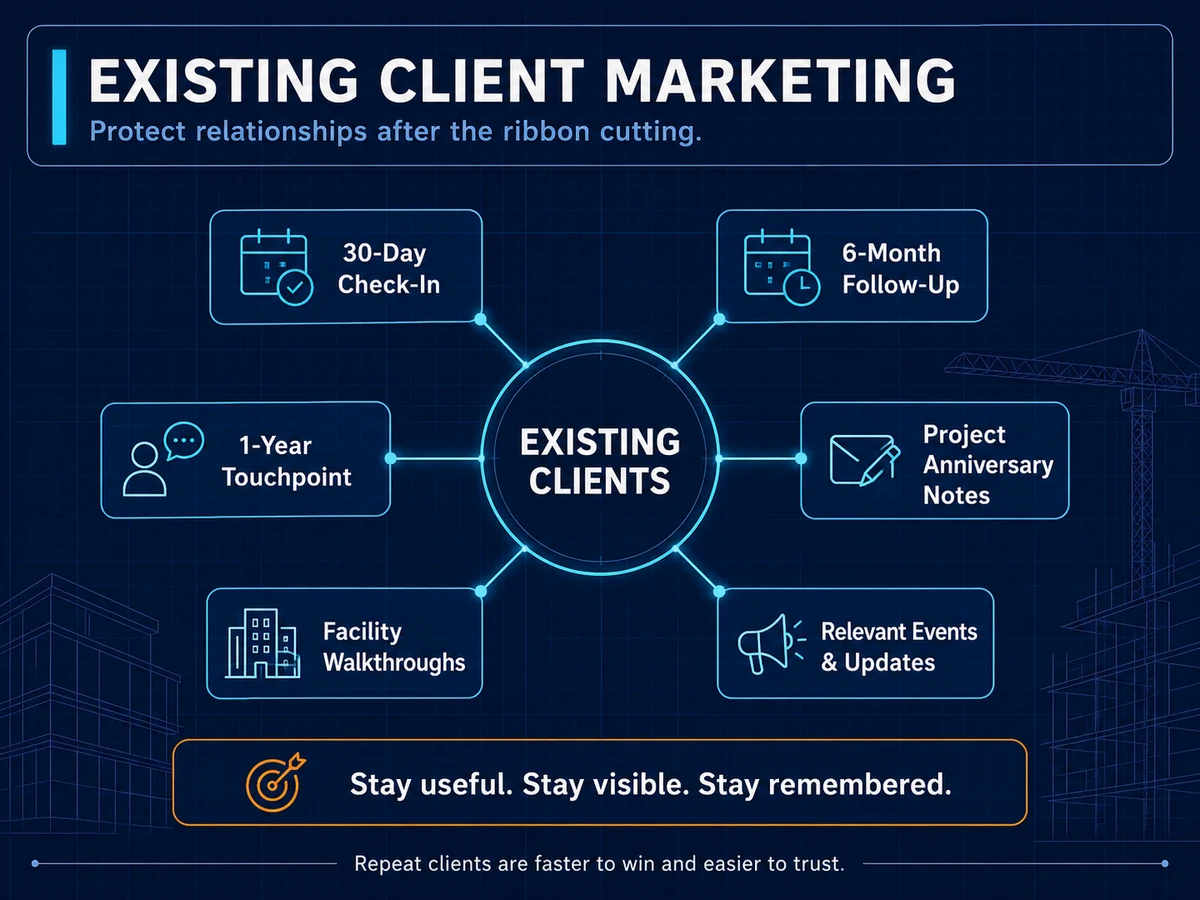
Existing client marketing is about protecting relationships after the ribbon cutting. Too many contractors finish a project, collect the final payment, and disappear until they hear about another RFP. The better approach is to keep the relationship warm with useful, low-pressure touchpoints that remind the client you are still available as a resource.
What this looks like in practice:
- Schedule post-project check-ins for 30 days, 6 months, and one year to ask what is working, what could have been better, and whether any new needs are coming up.
- Send project anniversary notes with a photo, milestone recap, or quick reminder of the value delivered.
- Offer facility walkthroughs to help identify maintenance needs, future renovations, phasing concerns, or budget planning items.
- Invite past clients to events, tours, panels, or lunch-and-learns that are genuinely relevant to their role.
- Create client-specific follow-up notes when you see news about their expansion, funding, leadership changes, campus plans, or real estate activity.
The goal is not to overwhelm clients with constant sales messages. The goal is to make sure they never feel forgotten. Repeat clients are often faster to win, less expensive to pursue, and more likely to trust your team during early budgeting or negotiated work.
One of the strongest questions a contractor can ask is: “Who have we already built for that we have not meaningfully followed up with in the last 90 days?”
3. Referral Networks
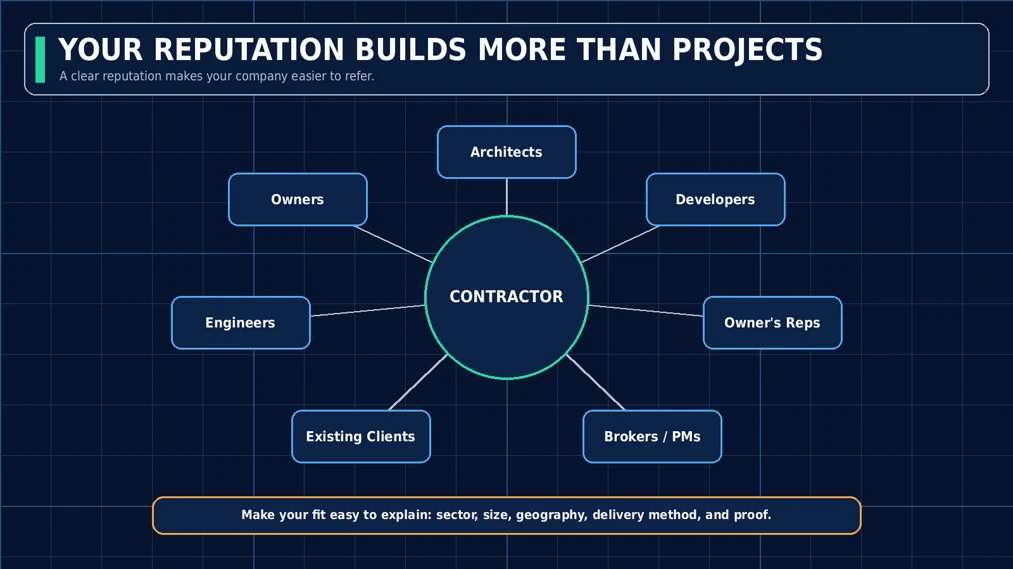
Referral networks are one of the most powerful marketing channels in commercial construction because of trust transfers. When an architect, engineer, developer, owner’s representative, or past client recommends your company, you enter the conversation with more credibility than a cold competitor.
Referrals rarely happen by accident. They usually come from people who understand what you do, where you are a good fit, and what kind of projects you want. If your referral partners cannot clearly describe your strengths, they are less likely to send the right opportunities your way.
What this looks like in practice:
- Build relationships with architects and engineers who serve the same markets you want to grow in.
- Stay connected with owner’s representatives, program managers, brokers, property managers, lenders, and developers who hear about projects early.
- Make it easy for referral partners to understand your ideal project type, project size, geography, and delivery methods.
- Send short project updates to referral partners so they have recent examples to mention when your name comes up.
- Thank referral sources quickly and personally, even when the opportunity does not turn into a contract.
The most common mistake is assuming that doing good work automatically creates referrals. Good work matters, but people are busy. They need reminders, proof points, and a clear reason to think of your company when the right conversation happens.
Contractors should track referral sources the same way they track leads. Over time, this shows which relationships are actually producing opportunities and which ones need more attention.
A referral network works best when every partner can clearly explain where your company is a strong fit.
4. Website and Content
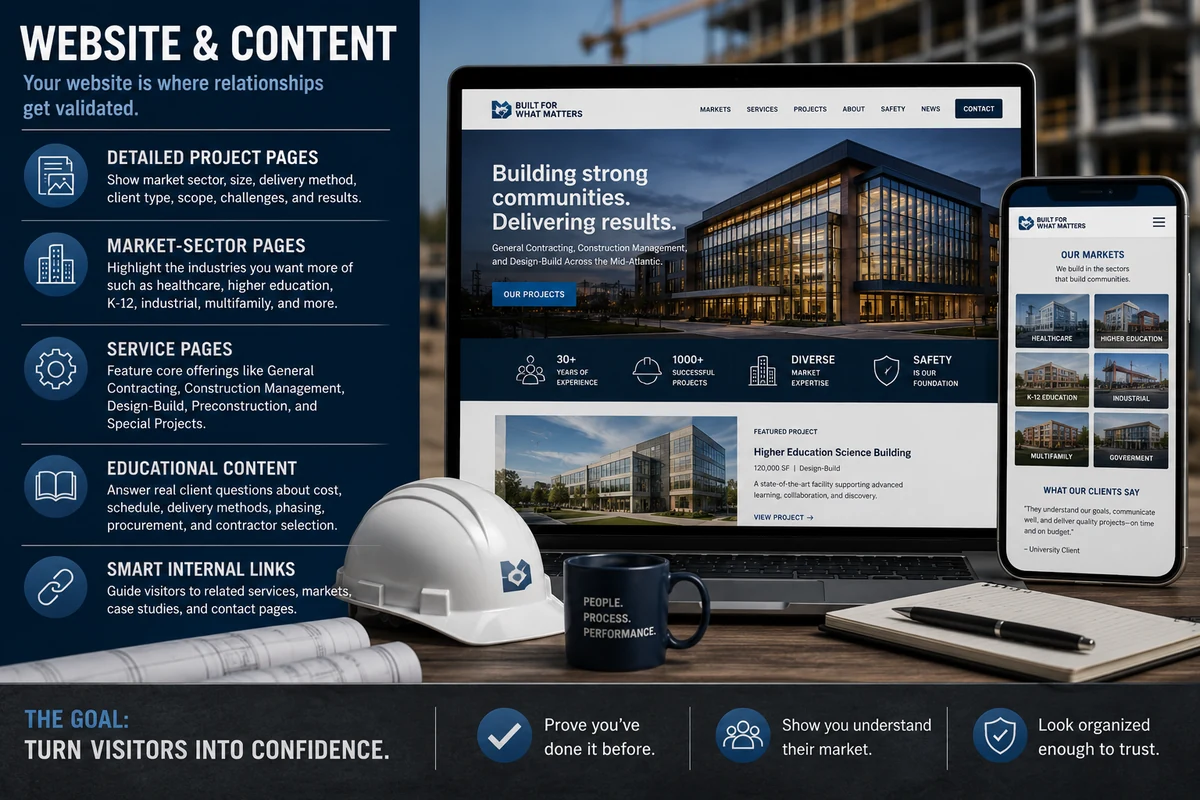
For most commercial contractors, the website is not where the relationship starts. It is where the relationship gets validated. A prospect hears your name from an architect, meets your team at an event, sees your project on LinkedIn, or receives a referral — then they look you up.
That moment matters. Your website should make it immediately clear what you build, where you work, who you serve, and why someone should trust you. If a qualified prospect has to dig to find relevant experience, project examples, delivery methods, leadership, safety information, or contact details, the website is creating friction instead of confidence.
What this looks like in practice:
- Create detailed project pages with market sector, size, delivery method, client type, scope, challenges, and results.
- Build market-sector pages for the industries you want more of, such as healthcare, higher education, K-12, industrial, multifamily, government, or hospitality.
- Create service pages for core offerings such as General Contracting, Construction Management, Design-Build, Preconstruction, and Special Projects.
- Publish educational content that answers real client questions, including cost, schedule, delivery methods, phasing, renovations, procurement, and contractor selection.
- Use internal links to guide visitors from educational content to related services, markets, case studies, and contact pages.
The mistake is treating the website like an online brochure. A strong construction website should function more like a credibility engine. It should help a prospect quickly say, “They have done this before,” “They understand my market,” and “They look organized enough to trust.”
5. LinkedIn
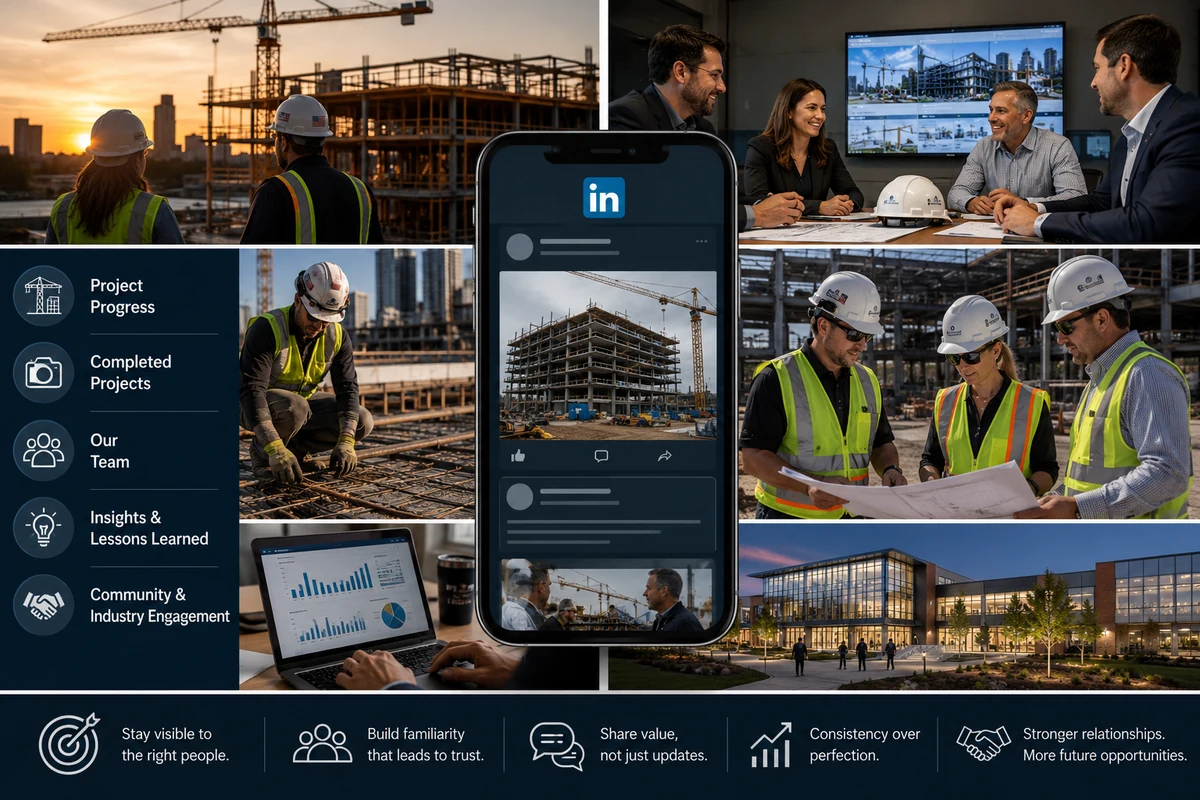
For most commercial contractors, LinkedIn is the most valuable social platform because it is where many owners, developers, architects, engineers, economic development leaders, and industry partners already spend time professionally. The goal is not to go viral. The goal is to stay visible to the right people between meetings.
LinkedIn works best when it reinforces credibility. A prospect may not call after one post, but after seeing consistent project progress, team expertise, client wins, community involvement, and useful insights, your company starts to feel familiar. Familiarity lowers the barrier to a conversation.
What this looks like in practice:
- Post project progress updates that explain what is happening on site and why it matters.
- Share completed project photography with a short story about the client’s need, scope, challenge, and outcome.
- Highlight team members, superintendents, project managers, safety leaders, estimators, and field crews to show the people behind the work.
- Share lessons learned, market observations, construction tips, safety reminders, and delivery method insights.
- Engage with posts from clients, architects, partners, municipalities, universities, and industry organizations instead of only posting from the company page.
The biggest mistake contractors make on LinkedIn is posting only award announcements, groundbreakings, and generic “progress is underway” captions. Those posts are fine, but the best content gives context. Explain what is being built, who it serves, what challenge the team solved, and what the update says about your company’s capabilities.
Consistency matters more than perfection. A realistic cadence, such as two to four strong posts per month, is usually better than posting every day for two weeks and then disappearing.
6. Thought Leadership
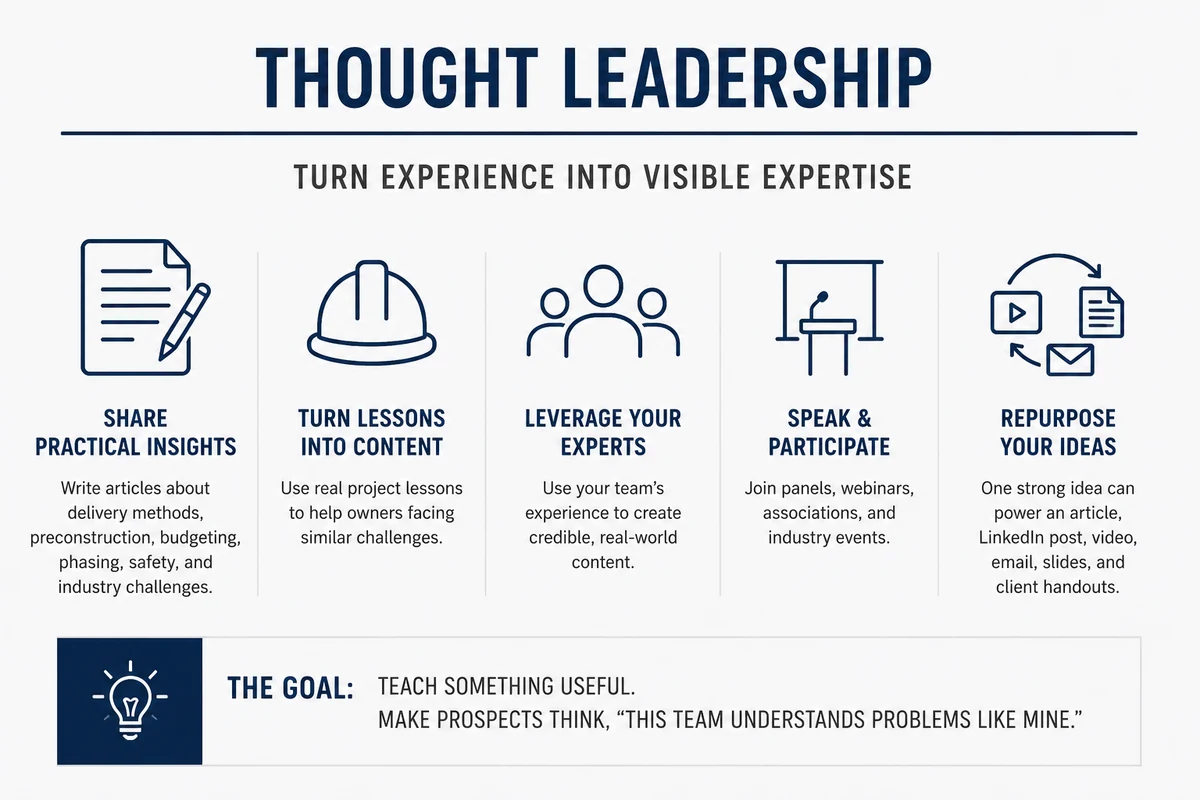
Thought leadership helps commercial contractors turn experience into visible expertise. Owners do not just want a company that can build. They want a team that can anticipate issues, guide decisions, protect budgets, manage risk, and communicate clearly.
This is especially important for negotiated work, Design-Build, CMAR, complex renovations, campus projects, healthcare environments, industrial work, and other projects where owners are selecting a partner, not just a price. Thought leadership gives prospects a preview of how your team thinks before they ever sit across the table from you.
What this looks like in practice:
- Write articles that explain delivery methods, preconstruction, budgeting, constructability, phasing, supply chain, safety, quality control, or market-specific challenges.
- Turn completed project lessons into practical content for similar owners.
- Use executives, project managers, superintendents, estimators, and subject matter experts as sources so the content feels grounded in real experience.
- Speak on panels, participate in webinars, contribute to association content, or present at industry events.
- Repurpose one strong idea into multiple formats: article, LinkedIn post, short video, email, presentation slide, and client handout.
The mistake is making thought leadership too generic. Articles like “Why Communication Matters” do not differentiate a contractor. Specific content performs better, such as “How Early Preconstruction Input Helps Higher Education Owners Protect Occupancy Dates” or “What Healthcare Owners Should Consider Before Renovating an Occupied Facility.”
Thought leadership should not sound like a sales pitch. It should teach something useful and make the reader think, “This team understands problems like mine.”
7. Industry Events and Face-to-Face Interaction
Construction is still a face-to-face business. Industry events create the kind of repeated exposure that is difficult to recreate through digital marketing alone. They give contractors a chance to strengthen existing relationships, meet new decision-makers, hear what is happening in the market, and stay visible within the communities they want to serve.
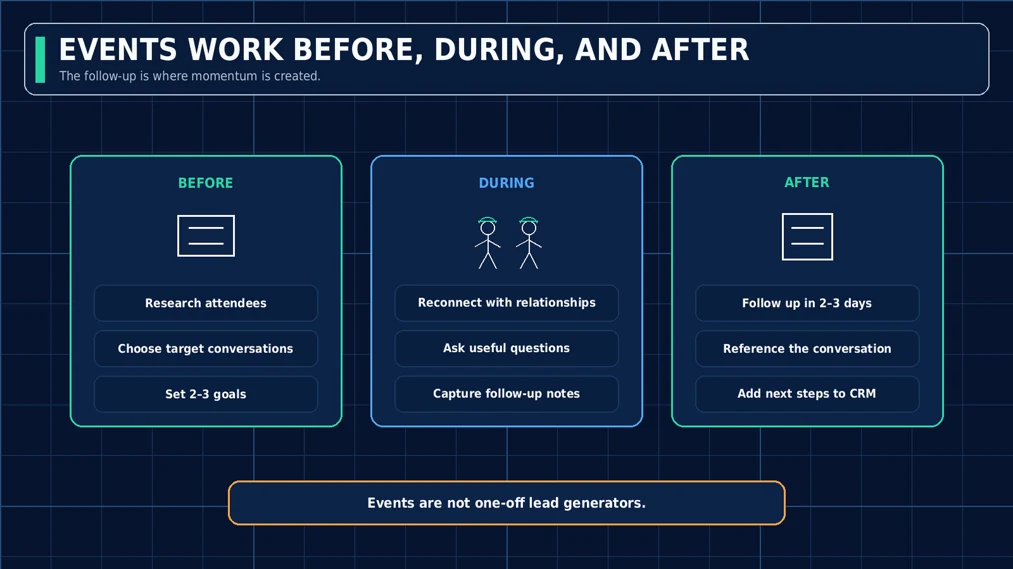
The value of events is rarely in the event itself. It is in preparation before the event and the follow-up afterward. Showing up without a plan often leads to a stack of business cards and no meaningful momentum. Showing up with a target list, conversation goals, and follow-up process can turn events into real pipeline activity.
What this looks like in practice:
- Identify which clients, architects, developers, and partners will be attending before the event.
- Set a goal for who your team needs to speak with and what you want to learn.
- Use events to reconnect with existing relationships, not just meet new people.
- Follow up within a few days with something specific from the conversation instead of a generic “nice to meet you” email.
- Sponsor selectively when the audience matches your target markets and the sponsorship includes meaningful visibility or relationship access.
The mistake is measuring events only by immediate leads. Many of the best event outcomes are softer but still valuable: learning about upcoming capital plans, getting introduced to a decision-maker, strengthening an architect relationship, or being remembered when a project starts forming months later.
Events work best when they are part of a broader relationship strategy, not a one-off activity.
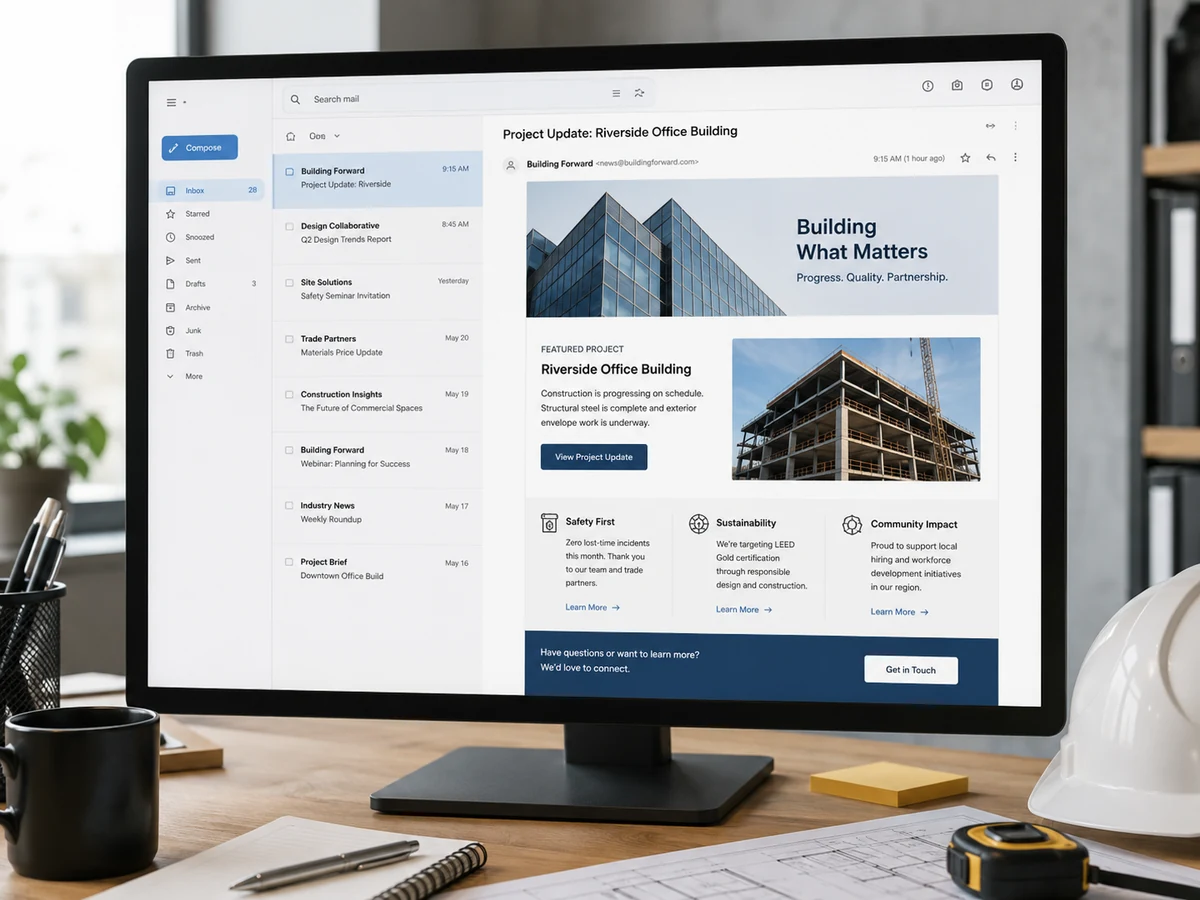
8. Email Marketing
Email marketing still works for commercial contractors when it is useful, relevant, and targeted. It is not about blasting a generic newsletter to everyone in the database. It is about staying in front of the right people with information that helps them understand your expertise and remember your company.
Email is especially valuable because it gives contractors a direct line to past clients, prospects, referral partners, and industry contacts. Unlike social media, you are not depending entirely on an algorithm. But that also means the content has to earn attention.
What this looks like in practice:
- Send market-specific updates, such as healthcare renovation insights, higher education project lessons, industrial construction trends, or local development activity.
- Share project milestones with context about the challenge, delivery method, schedule, or client outcome.
- Invite clients and partners to tours, events, lunch-and-learns, webinars, or community activities.
- Segment lists by audience so owners, architects, developers, and subcontractors are not all receiving the same message every time.
- Use short, practical emails that link to deeper resources instead of sending long, unfocused newsletters.
The most common mistake is sending company-centered updates that do not answer the reader’s question: “Why should I care?” A stronger email connects the company update to something useful for the audience, such as budget planning, risk reduction, project delivery, schedule certainty, or market knowledge.
A good email program is consistent enough to keep the company visible, but not so often that people tune it out.
9. Paid Advertising
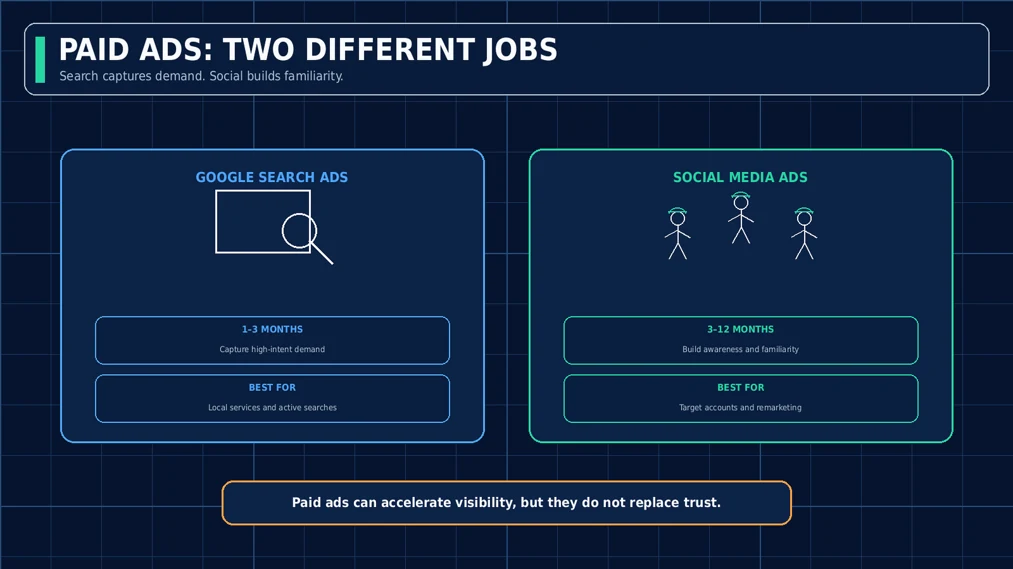
Paid advertising can support commercial construction marketing, but it rarely replaces relationships, referrals, or a strong reputation. Commercial construction advertising works best when the campaign has a specific job: capture active search demand, promote a focused service, distribute strong content, reach defined target accounts, or keep the company visible to people who already know the name.
Not all paid media should be judged on the same timeline. Google Search Ads can produce traffic, calls, and form submissions relatively quickly when people are already searching for the service. A focused campaign may show meaningful signals within one to three months, although qualified opportunities and closed work may take longer. Social media advertising is often a three- to twelve-month awareness and nurturing play because it reaches target accounts before they are actively shopping.
What this looks like in practice:
- Run Google Search Ads for high-intent local terms tied to a specific service, market, and geography.
- Use LinkedIn or other paid social campaigns selectively to reach defined companies, industries, job titles, or geographic markets.
- Promote useful content such as delivery-method guides, cost-planning resources, and relevant case studies instead of sending every click to the homepage.
- Create dedicated landing pages that match the ad message and include relevant experience, proof, and a clear next step.
- Retarget website visitors and known audiences with brand-awareness ads so the company remains familiar during a long buying cycle.
- Measure the campaign according to its purpose: high-intent leads for search, and reach, engagement, target-account traffic, and influenced pipeline for awareness campaigns.
The mistake is expecting paid advertising to create trust from nothing. Ads can create visibility, but the landing page, project experience, case studies, photography, testimonials, and follow-up process still have to do the heavier work.
Paid advertising should be viewed as an accelerator. It can put your company in front of more of the right people faster, but it cannot make an unclear message, weak website, irrelevant experience, or inconsistent follow-up perform. (For more on what works, see our guides to construction ads that work and running effective Facebook ads.)
10. SEO Content
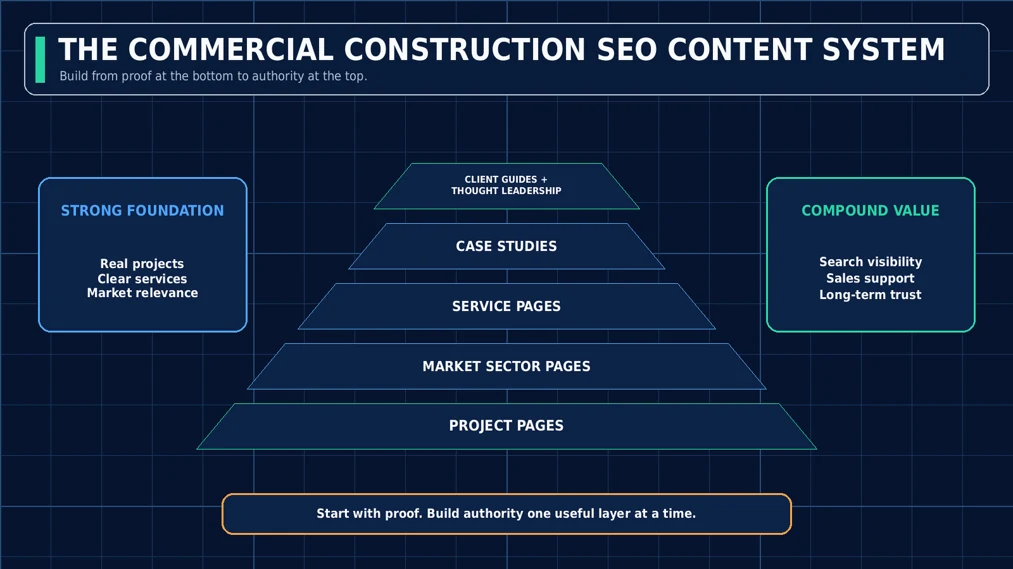
Many contractors hear they need SEO but have no idea what content they should actually be creating.
The good news is that commercial construction companies already possess most of the expertise required to create valuable content.
They simply need to package that expertise in a way prospective clients are searching for.
Project Pages
Detailed project pages remain one of the strongest assets on a contractor’s website.
Include:
- Professional photography
- Project size
- Client
- Market sector
- Delivery method
- Unique challenges
- Results achieved
Case Studies
Case studies explain not only what you built, but how you solved problems.
Owners want to understand how your team thinks.
Service Pages
Every core service should have its own dedicated page.
Examples include:
- General Contracting
- Construction Management
- Design-Build
- Preconstruction Services
Market Sector Pages
Dedicated market pages help both users and search engines understand your expertise.
Examples include:
- Healthcare Construction
- Higher Education Construction
- Industrial Construction
- Multifamily Construction
- Government Construction
Educational Content
Answer the questions owners are already asking.
Examples:
- What is CMAR?
- Design-Build vs Design-Bid-Build
- Commercial Construction Cost Per Square Foot
- How Long Does Commercial Construction Take?
- How to Select a General Contractor
The contractors that consistently publish helpful, experience-based content typically outperform those who don’t. SEO also pairs naturally with the rest of the funnel — educational content supports commercial construction lead generation long after it is published.
How Much Should Commercial Contractors Spend on Marketing?
There isn’t a one-size-fits-all answer.
A contractor generating most of its work from repeat clients will invest differently than a company entering a new market or aggressively pursuing growth.
As a general rule, many commercial contractors invest between 1% and 5% of annual revenue in marketing and business development activities.
That investment often includes:
- Business development personnel
- Proposal development
- Website development
- SEO and content marketing
- CRM systems
- Industry events
- Professional photography and videography
- Client relationship activities
The question isn’t simply:
“How much should we spend?”
It’s:
“Are we investing enough to create a predictable pipeline?”
Leveraging Technology Without Losing the Human Side
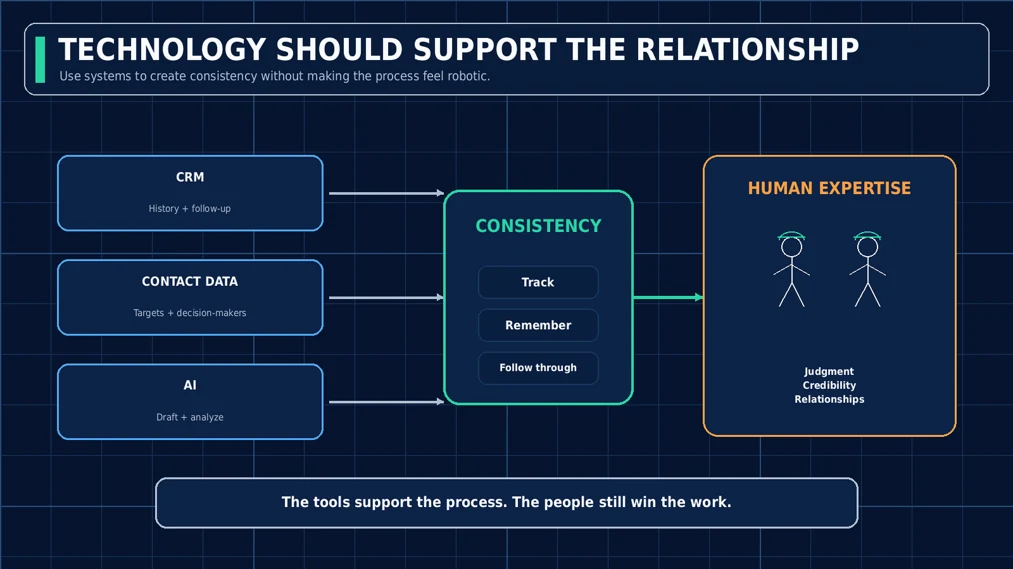
Technology should support relationships, not replace them.
CRM
A CRM is your institutional memory.
It should tell you:
- Who you’ve talked to
- What you discussed
- Upcoming opportunities
- Follow-up dates
- Relationship history
The strongest business development teams rarely rely on memory alone.
Contact Databases
Contact databases help identify:
- Active developers
- Decision-makers
- Market activity
- Target accounts
Used correctly, these tools create consistency.
AI
AI can help organize ideas, draft content, analyze data, and improve efficiency.
But it doesn’t replace expertise.
Your experience, projects, and perspective remain your biggest differentiator.
Common Commercial Construction Marketing Mistakes
Even contractors that understand all of this still make mistakes.
The most common include:
- Treating marketing like something you turn on and off.
- Quitting too early.
- Inconsistent follow-up.
- Trying to market to everyone.
- Ignoring existing clients.
- Trying to do everything at once.
Most contractors attempt every marketing idea at once and stay consistent with nothing.
The companies that grow pick a few strategies and execute them relentlessly.
Frequently Asked Questions About Commercial Construction Marketing
How do commercial contractors get new clients?
Most commercial contractors generate new work through existing client relationships, referrals, business development efforts, networking, and strategic marketing activities such as SEO and thought leadership.
What marketing works best for commercial construction companies?
The best-performing marketing for commercial contractors combines relationship-based business development, existing client marketing, referral networks, SEO, and LinkedIn. These typically provide the highest return on investment.
Is SEO worth it for commercial contractors?
Yes. SEO helps commercial contractors increase visibility, demonstrate expertise, and attract qualified inbound opportunities over time.
How long does construction marketing take to work?
Relationship-based marketing often takes six to eighteen months to produce significant results. SEO usually takes six to eighteen months to compound. Google Search Ads may produce early traffic or lead signals within one to three months when demand already exists, while paid social campaigns often require three to twelve months to build awareness and influence a longer buying cycle. The exact timeline depends on the campaign, business model, market demand, deal size, procurement process, and sales cycle.
Should commercial contractors use social media?
Yes, but strategically. For most commercial contractors, LinkedIn provides the greatest value because it helps companies stay visible to owners, developers, architects, and industry partners.
What Commercial Construction Marketing Really Comes Down To
Most contractors already know how to build. The challenge is turning a strong reputation and a collection of relationships into a consistent, predictable pipeline.
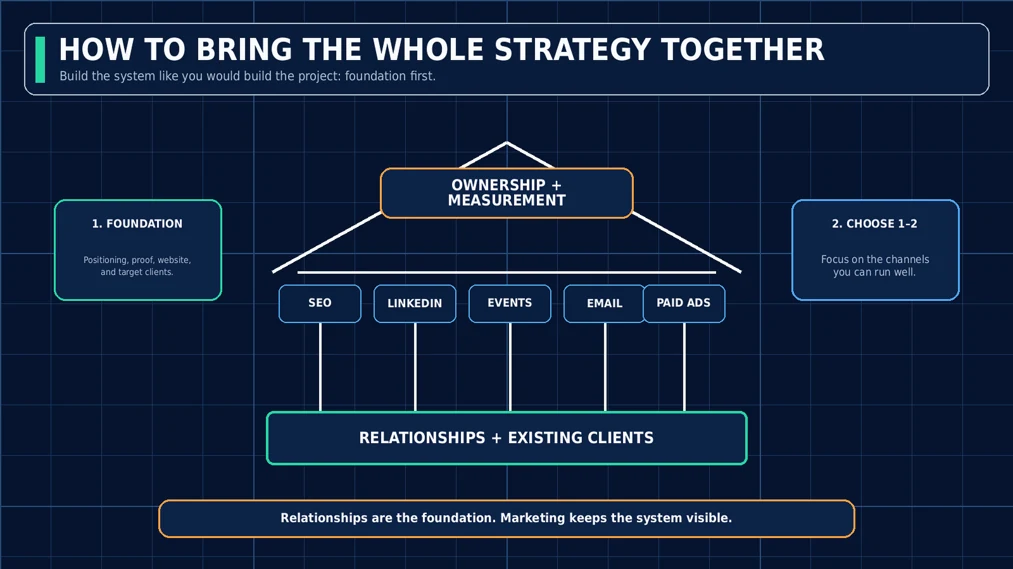
The strategy is not to do everything. Start with the fundamentals: know exactly who you want to work with, be clear about where your company is strongest, and make sure your website and marketing materials prove that experience quickly. Then make relationships the center of the system — existing clients, target accounts, architects, engineers, developers, owner’s representatives, and other referral partners.
From there, choose one or two additional channels you have real conviction in and execute them well. That might be SEO and thought leadership for a contractor with deep subject-matter expertise. It might be LinkedIn and industry events for a company that wins through local relationships. It might be Google Search Ads for a special-projects group serving urgent local demand. The right mix of marketing for commercial construction companies depends on the business, market, and sales cycle.
Give the strategy capable ownership. Good marketing does not happen because someone posts when they have time. It requires people who understand the business, can translate project experience into useful content, maintain consistent follow-up, track the pipeline, and connect marketing activity to real sales conversations.
Finally, stay with it long enough to work. Measure leading indicators — target-account meetings, referrals, qualified website traffic, engagement from the right people, follow-up activity, and opportunity intelligence — alongside proposals, win rate, backlog, and revenue. Then keep improving the system instead of turning it on only when work gets slow.
IdealRev helps commercial contractors bring these pieces together — from positioning and content to business development systems, follow-up, and sales strategy. If your company is ready to build a more predictable pipeline without losing the human side of the business, start a conversation with IdealRev.
Commercial construction is still a relationship business. Marketing simply helps the right people know you, trust you, and remember you when the opportunity is finally real.