
A practical playbook for contractors who want more of the right work
Most construction companies do not need 21 new marketing programs running at once. They need a few things done consistently: a website that makes it easy to call, proof that they can do the work, a reliable follow-up process, and a way to stay visible with the people who hire them.
That is what this guide covers. These are the construction marketing strategies we have used with contractors, adjusted after seeing what brought in conversations and what only looked good on paper. Some work better for residential contractors. Others make more sense for commercial GCs and subcontractors. Pick the ideas that fit the work you actually want, then keep doing them long enough to learn something.
But before you start marketing yourself, it’s important to set yourself up and get the right tools for success with these tips:
Set Yourself Up for Success
Laying a strong marketing foundation is crucial. Without it, it will be hard to build out your marketing strategies.
From defining your unique brand identity to understanding your target market, you will want to nail these before diving into your marketing.

Establishing Your Niche in the Construction Market
Carving out a niche in the construction industry can set your company apart and attract specific clientele. Identify what you do best: whether it’s painting & siding, luxury renovations, commercial renovations or budget-friendly residential projects.
Establishing your niche differentiates your services from competitors, and you can become known as the guy (or gal) for that. Potential clients will recognize and seek your unique skills and experience for their construction needs.
Here are a few ways to niche down your business:
- Industry (Multi-family, commercial, industrial, hospitality, etc.)
- Service (General contracting, builder, plumbing, etc.)
- Project Type / Size (New Construction, Renovation, $ amount, etc.)
- Geographic Location
Related IdealRev guide: See the most profitable construction niches and how to choose one.
Understanding Your Target Audience
Understanding your target audience allows you to spend time marketing to the people who most need your services.
For example, if you are a luxury builder, you are never going to make a sale marketing in a low-income area. You want to spend time marketing in higher-end neighborhoods.
Identify your ideal clients, whether they are homeowners, commercial developers, property investors, or managers. Consider their needs and preferences, are they looking for cost efficiency, quality craftsmanship, or speedy completion?
Tailor your marketing efforts to your customer’s preferences to make your communication more appealing.
Developing Your Construction Brand
Your brand should reflect your company’s values, quality of work, and unique selling points. Start by creating a memorable logo, a consistent color scheme, a pair of fonts, and a clear one-liner message that explains your value proposition.
To get started:
- Identify Your USP: Determine what sets your company apart from competitors. Is it your exceptional customer service, specialized expertise, faster project turnaround, or commitment to sustainability? Clearly define this USP and make it central to your branding.
- Define Your Brand Voice: Choose a tone and messaging style that represents your company, such as professional, approachable, innovative, or reliable, and align it with your USP.
- Create Brand Guidelines: Document your logo, color palette, fonts, USP, and messaging guidelines in a brand style guide. This ensures consistency across all marketing materials, from your website and social media to business cards and signage.
- Apply Consistently: Use your branding consistently across all platforms, including your website, social media, email signatures, job site signs, and company uniforms. Regularly audit materials to ensure they reflect your brand and USP accurately.
- Tell Your Story: Integrate your brand’s story and USP into your marketing. Highlight your company’s history, mission, and the values that set you apart in a way that resonates with your target audience.
- Engage Your Team: Share your brand values, USP, and visual identity with your team. Encourage them to embody these values and USP in their work, as their alignment with the brand can greatly enhance client perception and build a stronger internal culture.
A well-established brand not only builds trust and recognition among potential clients but also instills a sense of pride and belonging within your team.
By clearly defining and communicating your USP, you create a compelling reason for clients to choose your company over others.
Tools for Marketing Your Construction Company
Just as a craftsman needs the right tools for the job, a construction company requires the right marketing tools to effectively reach and engage its audience.
From developing a stand-out online presence to leveraging software to become a marketing expert.
Professional Website
A well-designed website can sell your services while you sleep. Your website works 24/7 to capture potential interest in your services and helps convert sales.
It should be visually appealing and easy to navigate, showcasing your portfolio, client testimonials, team, and detailed service information. It’s often the first impression potential clients will have of your business.
Your website is a perpetual open house that will continuously attract clients over the long run so it’s worth investing in.
Make sure your phone number is easy to find. Put it in the header, make it clickable on mobile, and repeat it near the main call to action. Do not make somebody scroll through the entire website or fill out a ten-question form just to talk to you.
The same goes for your service area and the type of work you want. A visitor should be able to tell within a few seconds what you build, where you work, and how to contact you. If they have to figure it out, the website is making the sale harder than it needs to be. For a practical review of what works, see our construction website design guide.
You can set one up yourself with do-it-yourself website builders like Wix or Squarespace or have a team that knows construction build it for you.
Developing Impactful Marketing Materials
Your materials should convey your work’s quality, expertise, and what sets you apart.
Showcasing testimonials and explanations of your experience and previous projects all work toward building trust.
This includes brochures, flyers, business cards, and digital content like email templates or a PDF slide deck you can share online. Ensure these materials are professionally designed, clearly branded, and contain all necessary contact information.
Make sure to put your best foot forward because they reflect your company’s professionalism and attention to detail.
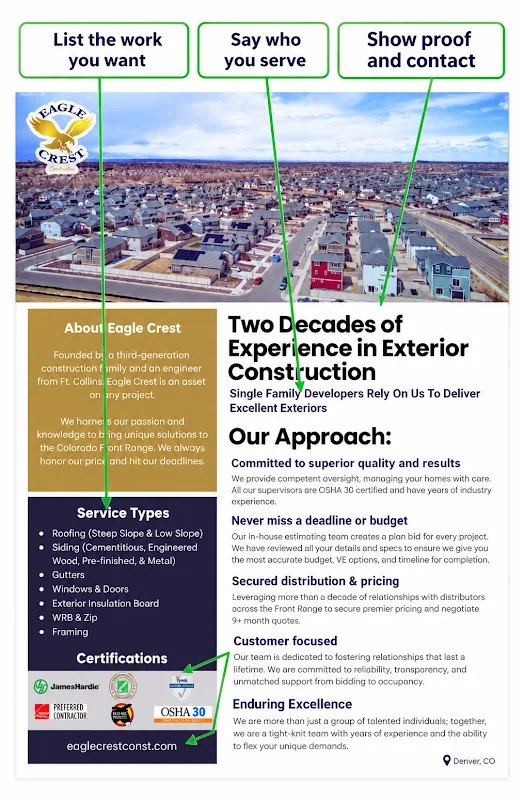
Here is an example of the first page of a capabilities statement:
Utilize a Customer Relationship Management System
A CRM, or Customer Relationship Management system, is like a digital toolbox that helps businesses manage and improve their interactions with clients and potential customers.
It keeps track of all your customer information, conversations, and history in one place. See everything about a customer, when you last talked to them, notes from meetings, logs of teammates’ conversations, what projects you’ve discussed, and any specific preferences or needs they might have.
The beauty of a CRM is that it helps you remember and personalize each interaction with your clients, making them feel valued. It can also remind you when to follow up with a potential client or alert you about opportunities to reconnect with previous ones.
General CRMs like HubSpot, Zoho, and Salesforce offer broad functionality but often require customization to meet the needs of construction companies. Construction-specific platforms may be easier to set up around bids, project stages, and owner or GC relationships.
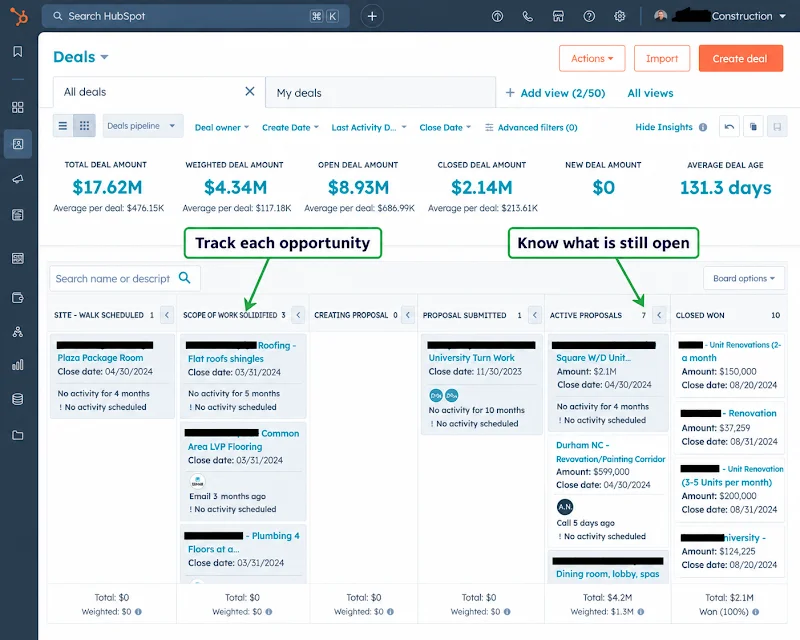
The software matters less than whether your team uses it. At a minimum, track the company, contact, opportunity, estimated value, current stage, last conversation, next action, and the person responsible for following up. We have seen pipelines go cold simply because everybody assumed somebody else made the call. For an example setup, read our HubSpot construction CRM review.
Construction-specific CRMs such as ProjectMark are designed around pipeline management, project tracking, and team collaboration. Whatever system you choose, keep the stages simple enough that the team will update them.
Related IdealRev guide: Learn how to set up a CRM for a construction company.
Here is an example of how we use a CRM to keep track of projects that we are bidding, what stage they are at, which ones we have won, how many projects we have bid versus won, etc:
Empower Your Team with Graphic Design Tools
Graphic design tools like Canva and Adobe Express can empower anybody on your team to create professional marketing materials in-house.
Design compelling visuals from logos to social media graphics to brochures to presentations.
Utilize customizable templates that align with your brand, ensuring consistency across all marketing efforts.
Empower your staff to produce designs quickly and cost-effectively so you can maintain a solid marketing presence without spending on a designer.
21 Construction Marketing Ideas to Get Your Company Out There
The construction business isn’t just about what you build but also about how you connect with your community, potential clients, current clients and teammates.
Learn how to increase your visibility, generate leads, and grow your network to drive business success.
Idea #1: Active Social Media Engagement
Social media platforms are excellent for showcasing your work and staying in touch with past and potential customers. Plus, it’s free!
Make sure to choose a platform that you (or someone on your team) enjoy using, are familiar with, and will be consistent with. The top three are Instagram, LinkedIn and Facebook.
Regularly update your followers with project progress, behind-the-scenes looks, and success stories. This builds your brand and keeps you at the forefront of potential clients’ minds.
Posting is only part of active social media engagement. Respond to comments. Answer messages. Congratulate customers and project partners. Comment on jobs, company announcements, and industry updates from the people you want to work with.
For a commercial contractor, that may mean spending 15 minutes a day engaging with target GCs, owners, developers, architects, and property managers on LinkedIn. For a residential contractor, it may mean staying involved with local Facebook groups, real estate agents, designers, neighborhood pages, and past customers. Our LinkedIn marketing for contractors service covers this type of commercial buyer outreach.
You never know who is watching or who might know somebody that needs a job done.
Start small, stay consistent, and make it easy by adding social media posts to your workflow, such as by taking before and afters of your projects.
Give one person responsibility for checking comments and messages. A question under a project photo can turn into a real estimate request, but not when it sits unanswered for four days.
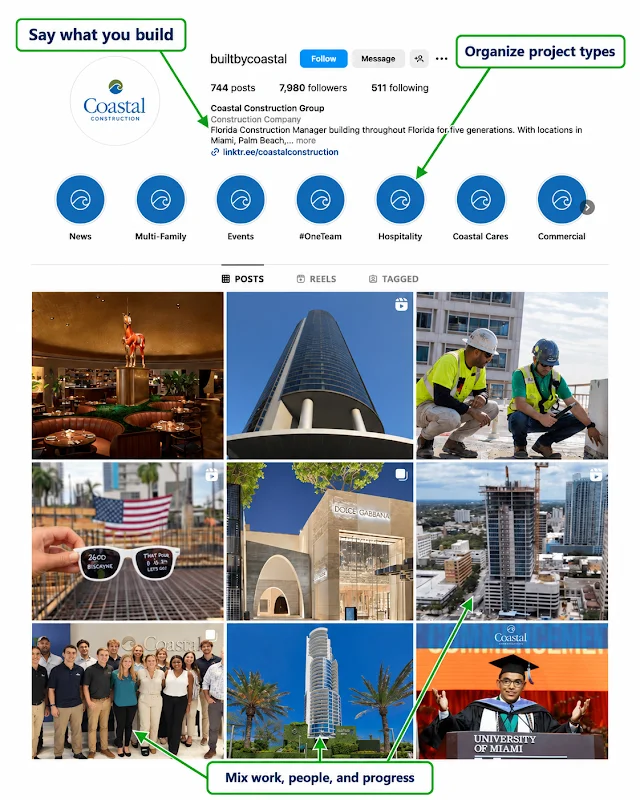
Here’s an example of a construction company who does a good job with their Instagram, Built By Coastal.
They have a good mix of content, from progress pictures, to team pictures and project photos.
Related IdealRev guide: Get more than 100 construction content ideas and a practical social-media plan.
Idea #2: Local SEO and Google Business Profile Optimization
Another free way to advertise your business. Create a Google Business page here. You can also create a free Yelp page here. This will help to optimize your online presence for local searches.
Get listed in as many local databases as possible and upload all of your info, including pictures of your team and projects.
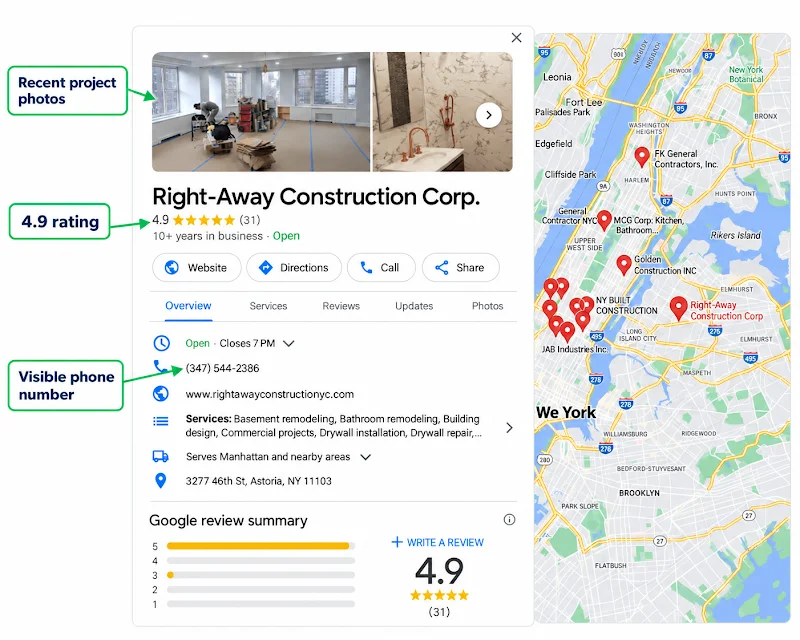
Keep the business name, phone number, website, hours, and service area accurate. Use the same information everywhere. If the phone number is wrong or missing, it does not matter how good the photos and reviews look because the customer still cannot reach you.
Treat the profile like a small version of your website. Choose the most accurate business category, list the services you want to sell, add the areas you actually serve, and upload current job photos every month. Ask customers to mention the type of project and location naturally in their review. That gives the next customer useful context and helps Google understand what you do.
A well-maintained Google Business Profile profile and Yelp page ensure your business appears when potential clients search for construction services in your area.
Mention your location and service areas throughout your website, like on meta descriptions, contact us, and home page so that Google knows where you are based.
Here is an example of a professional Google Business Profile with clear contact details, reviews, and project photos for Right-Away Construction:
Idea #3: Customer Reviews and Testimonials
Actively collect and showcase reviews and testimonials from satisfied clients. Create an incentive to do so if you have to and make it as easy as possible for your clients to do.
Positive feedback on your website, review sites, and social media platforms can significantly influence potential clients’ decision-making.
Do your best job to encourage positive, 5-star reviews, but if you do get any bad reviews, address them online in a respectable way.
Try to keep the overall rating above 4.5 stars. Customers look at the number, but they also look at how recent the reviews are, what people say about communication, and how the contractor responds when something goes wrong. A steady flow of detailed reviews is more convincing than a perfect rating built from five old comments.
You can do this by asking for a review at the right time, aka after you have done a good job for them or have done them a favor.
Make the request easy. Text or email the direct review link instead of telling the customer to search for your company. Ask shortly after a positive walkthrough, a successful turnover, or a compliment. Reply to good reviews like a person, and respond calmly to the bad ones. The goal is to keep the rating above 4.5 stars while continuing to earn recent reviews, not to chase a perfect score and stop asking.
Idea #4: Content Marketing & Blogging For SEO
Create a blog to share your expertise and insights about the construction industry.
Sharing content about your craft establishes yourself as an expert and builds trust.
Regularly posting high-quality, informative content can improve your SEO, establish your authority, and attract more visitors to your website.
Double down by creating content you can share on your social media channels.
Start with questions customers already ask during estimates and preconstruction meetings. Cost ranges, timelines, permits, material choices, common mistakes, and what to expect during the work all make useful articles. One detailed answer based on real experience is more valuable than ten generic posts that could have come from any contractor.
Show your work when you can. Add original project photos, explain the problem, describe what your team did, and link the article to the relevant service and location pages on your website. Update older posts when pricing, codes, or your process changes.
Related IdealRev guide: Read the complete construction SEO guide.
Idea #5: Cold Calling and Email Outreach
Reach out to potential clients or partners through targeted cold calls and emails, or hire a construction sales rep to do it for you.
Start by building a list of organizations you want to contact, finding the right contact, and organizing them in a spreadsheet or your CRM. You can use databases like Apollo.io or ZoomInfo to get this contact info.
Call and send personalized emails to introduce yourself and start a relationship with your target customers or partners.
In your sales outreach, make it less about making the sale and more about starting a relationship. You want to come across more like a person who understands their work than a salesperson reading a script.
Before you call, spend a few minutes looking at the company, the projects it works on, and the person you are trying to reach. Have one relevant reason for calling and one simple question. The goal of the first call is not to close a job. It is to learn something useful and earn the next conversation.
After the call, record what happened in the CRM, send anything you promised, and set the next follow-up date. Making a pile of calls without tracking the conversations is not a sales process.
Related IdealRev guide: Use our construction cold-calling scripts and no-BS guide to winning projects.
What has worked best for us is a short, specific opening. Say who you are, why that company made your list, and ask one question that is easy to answer. If you are calling a GC, ask how they add subcontractors to the bid list. If you are calling an owner or property manager, ask who handles the type of work you perform. Do not unload your entire company history before you know whether you have the right person.
Idea #6: Strategic Partnerships
Collaborate with local businesses, suppliers, architects, real estate agents, etc.
These partnerships can lead to referrals, joint marketing efforts, and increased visibility in your community.
Reach out to potential partners on social media, email, or give them a ring. Then work on building genuine relationships with them. Ask them to attend an event with you, host a coffee get together or grab dinner with a few folks in the industry.
Find win-win partnerships that benefit both parties. Sometimes partners are happy with just referring a trusted resource, while others might appreciate a referral bonus or sending them referrals in return.
Be specific about what a good referral looks like. “Send us anyone who needs construction” is too broad. A residential remodeler might ask designers and real estate agents for homeowners planning kitchens, additions, or pre-sale work. A commercial subcontractor might build relationships with GCs that regularly bid the right project size and market.
Idea #7: Customer Relationships and Networking
Construction is a relationship-based business. Building and maintaining strong customer relationships is key.
Attend industry events, participate in local business groups, and regularly communicate with past clients to build your network.
Take them out to dinner, ask them about their interests and hobbies, and really get to know them to build deeper relationships that go beyond business.
Make it easier to keep track of your clients and stay in touch using a CRM (mentioned above).
Put relationship time on the calendar. That may be two customer lunches a month, one industry event, or five personal follow-ups every Friday. Keep notes about what people are working on and what matters to them. The point is not to act like every conversation is a sales meeting. It is to stay close enough that you hear about the next project before the bid invitation goes everywhere. For a broader relationship-building framework, see our construction business development guide.
Idea #8: Foster Repeat Business Through Follow-Ups
Regular follow-up with past customers is critical for nurturing long-term relationships and encouraging repeat business in the construction industry.
Reach out periodically to check on the status of projects you’ve completed and inquire about any new needs they might have. A simple phone call, email or text can go a long way.
Give each follow-up a reason. Share a relevant project, ask about a date they mentioned, send an update that matters to their work, or check on a completed job. “Just checking in” becomes easy to ignore when that is the only thing you ever say.
This approach helps retain customers and increases the likelihood of referrals, as satisfied clients are more likely to recommend your services to others.
Use a simple schedule so follow-up does not depend on memory. Check in after turnover, again before the warranty period ends, and periodically after that based on the customer and type of work. Record the next step before closing the task. If there is no next date, the opportunity usually disappears. Our construction sales process guide lays out what to do before and after the bid.
Idea #9: Email Marketing
Keep in touch with your clients through regular email newsletters. This keeps your business top-of-mind and encourages repeat business.
The first step to email marketing campaigns is collecting emails and having people opt into your email marketing. Make sure to allow them the option to unsubscribe as well.
Share updates about new services, completed projects, relevant industry news, or helpful tips.
Put yourself in their shoes and provide them content that they would genuinely appreciate, find valuable or entertaining.
You do not have to send an email every week. A useful monthly or quarterly email is enough for many contractors. Keep it focused on one completed project, one helpful lesson, or one service the audience may need. Use a real sender name, keep the design simple, and make it easy for the reader to reply.
Related IdealRev guide: Read the full guide to email marketing for construction companies.
Idea #10: Paid Advertising Campaigns
Use paid ads like Google Ads or Facebook Ads to increase your online visibility quickly.
These targeted ads can direct potential clients to your website, providing immediate leads, so you will want a good website.
Google search ads targeted at searches for keywords related to your services can be a good foray into paid advertising as it’s a more straightforward and direct way to generate leads.
You can easily spend a lot of money on paid ads with little ROI if you don’t experiment with small amounts of spend first and do your research before making an investment. You will need to invest at least $1,500-$3,000/month.
Send each ad to a page that matches the search. Someone looking for a bathroom remodel should not land on a general homepage that also talks about roofing, concrete, and commercial construction. Track calls and form submissions, and ask every lead how they found you. Pause keywords that attract job seekers, DIY questions, or work outside your service area.
Related IdealRev guide: Read the complete guide to construction advertising.
Idea #11: Trade Shows and Expos
These events are a great place to display your past and current projects, engage directly with people in your industry, and make a lasting impression in person.
It can be a good way to meet potential customers, partners or suppliers
They are also opportunities for learning about the latest trends and technologies in the construction industry, which will keep your business ahead of the competition.
By setting up an engaging booth or just attending and networking, you can generate leads and establish connections that could lead to future projects.
Decide who you want to meet before you go. Review the exhibitor or attendee list, schedule a few conversations in advance, and have a simple way to capture notes. The follow-up after the show matters more than the stack of business cards you bring home.

Idea #12: Participate in Local Groups and Online Communities
Leverage local groups and online communities, like those on Facebook and LinkedIn, to find new project opportunities and showcase your expertise.
Active participation in these forums connects you with potential clients and establishes you as a knowledgeable and trusted resource in the construction industry.
You can also use sites like MeetUp or Eventbrite or the chamber of commerce to find local, in-person groups that you can go to network.
Relevant groups like real estate meetups are the best, but even less relevant ones can work toward building your network. Everyone is connected to a construction project somehow.
Do not enter a group and immediately post an advertisement. Answer questions, recommend good resources, and share useful local information. People pay attention to the contractor who helps without turning every comment into a pitch.
Idea #13: Marketing Material Drops
Marketing material drops are a low-cost yet effective way to increase local awareness of your construction company.
You place your brand directly in front of potential clients by leaving brochures, flyers, or business cards at local businesses, apartment complexes, and other strategic locations.
This approach works especially well in establishments frequented by your target audience, like home improvement stores or local real estate offices.
Always ask for permission first.
Use a trackable phone number, landing page, QR code, or offer so you know whether the drop produced anything. Keep the piece focused on one audience and one service. A flyer for apartment turnovers should look and read differently from a postcard for residential additions.
Idea #14: Showcase your Portfolio with High-Quality Imagery
Use professional photos in your marketing materials to visually communicate the quality of your work.
This helps potential clients envision what you can create for them and build trust that you can get the job done.
If you have an eye for good pictures, you can take pictures yourself on your phone, but it could be worth investing in professional photos, especially for the key photos on your website or marketing materials.
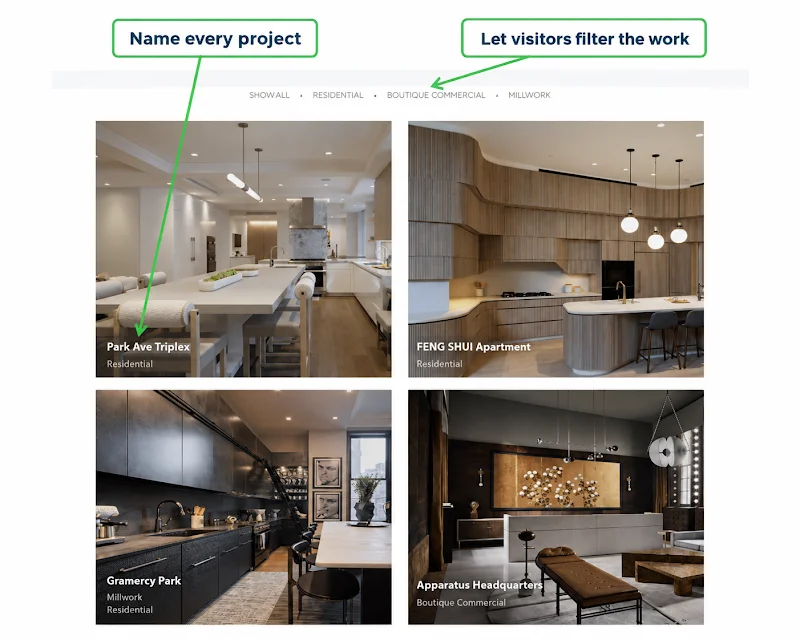
Do not post a gallery with no explanation. Name the project, identify the market and location when you have permission, and explain the scope. Add a few progress photos when they help people understand the difficulty of the work. A polished final photo proves the result. The short story beside it proves your team knew how to get there.
Here is an example of an epic portfolio by Structure Ventures.
Idea #15: Utilizing Direct Mail for Targeted Outreach
The key to succeeding at direct mail is to stand out from the pile of marketing mail that people get every week.
You can create a lasting impression by sending well-designed brochures, postcards, or flyers directly to homes or businesses in your targeted areas.
This approach is particularly effective in local markets, allowing you to showcase your services and past projects with high-quality images and compelling copy.
Include a clear call-to-action, such as an invitation to visit your website or free inspection, estimate or mock-up design.
Start with a small, well-chosen list. For residential work, that could be specific neighborhoods, home values, or property ages. For commercial work, it could be owners and property managers with the right building types. Send more than once, track calls or visits, and change the offer or list before assuming direct mail does not work.
Idea #16: Leveraging Personal & Professional Network
Leveraging your personal and professional networks can help you uncover new and consistent business opportunities.
People in your network are more likely to trust you and, will want to work with someone they know and can recommend to friends
Don’t hesitate to contact friends, family, and former colleagues, informing them about your business and asking for referrals. Encourage them to spread the word within their own networks.
A simple conversation or a shared post can often lead to valuable leads and project opportunities.
Give people language they can repeat. Tell them the exact work you want and where you do it. “We are looking for occupied commercial renovations between $250,000 and $2 million in Hampton Roads” is easier to remember than “We do all types of construction.”
Idea #17: Community Service and Sponsorship
Participating in community service projects and sponsoring local events boost your image as a community-focused business and increase your visibility among potential local clients.
You can sponsor local initiatives, such as neighborhood improvement projects, charity events, or local sports teams.
This kind of involvement can foster goodwill and trust, making people more likely to think of your company when they need construction services. It also provides excellent opportunities for networking and building relationships that could translate into business.
This can also help to build your SEO if you get mentioned in the news and get links back to your website.
Choose organizations your team actually cares about and can support consistently. Take real photos, tag the partner, and give the organization something useful to share. The community work should come first. The visibility follows when the involvement is genuine.
Idea #18: Guerrilla Marketing Tactics
This is your chance to get creative and think outside of the box. Guerrilla marketing tactics involve implementing innovative and unconventional marketing strategies to garner attention and interest in your community or in the areas where you are active.
Consider placing eye-catching signage at your construction sites or organizing local engagement events that resonate with your community, like construction-related contests, like a “best DIY project” competition, and offer prizes.
Such tactics not only increase your company’s visibility but also create a buzz, making your brand more memorable and generating PR.
Connect with the community in a way that highlights your company’s unique personality and services.
For most contractors, the best version is not a stunt. It is a clean jobsite, a good project sign, wrapped trucks, and neighbors who know who is doing the work. Make sure the phone number and website can be read quickly. Get permission before placing signs or using a customer’s project in a promotion.
Idea #19: Account-Based Marketing for B2B Clients
Account-based marketing is a focused approach in marketing where you target specific clients or companies that are a great fit for your services.
You take more personalized strategies that increase your chances of landing these high-value clients.
It typically involves taking multiple approaches to penetrate these accounts, such as a combination of direct mail, events, cold calling, emailing, and LinkedIn outreach to multiple people at the company.
It’s all about making each targeted client feel uniquely catered to, increasing the chances of securing their business.
Build a short list of accounts you would genuinely like to work with. Map the people involved in hiring, estimating, operations, and project delivery. Then coordinate the outreach so the same company sees you in several useful places without receiving the same copied message from three people on your team. If you need someone to run this outreach every week, see how IdealRev handles outsourced business development.
Idea #20: Video Marketing
Videos can vividly showcase your projects, the quality of your work, and your team.
Share time-lapse videos of construction progress, client testimonials, or virtual tours of completed projects on platforms like YouTube and your website.
Use these to show off your expertise and show you and your team are friendly and relatable. Video brings marketing to life.
Keep it simple. A superintendent explaining what is happening on site can be more believable than an overproduced company video. Film vertically for social media, use clear audio, and focus each video on one point. Show the condition, explain the decision, and show the result when the work is complete.
Idea #21: Free Resources or Educational Content
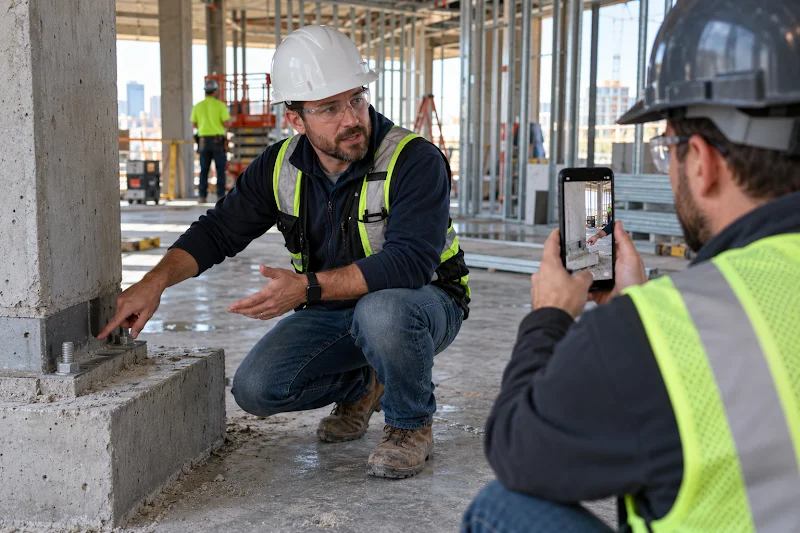
Offer free downloadable resources like free estimates, inspections, guides, or webinars related to construction and renovation. This helps lead generation and positions your company as a helpful resource.
You have to give to get. When you give away a free resource or help a potential client before asking for their project, they are much more likely to choose you.
Make the resource useful enough that someone would save it. A preconstruction checklist, renovation budget worksheet, bid-readiness guide, maintenance calendar, or list of questions to ask a contractor can all work. Ask only for the information you truly need, then follow up with something relevant to what they downloaded.
Where to Start
You do not need to start all 21 ideas next week. Fix the places where leads already fall through first. Make the phone number easy to find. Update the Google Business Profile. Ask for recent reviews. Follow up on every real opportunity. Then add the next strategy once the first one is working.
Want help choosing the right marketing channels for your commercial construction company? Book a growth strategy call. If the gap is consistent prospecting and follow-up, learn how our outsourced business development team works with contractors.
change image
change image/ example email- real estate agent, hey i know you work with a lot of home owners if youe ver need an opinion on cost I would love to help!