
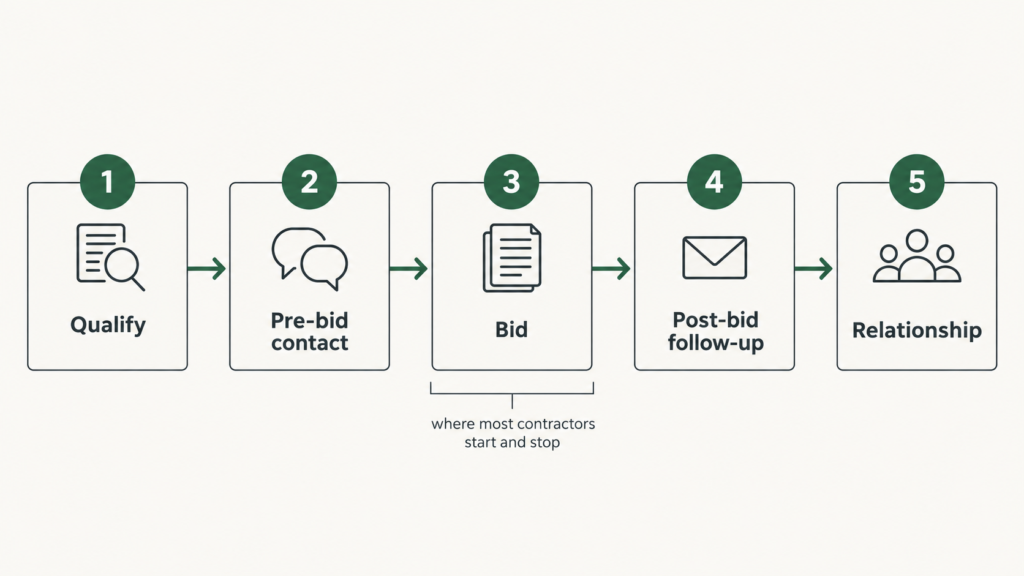
Most commercial contractors do not have a sales process. They have a bid process.
A lead shows up, from a platform, a GC invite, a referral, a cold call that finally landed. The estimator takes off the drawings, builds a number, sends it in before the deadline, and everyone waits. If the phone rings, great. If it does not, the lead goes in the “lost” column and nobody thinks about it again until the same GC sends the next invite.
That is not a sales process. That is a pricing service with a hopeful ending.
The contractors we work with who consistently win new work do something different. They treat the bid as one step in the middle of a longer sequence, with real work happening before the number goes in and real work happening after. That sequence is what this post lays out. It is the construction sales process we run for clients, stage by stage, with the questions to ask, the calls to make, and the follow-up that actually gets answered.
If you are looking for how to price a bid or what a bid package should contain, that lives in our guide to bidding and winning commercial construction jobs. This post is about everything around the number.
Why a bid process is not a sales process
Here is what a bid looks like from the other side of the table.
A GC’s preconstruction manager puts a job out to bid. For each trade, they invite three to six subs. One or two of those are firms they already trust and expect to use. The rest are there for coverage: to make sure the number they like is competitive, to satisfy an owner who wants to see multiple bids, or because the sub asked to be included and there was no reason to say no.
If you are one of the coverage bids, you can price the job perfectly and still lose. The GC was never going to award it to a firm they have not worked with unless the trusted sub fell through or came in badly out of line. Your number did its job. It was just not the job you thought.
That is why a bid-only process has such a low hit rate on new accounts. You are spending estimating hours on jobs where the decision was mostly made before the invite went out. The sales process exists to change that: to find out where you really stand before you spend the hours, to move from coverage bid to real contender, and to make sure that when you lose, you lose in a way that gets you a better seat next time.
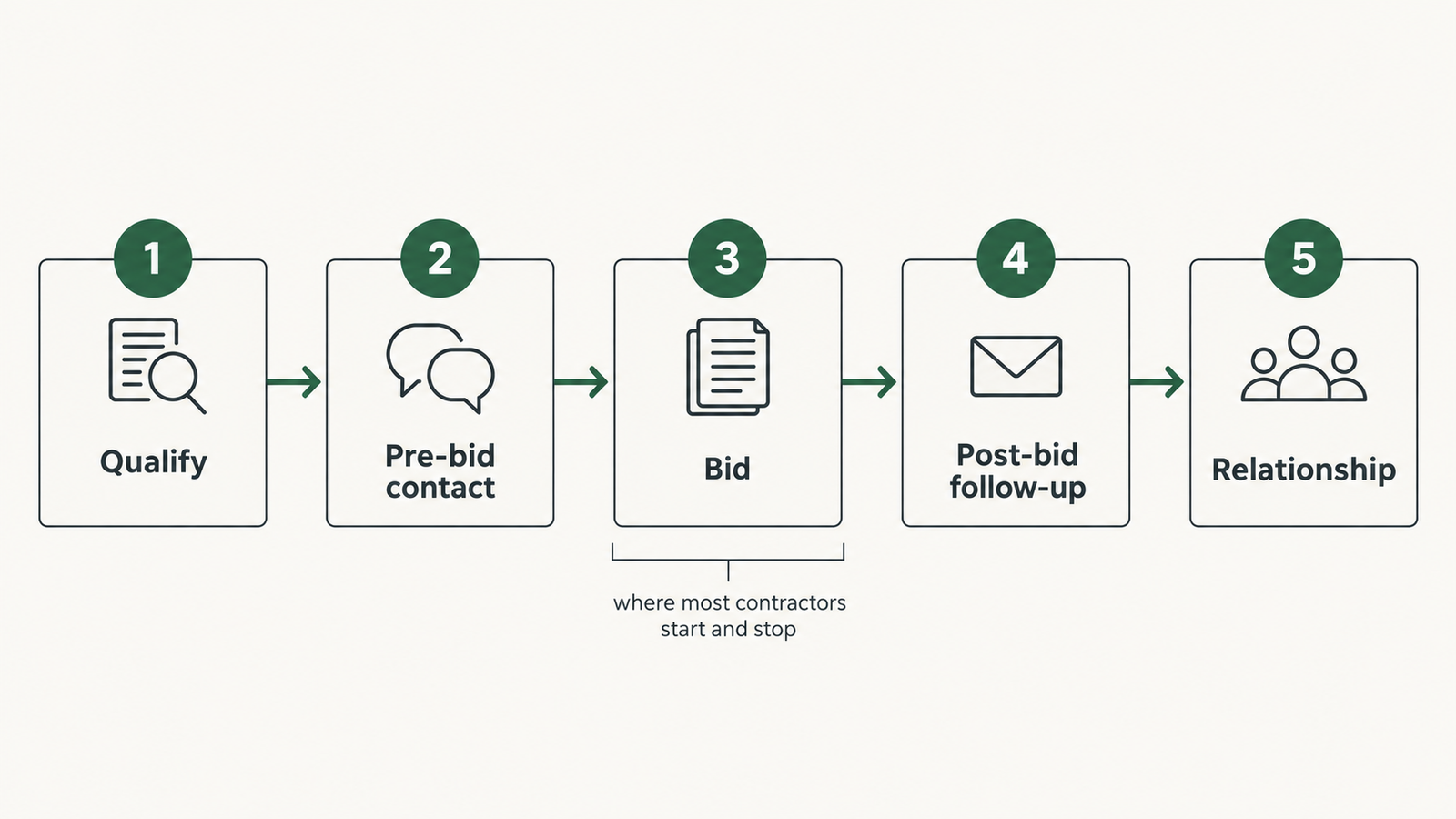
The five stages of the construction sales process
We break it into five stages. Each one has a job to do, a person to talk to, and a specific action. Skip a stage and the next one gets harder.
Stage 1: Qualify the lead before you touch the drawings
The most expensive mistake in construction sales is estimating a job you were never going to win. The fix is a qualification step that takes fifteen minutes and happens before anyone opens the plans.
The five questions. Answer these for every lead. If you cannot answer three of them, you do not have a lead yet, you have a listing.
- Who is the decision maker on the award, and have we ever spoken to them? Not the company. The person. If the answer is “nobody here has talked to anyone there,” you are a coverage bid until proven otherwise.
- Is the project real and funded? Owner-financed, lender-approved, or still a rendering on a broker’s website? Platforms surface a lot of projects at the planning stage that never break ground. Ask the GC where the job is in its life.
- Does the scope fit what we actually do well? Not what we could do. What we have done three times in the last two years in this building type and size.
- Can we staff it when it starts? A win you cannot man is a loss with extra steps.
- Why would they pick us over the incumbent? If the honest answer is “price,” decide now whether you are willing to buy the relationship with margin. Sometimes that is the right call for a first job with a GC you want. It should be a decision, not a surprise.
One thing most subs miss: the qualification call is itself a sales touch. Calling the precon manager to ask “where is this job at, and how many are you sending it to?” tells them you are the kind of sub who thinks before bidding. That is a small signal, but it is exactly the signal a GC uses to decide who moves from the coverage list to the short list.
Where the leads come from matters less than what you do with them. Platforms, bid boards, GC relationships, and outbound all feed this stage. We cover the sources in our post on generating commercial construction leads and compare the commercial construction bid sites worth paying for. For the bigger picture on building a pipeline that is not dependent on any one source, see our business development guide for construction companies.
Stage 2: Pre-bid contact, the stage almost nobody does
This is the stage that separates a sales process from a bid process, and it is the one most contractors skip entirely.
Between receiving the invite and submitting the number, make one call. Not to the estimating inbox. To a person.
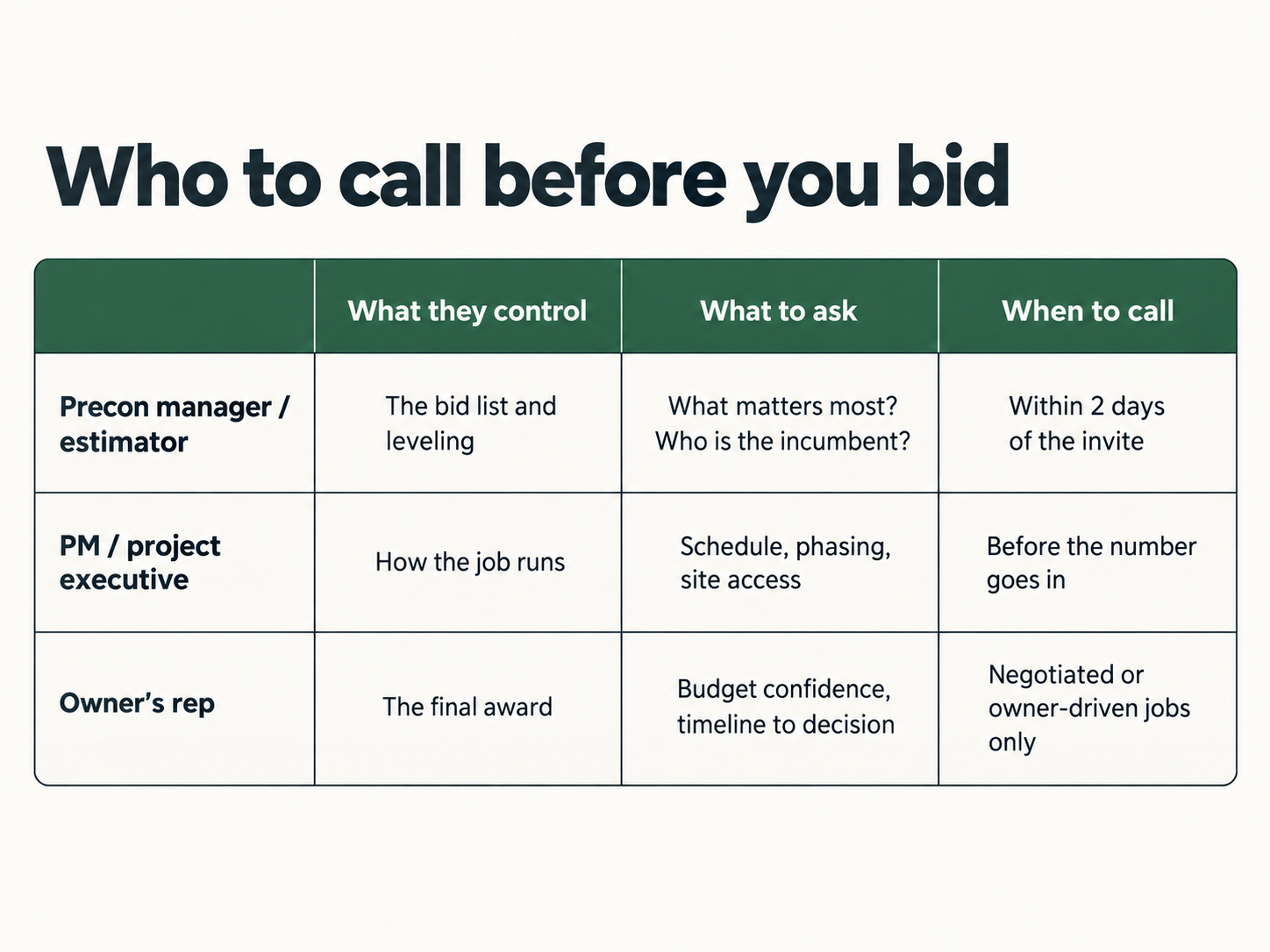
Who to call. On a GC-led job you usually have three options: the estimator or precon manager who sent the invite, the project executive or PM who will run the job, and, if it is a negotiated or owner-driven project, someone on the owner’s side. For a first job with a new GC, call the precon manager. They control the bid list, they know where the job stands, and they are the one who will remember you asked.
What to ask. Keep it under ten minutes. Three questions:
- “What matters most on this one? Schedule, self-perform, a specific building type, price?” You are finding out what the bid needs to lead with. The answer is rarely “lowest number.”
- “Is there a sub you have used on this scope before?” This tells you whether you are a contender or coverage. If there is an incumbent, ask what they would need to see to try someone else.
- “Who else is involved in the award, and what does the timeline look like after the bid date?” Now you know who to follow up with and when.
Here is what happens on that call more often than you would think. The precon manager tells you something that is not in the bid documents: a phasing constraint, an owner who is nervous about a particular material, a schedule the GC already knows is unrealistic. That detail goes into your bid as a clarification or an alternate, and your bid becomes the only one that shows you understood the job. That is worth more than a two percent price difference, every time.
If you cannot get the person on the phone, send one email with the three questions and move on. The point is not to force a conversation. The point is to be the sub who tried.
Stage 3: The bid as a sales document, not a price
The number matters. It is not the only thing the reviewer reads.
When a precon manager levels bids, they are looking for three things beyond price: does this sub understand the scope, are there holes that will become change orders, and will they be easy to work with. A bid that answers those questions in the first page gets read differently than one that is a lump sum and a signature.
Three things to add to every bid on a new account:
- A short scope letter. Half a page. What is included, what is excluded, what you assumed. Precon managers love this because it saves them a leveling call, and it makes your number comparable to the incumbent’s on the same basis.
- One or two clarifications that show you read the job. “Bid assumes phase two access from the north side per the pre-bid walk.” “Alternate provided for the spec’d material, which currently carries a 14-week lead time.” This is where the Stage 2 call pays off.
- A single paragraph on why you. Not a capabilities statement. One relevant project, one relevant number, one sentence about the team that would run it.
That is it. Do not bury the number under a brochure. A bid is not the place for your company history.
For pricing strategy, margin targets by project size, bid types, and a full bid structure template, use our guide to bidding on commercial construction jobs. This post picks up where that one leaves off.
Stage 4: Post-bid follow-up that gets answered
Most bid follow-up is one email that says “just checking if you received our bid.” That email gets ignored because it asks the reviewer to do work for you and gives them nothing.
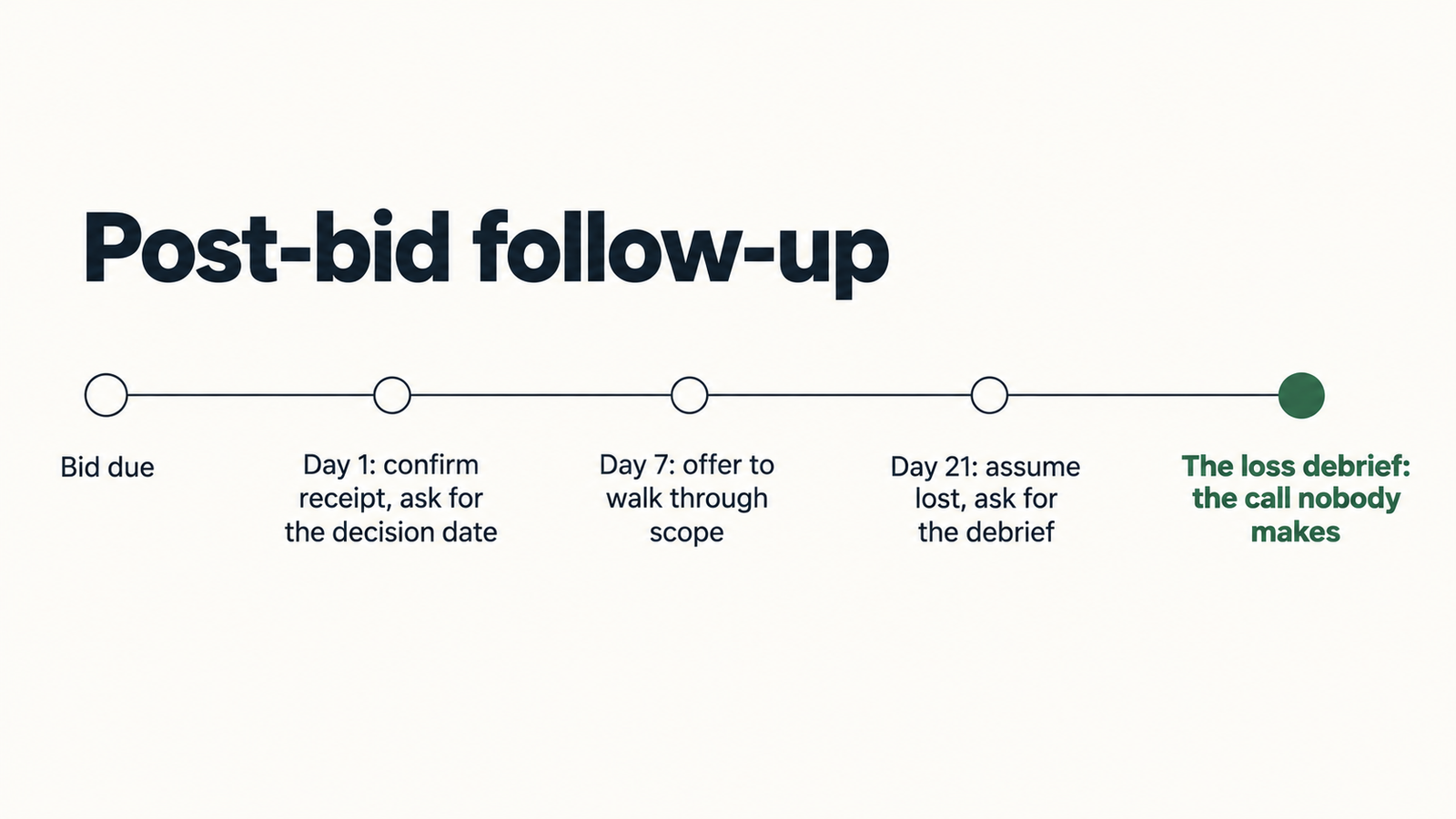
The follow-up cadence that works is three touches, each with a reason to exist.
The cadence:
- Day after the bid date. A short note to the person you spoke to in Stage 2. Confirm receipt, restate the one thing your bid does differently, and ask one question: “When do you expect to have a decision, and is there anything you need clarified on our end?” You are asking for a date, not a status.
- One week out, or the day after the decision date they gave you. “Any movement on the award? If you are leveling and our number needs adjusting on scope, happy to walk through it.” This is the touch that turns a coverage bid into a conversation, because you are offering to help them compare rather than asking them to pick you.
- Three weeks out, if silent. Assume you lost and ask for the debrief (below). Do not send a fourth “checking in.”
The loss debrief is the most valuable call in this entire process, and it is the one nobody makes. When you lose, call the precon manager and ask two questions:
- “Where did we land? Not the exact numbers, just were we close or were we out of the running?”
- “What would you need to see from us to use us on the next one?”
You will get an honest answer more than half the time, because you are not arguing, you are asking how to be useful. And the answer tells you exactly what to change. Sometimes it is price. More often it is “we did not know you did that scope” or “we had never worked with you and the owner wanted a known name.” Both of those are fixable before the next bid, and neither is fixable by estimating harder.
We have watched subs go from coverage bid to awarded on the third job with a GC entirely on the strength of two loss debriefs. The GC remembers the sub who asked how to get better.
For the mechanics of a follow-up sequence, email templates, and timing, our post on construction email marketing covers the writing side. If the follow-up is happening by phone, the construction cold calling guide has the scripts.
Stage 5: The relationship after the award (or the loss)
The award is not the end of the sales process. It is the beginning of the account.
If you won. The job itself is the sales process now. The PM who runs your first project with a GC is the person who decides whether you get invited on the next one, and they decide based on three things: did you hit your dates, did your paperwork show up on time, and did you make their life easier or harder. Every sub says they are easy to work with. The GC’s PM knows which ones actually are.
Two things to do in the first 30 days of a new account, before the job is even underway:
- Ask the PM or precon manager: “What else do you have coming in the next 90 days that fits our scope?” You are on the inside now. Use it while the win is fresh.
- Get a second contact at the GC. If your only relationship is with one estimator, you lose the account the day they leave. Precon manager plus PM plus a project executive is the goal.
If you lost. Stay on the bid list and stay in touch, but change what you are sending. A sub who lost and then sends a quarterly “here is what we are working on” note with one photo and one number is a sub who gets a real look on the next invite. A sub who goes silent until the next bid is a coverage bid forever.
The timing here is longer than most people expect. On new commercial accounts, the first real award often comes six to eighteen months after first contact, and the second job comes a lot faster than the first. We wrote about what a normal timeline looks like in how long it takes to close a commercial construction deal.
Who owns this in a small shop
The reason most contractors run a bid process instead of a sales process is not that they disagree with any of the above. It is that nobody owns Stages 2, 4, and 5. The estimator owns Stage 3. The owner owns the relationships they already have. The stages in between fall into a gap.
There are four ways to close that gap, and each one fits a different size of company.
The owner does it. Works under about $5M in revenue, when the owner is still close enough to every bid to make the calls. Stops working the moment the owner is running jobs and estimating at the same time, which is usually right around when it matters most.
The estimator does it. Some estimators are natural at the pre-bid call and the debrief. Most are not, and asking them to sell on top of a takeoff backlog produces neither good bids nor good follow-up. If you go this route, take estimating hours off their plate to make room, and pay for the sales part; our guide to construction sales commission structures covers how.
A dedicated BD person. Usually makes sense from about $10M up, or earlier if you are trying to break into a new market or building type. The role is Stages 1, 2, 4, and 5, full stop. If they are also estimating or running jobs, you have not hired a BD person, you have hired a second PM who occasionally makes calls. We have written a lot on this, starting with how to build a sales team in construction and sales skills for construction business owners.
An outsourced team. This is what we do at IdealRev, so take it with the obvious grain of salt. It fits contractors who know the stages above are the gap, do not have a $100K+ salary plus ramp time to spend finding out whether a BD hire works, and want the process running in weeks rather than quarters. Our outsourced sales for construction companies page explains how it works, and the commercial construction lead generation page covers the front end of the process on its own. For owners who want to run it themselves and just need the system, there is construction sales training.
Whichever route you pick, put the stages in a system. A spreadsheet is fine at first. A CRM is better once there are more than twenty open opportunities, and we covered what that looks like in CRM in the construction industry. What does not work is keeping it in the estimator’s head.
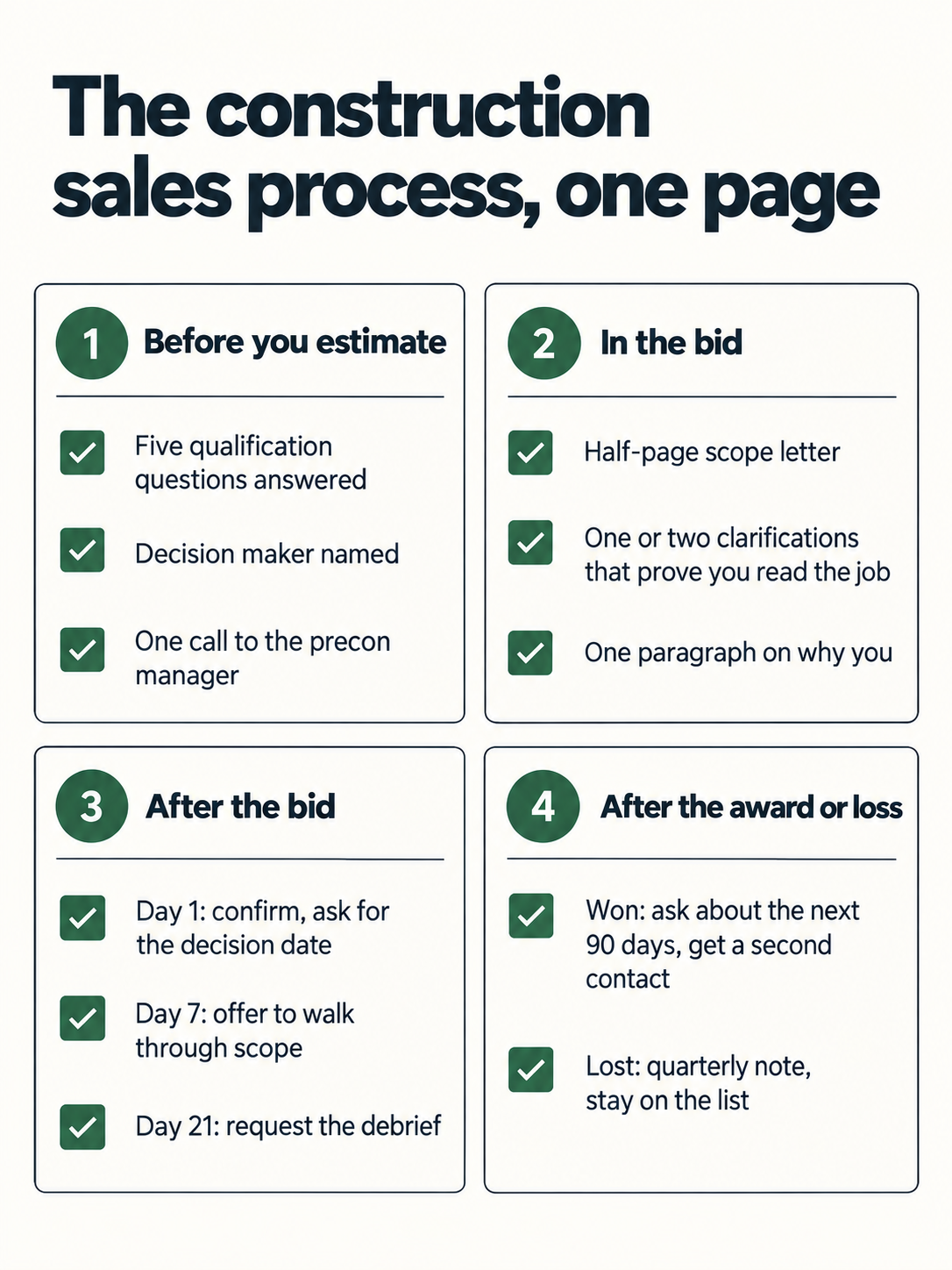
The one-page version
Print this and tape it next to the bid calendar.
Before you estimate
- Five qualification questions answered, decision maker named
- One call to the precon manager: what matters, who is the incumbent, who decides and when
In the bid
- Half-page scope letter
- One or two clarifications that prove you read the job
- One paragraph on why you, one relevant project
After the bid
- Day 1: confirm, restate your difference, ask for the decision date
- Day 7: offer to walk through scope on the leveling
- Day 21: assume lost, request the debrief
- Debrief questions: where did we land, what would you need to see next time
After the award or the loss
- Won: ask about the next 90 days, get a second contact at the GC
- Lost: quarterly note with one photo and one number, stay on the list
Frequently asked questions
How long does the construction bidding process take?
For the bid itself, from invite to submission, one to four weeks depending on scope and drawings. For the award decision, another two to eight weeks on private work and longer on public. For a new account, expect the first award to take six to eighteen months from first contact, because you are usually not a real contender on the first bid or two.
How many bids does it take to win one?
On existing relationships, a good sub wins one in three to one in four. On new accounts with no pre-bid contact, it is closer to one in ten or worse, because most of those are coverage bids. The pre-bid call and the loss debrief are what move a new account from the second number toward the first.
Should I follow up after submitting a bid?
Yes, three times, each with a reason: confirm and ask for the decision date, offer to walk through scope during leveling, and request a debrief if it goes quiet. Do not send “just checking in.” It asks the reviewer to do work for you and gives them nothing.
How do I get on a general contractor’s bid list?
Call the precon manager, not the general inbox. Tell them the scope, the building types you have done, and the size range you are good at. Ask what they have coming up. Then send a one-page capabilities sheet and follow up when a fitting job appears. Being on the list is easy. Moving from coverage to contender is the work described above.
Is a construction leads service worth it?
Yes, if you have a process to run the leads through. A platform solves the finding problem. It does not solve the qualification, pre-bid contact, or follow-up problems, and a contractor without those will spend money on leads and estimating hours on coverage bids. Buy the leads service and run the five stages. The combination is what works.
What is the difference between a construction sales process and a bidding process?
The bidding process is the sequence the owner or GC runs: solicitation, submission, leveling, award. The sales process is what the contractor does around it: qualifying before the bid, making contact before the number goes in, following up after, and building the account after the decision. Most contractors only run the middle part.
Want the five stages running on your pipeline without hiring for it?
We act as the sales team for commercial contractors: qualifying, pre-bid contact, follow-up, and the account work after the award. Book a strategy call and we will walk through where your current process is losing bids you should be winning.