
How to match private ITB networks, project intelligence, public procurement, and workflow tools to the work you want to win.
Want to win more commercial jobs?
Talk through your pipeline with Kyle for free. No pitch, just a working session on where your next projects should come from.
You already know the names. Search “best construction bidding websites” and the same platforms show up in a slightly different order every time, which does not help much when you are deciding where to spend money, estimator hours, and business development attention.
The questions you actually showed up with are more specific than “which platform has the most projects”:
- What kind of work do I want to win, and which tool is built for that?
- At what stage do I need to find it: planning, design, or active bid?
- Am I looking for private invitations, public solicitations, or projects that have not reached bid yet?
- Does my team have the time and process to act on what the platform surfaces?
- What would the platform need to produce to justify its cost?
This guide answers those first. It compares 16 platforms by the job each one is best at, explains where each is strongest, flags the limitations you should understand before signing anything, and gives you a practical way to test whether a platform is creating real pipeline or just more noise. For some readers the honest answer will be “stay on the free tiers and spend the money on relationships.” That is in here too.
One note before we start. I run sales for commercial GCs and subs in the $5M to $100M range. I sit on bid boards, I see what GCs do with these tools, and I see which subs win and which spend a year paying for a platform without closing a project. The pattern is consistent enough to write down, and it shapes the verdicts below.
A second note: the categories in this guide are not hard boundaries. Modern construction platforms overlap. A tool may manage private ITBs, surface new opportunities, provide company data, and connect into estimating or CRM workflow at the same time. The categories describe each platform’s primary center of gravity, not the only thing it can do. The platforms are numbered for reference, grouped by job, not ranked best to worst.
The Short Answer: Best Construction Bid Sites by Contractor Need
| Contractor need | Best starting point | Strong alternative | What to know |
|---|---|---|---|
| Receive private commercial ITBs from established GCs | BuildingConnected | Procore Construction Network | Strongest for private ITBs and bid workflow; BuildingConnected also includes discovery features. Value depends on which target GCs are active in your market. |
| Find open commercial projects and manage bids in one place | PlanHub | ConstructConnect | Check project density in your trades and territory before paying. |
| Send ITBs and build subcontractor coverage as a GC | BuildingConnected Pro | Procore Bid Management or Downtobid | Network quality and sub response matter more than directory size. |
| Post a job and collect sub bids for free as a smaller GC or remodeler | EZ Subcontractor | PlanHub | Free for GCs, cheap for subs, young network. Test one bid cycle before paying. |
| Find commercial projects in planning, design, and preconstruction | Dodge One | ConstructConnect | Best for teams with a defined business development process. |
| Detect early private development signals in supported markets | Mercator.ai | Construct-A-Lead or ConstructionWire | Coverage is not equally deep in every geography. Validate your exact market. |
Public, directory, and workflow needs
- Federal solicitations: Start with SAM.gov. Add GovWin IQ when you need pre-RFP intelligence; it is an intelligence layer, not a replacement for the official source.
- State and local opportunities: Start with BidNet Direct and supplement with Construction Bid Source. Always confirm the final solicitation and addenda on the issuing agency’s portal.
- Contractor visibility: Start with The Blue Book and the Procore Construction Network. A complete profile helps visibility, but a directory listing is not a sales strategy.
- Invitation organization: Consider Dodge Bid Board by Downtobid or BuildingConnected Bid Board Pro. These improve workflow; they do not necessarily create new project discovery.
There is no single best platform across all of these needs. A subcontractor receiving private ITBs, a GC hunting owner opportunities, and a federal contractor monitoring agency procurement are solving three different problems.

First, Understand the Five Jobs Construction Bid Sites Perform
Use the categories as a map of primary use, not hard product boundaries.
Most comparison articles get confusing because they force overlapping products into rigid categories. A better way to compare them is by the primary job you need the software to do.
Think of the five groups below as use cases. BuildingConnected is best known for private bid management, but Autodesk also offers an online Plan Room in Bid Board Pro for discovering new job opportunities. ConstructConnect combines project intelligence with bid and estimating workflow. Dodge spans project intelligence, contractor data, directories, and bid network tools. The question is not “which box does this platform belong in?” It is “which part of our pursuit process does this platform improve the most?”
1. Private invitation, bid management, and marketplace networks
Platforms such as BuildingConnected, PlanHub, Procore, Downtobid, and EZ Subcontractor are used to distribute, receive, organize, and respond to private invitations to bid, or to post work and collect bids directly. Several include project discovery features, plan rooms, or contractor networks, so this group should be understood as “bid management first,” not “bid management only.” They are most useful once a project is moving into active preconstruction or bidding.
Best for: GCs seeking trade coverage and subcontractors bidding private commercial work.
Do not assume they provide the same depth of planning-stage owner and developer intelligence, or comprehensive public procurement coverage, as tools built specifically for those jobs. Compare the timing and depth of the data, not just whether a platform technically offers “project discovery.”
2. Project intelligence databases
Dodge, ConstructConnect, Mercator.ai, Building Radar, ConstructionWire, and Construct-A-Lead are oriented toward finding projects during planning, design, permitting, or preconstruction. The defining question is whether the tool can help you see and understand a project early enough to change your position before the bidder list is set.
Best for: GCs, larger specialty contractors, manufacturers, and business development teams pursuing commercial opportunities before bid day.
They require: consistent qualification, outreach, and CRM follow-up. Early information has little value if nobody owns the next action.
3. Official government procurement portals
SAM.gov and individual state, local, school, university, authority, and agency portals publish the actual solicitation documents and addenda that govern public procurements.
Best for: contractors pursuing federal, state, municipal, education, utility, transportation, and other public work.
They require: careful compliance. On a sealed low-bid procurement, responsiveness, responsibility, price, bonding, licensing, forms, and deadlines can matter more than relationship strength.
4. Government bid aggregators and intelligence services
BidNet Direct, GovWin IQ, and Construction Bid Source consolidate opportunities from multiple public sources or provide information before an RFP is released.
Best for: contractors that do not want to monitor dozens of agency portals manually.
Important limitation: an aggregator should help you discover the opportunity. The issuing agency’s solicitation, addenda, and submission portal remain the controlling source.
5. Contractor directories and discovery networks
The Blue Book and public contractor networks help GCs find subcontractors and help trade contractors become more visible in target markets.
Best for: market visibility and subcontractor sourcing.
They do not replace: prequalification, direct outreach, performance history, or a focused target account strategy.
How We Evaluated the Platforms
The recommendations below are not based on review stars alone. A free subcontractor evaluates a platform very differently from a GC purchasing enterprise access, and a national database can look impressive while offering weak coverage in one local market. We also account for product overlap: platforms are evaluated by the specific job a contractor needs them to do, rather than being penalized or rewarded for spanning multiple categories.
Each platform is evaluated on:
- fit for the intended contractor and project type;
- quality and timing of available opportunities;
- geographic and trade coverage;
- ability to identify or reach the right decision makers;
- bid board, document, filtering, and collaboration workflow;
- pricing transparency and commitment required;
- ease of testing before a longer commitment; and
- whether the information can be converted into measurable actions and pursuits.
Where we know real pricing, we include it. Where it is quote-based, we say so and give you the range we see in the market.
Best Platforms for Private Commercial ITBs, Bid Management, and Marketplaces
1. BuildingConnected (Autodesk): Best Overall for Established Private GC Networks
BuildingConnected is the most established private commercial bidding and subcontractor network platform. Its primary strength is still the private ITB workflow: GCs find and invite subcontractors, manage bid packages, compare responses, and centralize communication. But it should not be described as invitation-only. Autodesk also markets Bid Board Pro with an online Plan Room that lets subcontractors discover new job opportunities and add them to their bid board. That gives BuildingConnected a real discovery component, just at a different depth and stage than planning-stage intelligence databases.
Best for: commercial GCs with recurring bid volume, and subcontractors that want access to invitations from established regional and national builders.
What it does well:
- the broadest commercial subcontractor network, and free for subs;
- familiar workflow for many mid-sized and large GCs;
- centralized ITBs, bid packages, bidder communication, and bid comparison;
- Autodesk ecosystem connections; and
- a low-friction way for subcontractors to maintain a company profile and receive invitations.
Where it falls short:
- its discovery features are useful, but they are not a broad planning-stage owner and developer intelligence database; contractors looking months or years ahead should compare depth and timing against Dodge, ConstructConnect, or Mercator.ai;
- broad invitation lists create low-fit volume for subcontractors, and a company can receive many invitations without being positioned to win any of them;
- email deliverability is a real problem. BuildingConnected invitations land in spam and promotions tabs constantly (more on that below); and
- GC-side pricing is quote-based. Expect $10K or more per year for a small team’s bid management seats, and confirm users, modules, implementation, renewal terms, and integrations in writing.
Contractor verdict: Mandatory for subs. It is free, and if the private commercial GCs you want to work with use it, your profile should be complete and current. For GCs running real bid coverage, it is the default. The platform is strongest when the subcontractor database is actively maintained and invitation lists are curated by project, geography, trade, and capacity. For subcontractors, judge it on both invitation quality and whether its Plan Room surfaces net-new opportunities you would not have found otherwise.
2. PlanHub: Best Accessible Starting Point for Open Commercial Opportunities
PlanHub is a good example of why hard platform categories can be misleading. It combines a project plan room, contractor network, bid management tools, takeoff and estimating options, and project discovery. It sits between open-project discovery and bid workflow rather than fitting neatly into one bucket.
Best for: small and mid-sized subcontractors that want searchable commercial opportunities in addition to direct invitations, especially those competing for work below $5M, and GCs that want another channel for bid coverage.
What it does well:
- easier entry point than many enterprise intelligence products;
- a free tier that is useful on its own: searchable projects, filters, document downloads, and bid submission;
- both public and private projects in some markets;
- tools that extend into takeoff, estimating, and contact management; and
- a practical way to test local opportunity volume before expanding access.
Where it falls short:
- GC adoption is uneven. Some markets are well served, others are thin;
- an attractive national project count does not guarantee useful local density;
- free and paid capabilities differ, so confirm exactly what geography, contacts, documents, and exports are included; and
- some projects will also appear through other networks or public portals.
Contractor verdict: A free profile for subs is a no-brainer. Judge the platform using your actual filters. A paid plan is defensible only if PlanHub consistently surfaces qualified opportunities or GC relationships that your current sources miss.
3. Procore Construction Network and Bid Management: Best for Contractors Already Working in Procore
The Procore Construction Network is a free public network where contractors publish company pages and connect. Procore users can invite companies to bid, and invited subcontractors use Bid Board or Planroom tools to view documents and respond. On the GC side, Procore Bid Management supports ITBs, bid forms, bid leveling, and conversion into downstream project workflows.
Best for: contractors already operating inside Procore, and subcontractors whose target GCs use Procore bidding tools.
What it does well:
- connects bidding with the broader Procore project environment;
- reduces duplicate setup for companies already using Procore;
- provides a public company discovery network; and
- supports centralized bid review and comparison.
Where it falls short:
- invitation volume depends on whether target GCs actually use Procore for bidding, not simply whether they use Procore somewhere in operations;
- it is not a comprehensive early-stage project intelligence database; and
- value is limited for subcontractors whose customer base standardizes on other tools.
Contractor verdict: Claim and complete the free company profile. If any of your top ten GCs run on Procore, the setup is worth it. Before investing in additional workflow, ask your top target GCs which platform their estimating teams use to issue ITBs.
4. Downtobid: Best Emerging Option for AI-Assisted ITB Creation and Bid Organization
Downtobid uses AI to read project information, organize bid packages, match subcontractors, generate invitation lists, and consolidate bid activity. Dodge also offers a Bid Board powered by Downtobid that organizes invitations arriving from multiple sources.
Best for: GCs that want to reduce manual ITB setup, and subcontractors that need one dashboard for invitations scattered across email and different platforms.
What it does well:
- addresses the practical problem of fragmented bid invitations;
- can reduce manual plan review and invitation list setup;
- offers workflow automation that older networks do not emphasize; and
- supports both GC and subcontractor use cases.
Where it falls short:
- it is newer than the largest established networks;
- AI-generated scopes and trade matches still require estimator review;
- consolidating existing invitations is different from generating net-new opportunities; and
- teams should clarify whether they are buying Downtobid directly, Dodge’s powered experience, or another overlapping product.
Contractor verdict: Worth piloting if bid administration is consuming estimator time. Measure hours saved, missed addenda avoided, and qualified bidder response, not simply how many invitations enter the system.
5. EZ Subcontractor: Best Free Option for Smaller GCs Who Want to Post a Job and Collect Bids
EZ Subcontractor is a construction marketplace where GCs post jobs for free and receive bids from vetted subcontractors in their area. For subcontractors, pricing starts at $400 per year or $50 per month, which is cheap compared to the aggregators later in this list. It is the youngest platform here, with a little over 100 active projects at the time of writing and coverage nationwide.
Best for: smaller GCs and remodelers who want free bid coverage without setting up a full bid management platform, and subs willing to test a young network in their market. Its emphasis skews residential and light commercial, which is a segment the larger platforms mostly ignore.
What it does well:
- free for GCs, so there is no downside to posting a job;
- sub pricing is low enough to try without a budget conversation;
- fills a real gap for residential GCs and remodelers who need reliable sub crews; and
- a simple post-and-bid model with less setup than the enterprise networks.
Where it falls short:
- the network is small, so a commercial sub in a mid-sized market may see very little relevant work yet;
- the residential emphasis means it is an add-on for most commercial contractors, not a primary source; and
- it does not offer the plan room, estimating, or project intelligence layers of the platforms above.
Contractor verdict: GCs should post; it is free. Subs should run the trial for one bid cycle in their market before paying. Treat it as a supplement to BuildingConnected and PlanHub, not a replacement.
Best Platforms for Commercial Project Intelligence and Early Discovery
6. Dodge One: Best Enterprise Platform for Full-Lifecycle Commercial Intelligence
Dodge One is centered on commercial project intelligence, but the broader Dodge ecosystem reaches beyond a single category through company data, relationship intelligence, The Blue Book, bidder network tools, and other workflow products. Dodge One itself tracks public and private commercial construction from pre-planning through construction, which is why we evaluate it here as an early intelligence platform.
Best for: established GCs, large specialty contractors, manufacturers, and business development teams that need early project visibility and market data across a broad territory. In practice that means $25M+ shops with someone whose job is to work the data.
What it does well:
- full-lifecycle project tracking rather than bid-stage listings alone;
- the deepest historical data and the strongest market intelligence layer of the major platforms;
- early visibility into owners, designers, contractors, project stages, and specifications; and
- broad public and private commercial coverage.
Where it falls short:
- pricing is customized by product, territory, access, and users. Expect $6K to $12K per seat per year, the most expensive of the major platforms;
- the volume can overwhelm a team without disciplined filters and ownership;
- some early projects will change, pause, or never reach construction; and
- The Blue Book and Dodge products now overlap, so understand the exact bundle and avoid paying twice for similar capabilities.
Contractor verdict: Strongest for companies that can act before the bid drops. If your team only opens the platform when it needs work next month, you are paying for intelligence you are not using. Pick either Dodge or ConstructConnect; paying for both is rare and rarely justified.
7. ConstructConnect: Best Blend of Project Discovery and Estimating Workflow
ConstructConnect is another cross-category platform. It combines project intelligence (500,000+ active projects across the U.S. and Canada) with Bid Center, bid management, takeoff, estimating, and contractor network capabilities, making it less a pure lead database and more a discovery-to-estimating workflow for teams that use the broader toolset.
Best for: GCs and specialty contractors that want project leads tied closely to document access, takeoff, estimating, and bid pipeline management.
What it does well:
- strong commercial project database across the United States and Canada;
- filters for project stage, location, trade, and other qualification criteria;
- integrated bid center, digital takeoff, and estimating workflow; and
- consolidated capabilities from products including iSqFt, BidClerk, SmartBid, and CMD.
Where it falls short:
- packages are quote-based. Expect roughly $4,800 to $8,400 per seat per year;
- database overlap with other lead services can be significant;
- plenty of “projects” in the database never make it to bid, so reported projects require validation before estimator time is committed; and
- the platform is only valuable when saved searches, routing, and follow-up are maintained.
Contractor verdict: Often the better fit than a pure intelligence database for contractors that want one workflow from discovery into takeoff and bidding. Worth it if you have at least one person whose job is to hunt early-stage work. Skip it if your business development effort is “the owner does it on weekends.” During a trial, compare it directly against your current lead sources using the same trades, counties, project values, and stages.
What happened to BidClerk? BidClerk is part of the ConstructConnect product history and data ecosystem. It should not be treated as a separate platform purchase. If you have ConstructConnect, you have BidClerk. Ask ConstructConnect which current product replaces the legacy workflow you need.
8. Mercator.ai: Best for Early Private-Project Signals in Supported U.S. Markets
Mercator.ai tracks early signals such as land transactions, rezonings, registrations, and permits, then connects projects with owners, developers, architects, and other decision makers. As of August 2026, its published U.S. coverage is concentrated in Texas, Florida, and Indiana.
Best for: commercial GCs and business development teams in supported markets that want to identify private projects before a contractor is selected.
What it does well:
- surfaces signals earlier than a traditional active-bid board;
- emphasizes decision maker contacts and relationship development;
- tracks changes in public records that can indicate private development; and
- supports exports for CRM and reporting workflows.
Where it falls short:
- geographic coverage is not nationwide;
- early signals require qualification and can have long or uncertain timelines;
- pricing is demo or quote driven; and
- it is designed for proactive business development, not passive bid alert monitoring.
Contractor verdict: Potentially high value in a covered metro, limited value outside one. Do not buy based on a generic demonstration. Require a live search using your real counties, sectors, project values, and target owner profile, and buy only if you can name three projects you would not have seen otherwise.
9. Construct-A-Lead: Best for Human-Verified Early Commercial Leads
Construct-A-Lead positions itself as a human-researched commercial lead database covering the United States and Canada. It reports that projects include verified decision maker contacts, scope, estimated value, and materials information.
Best for: contractors, suppliers, and manufacturers that value researched contact information and early commercial leads over a broad automated feed.
What it does well:
- human verification can reduce obvious data noise;
- early-stage project and decision maker focus;
- coverage across the United States and Canada; and
- a short test-drive option for evaluating real records.
Where it falls short:
- a smaller researched database may not match the volume of enterprise platforms;
- lead quality will still vary by geography and sector;
- human verification does not guarantee the project will proceed; and
- users must compare freshness and exclusivity against existing sources.
Contractor verdict: A sensible pilot for a focused territory. Test whether contacts answer, whether project stages are current, and whether the leads are new to your team.
10. ConstructionWire: Best for Development-Stage Commercial Real Estate Leads
ConstructionWire is part of BuildCentral’s data offerings and focuses on planned commercial real estate developments, decision maker profiles, and location analytics across sectors such as retail, multifamily, hospitality, medical, residential, and energy.
Best for: contractors, suppliers, manufacturers, and sales teams focused on private development and commercial real estate, especially those chasing $50M+ work.
What it does well:
- planning- and proposal-stage project information;
- people and company reports;
- location and development analytics; and
- free trial access for market testing.
Where it falls short:
- it is a lead and intelligence database, not a substitute for an ITB platform;
- relevance depends heavily on sector and geography;
- contract and cancellation terms should be reviewed before purchase; and
- project data still needs verification and active follow-up.
Contractor verdict: Stronger for private development prospecting than for contractors seeking only projects that are ready to bid this week. Niche, and useful if mega-projects are your sweet spot and you are not already getting that intel from Dodge.
11. Building Radar: Best for Manufacturers and Sales Teams Tracking Early Projects
Building Radar focuses on AI-supported early project detection, qualification, outreach, and CRM integration.
Best for: building product manufacturers, suppliers, specialty contractors, and sales organizations that need early opportunities and structured outreach, not just plan room access.
What it does well:
- early-stage signals and AI qualification, including some that other platforms miss;
- sales workflow and CRM orientation;
- company and project discovery; and
- a free trial, and international applicability for firms operating beyond a single U.S. region.
Where it falls short:
- less directly aligned with a subcontractor simply looking for local ITBs;
- newer and less established than Dodge or ConstructConnect;
- custom pricing and coverage require validation; and
- AI ranking should supplement, not replace, human go/no-go review.
Contractor verdict: Consider it when project intelligence is feeding a real sales team. Pilot it on the free trial and apply the same test as Mercator.ai: does it surface projects your existing tools miss? Smaller local contractors will get faster value from a regional plan room, GC network, and direct relationships.
Best Platforms for Government and Public Construction Bids
12. SAM.gov: Best and Required Starting Point for Federal Opportunities
SAM.gov Contract Opportunities is the official centralized source for federal procurement notices, including pre-solicitations, solicitations, awards, and sole-source notices. It is free to search.
Best for: primes and subcontractors pursuing federal construction, maintenance, design-build, renovation, and related opportunities.
What it does well:
- the official federal source, and the front door every federal solicitation eventually lands on;
- free saved-search and opportunity access;
- solicitation, award, entity, wage determination, and contract data resources; and
- filters for agency, NAICS, set-aside, place of performance, notice type, and dates.
Where it falls short:
- the interface is government-grade and the search requires careful setup;
- opportunities can appear late relative to the relationship and teaming cycle;
- you must monitor amendments and submission instructions closely; and
- registration, entity validation, bonding, safety, past performance, and other requirements are separate from finding the notice.
Contractor verdict: Mandatory if federal work is part of your strategy. Build several narrow saved searches instead of one broad alert, and review the complete solicitation, not only the notice summary.
13. BidNet Direct: Best Broad Aggregator for State and Local Solicitations
BidNet Direct connects vendors with participating state and local purchasing groups and agency opportunities.
Best for: public works contractors pursuing municipal, county, school, authority, utility, and state opportunities across multiple jurisdictions.
What it does well:
- consolidates opportunities from participating public agencies;
- supports vendor registration, commodity or classification codes, alerts, and documents; and
- reduces the number of individual portals a contractor must check manually.
Where it falls short:
- not every public agency uses the network;
- some notification or access features depend on the selected service level;
- duplicate notices can appear through other feeds; and
- contractors must verify documents, addenda, deadlines, and submission procedures with the issuing agency.
Contractor verdict: Useful for state and local coverage, especially across many jurisdictions. Skip it if you are 100 percent private commercial. Keep a separate list of must-watch owner portals because no aggregator is complete.
14. GovWin IQ: Best for Mature Government Contractors Seeking Pre-RFP Intelligence
Deltek GovWin IQ combines analyst research, budget and spending data, incumbent and award information, agency intelligence, teaming information, and early opportunity tracking across federal and state, local, and education markets.
Best for: established government contractors with dedicated capture, business development, or proposal resources.
What it does well:
- identifies budget and acquisition signals before formal solicitation;
- adds incumbent, agency, competitor, award, and teaming context;
- supports pipeline qualification and capture planning; and
- covers federal and SLED markets, depending on subscription.
Where it falls short:
- custom pricing is significant;
- the platform is dense for teams without government capture experience;
- it does not replace SAM.gov or the issuing agency’s official portal; and
- early information only pays off when the contractor has time and resources to position.
Contractor verdict: Valuable for a mature public-sector growth strategy; excessive for a contractor testing federal work for the first time. Start with official portals and basic market research, then add GovWin when the cost of missing early intelligence exceeds the subscription cost.
15. Construction Bid Source: Best Supplemental, Construction-Specific Public Feed
Construction Bid Source lists local, regional, state, and federal construction bid opportunities, including ITBs, RFBs, and prequalification notices.
Best for: smaller contractors that want an additional construction-focused public bid feed without starting with an enterprise intelligence platform.
What it does well:
- construction-specific opportunity focus;
- local through federal coverage;
- free account entry point; and
- straightforward supplemental discovery.
Where it falls short:
- depth, document access, and timeliness should be checked against original agency sources;
- it is not a capture intelligence platform;
- it may overlap heavily with state and agency portals; and
- confirm current premium features and pricing directly.
Contractor verdict: Cheap and useful as a secondary alert source. It should not be the only place a public contractor monitors addenda and deadlines.
Best Contractor Directory and Discovery Network
16. The Blue Book: Best for Trade Partner Visibility and GC Sourcing
The Blue Book is now part of Dodge Construction Network. Dodge describes it as a directory and software network connecting GCs, subcontractors, suppliers, and other construction businesses, tied to Dodge data and bid network capabilities.
Best for: subcontractors and suppliers that want to be found by GCs, and GCs expanding their bidder base in a new market or trade.
What it does well:
- long-established commercial contractor directory;
- trade, geography, qualification, and company discovery;
- visibility within the broader Dodge ecosystem; and
- sourcing support when a GC needs additional bidders.
Where it falls short:
- it is not really a bid source anymore; directory visibility does not guarantee qualified invitations;
- paid tiers start around $299 per month, and the value depends entirely on whether your target GCs use the network;
- overlap with other Dodge products can make packaging confusing; and
- a profile cannot replace direct prequalification and relationship development.
Contractor verdict: A free profile is fine. Before purchasing expanded visibility, ask for usage and opportunity examples in your exact trades and counties, and confirm what is already included in any Dodge subscription.
Not sure which of these you should actually be paying for?
Bring your bid volume, trades, and territory to a free 30-minute call and we will tell you which platforms earn their seat fee for a shop your size, and which ones to skip.
What Bid Platforms Can and Cannot Do for You
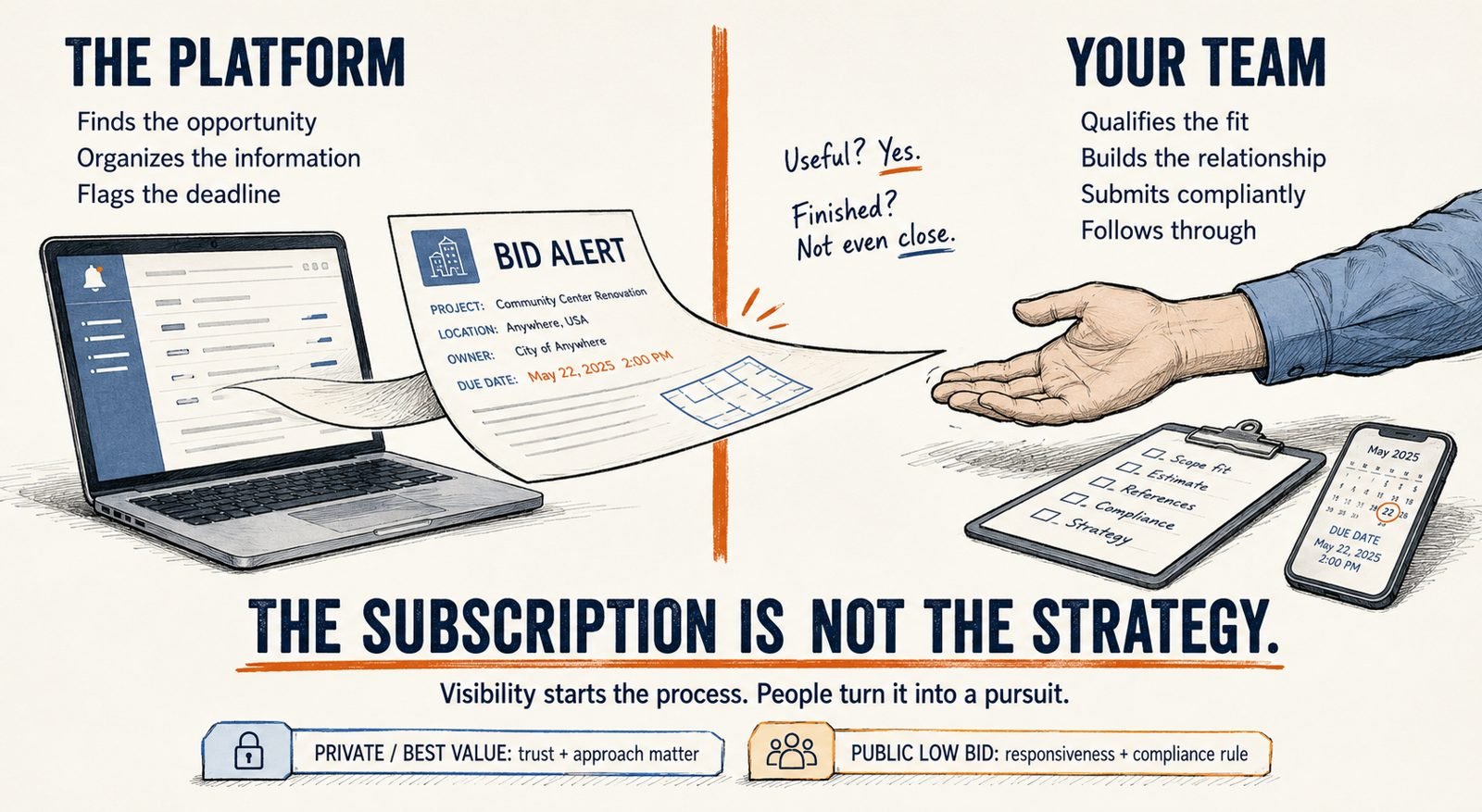
The platform is step one. The value comes from what your team does with the opportunity after it appears.
Bid platforms are useful, but contractors often purchase them with the wrong expectation.
What they can do
- expose your team to projects it would not have found otherwise;
- centralize invitations, plans, specifications, contacts, and deadlines;
- reveal projects earlier in planning or design;
- expand a GC’s potential subcontractor pool;
- reduce manual portal monitoring; and
- provide data for better go/no-go decisions.
What they cannot do
- make an opportunity a good fit for your team;
- create bonding capacity, labor capacity, relevant experience, or a competitive scope;
- guarantee that the listed project proceeds;
- ensure the decision maker knows or trusts your company;
- replace a compliant public bid; or
- follow up, attend the walkthrough, clarify exclusions, and close the opportunity for you.
The practical distinction: a platform can create visibility, data, and workflow. Your people still have to turn that information into a decision, a conversation, a relationship, a qualified pursuit, and eventually a win. The subscription is not the strategy.
That process also changes by procurement type. On private negotiated work and best-value selections, trust, past performance, approach, responsiveness, and relationships heavily influence who is selected. On sealed public low-bid work, the award is governed primarily by the lowest responsive and responsible bid. Relationships still help a contractor understand the owner and prepare intelligently, but they cannot cure a missing form, late bid, improper bond, or nonresponsive submission.
Five Things About Bid Sites That Operators Learn the Hard Way
A few things every commercial operator either knows or learns the expensive way. They rarely make it into a platform comparison.
1. GCs use these platforms to “get coverage,” including from subs they will never seriously consider. When a $40M GC is filling out their bid form for an owner, they may invite 18 subs in a trade knowing they will seriously look at four. The other fourteen are insurance and price checking. If you are not on the trusted list before the invite hits your inbox, you are calibrating their estimate, not competing for the job. Submitting a sharper number does not change that. Stop optimizing the bid and start optimizing the relationship. Get on the trusted list before the next round starts.
2. The platform is a top-of-pipeline tool, not a sales engine. The most expensive mistake we see is contractors treating these platforms like their pipeline. They generate awareness and invitations. That is it. The work happens in the next 72 hours: phone calls, scope clarifications, in-person walks, follow-ups with the preconstruction lead. Subs who treat the platform inbox like their CRM lose to subs who treat it as the start of a relationship.
3. ITBs land in spam folders constantly. This is the dirty secret of platform-based bidding. BuildingConnected emails, and platform emails generally, frequently land in subs’ spam or promotions tabs. Estimators miss invitations they would have bid on, and GCs assume the sub passed. If you are a GC, call your top three subs in each trade to confirm they got the invite. If you are a sub, sweep your spam folder every Monday morning, and once a week pick up the phone and ask your best GCs, “do you have anything coming up that I should be tracking?” That one conversation gets you on bid lists faster than any platform setting.
4. Proximity beats price more often than people admit. A sub 10 miles from the jobsite is nearly twice as likely to be selected as a sub 50 miles away with a similar number. Less logistics risk, easier site visits, and the GC trusts execution more. Most platform comparisons ignore this. Most savvy GCs build their bid lists around it. If your shop is 90 minutes from the project, your number has to be sharper than the local sub’s, not just close.
5. The 400-invitation cliff. BuildingConnected’s own published data shows that as a sub receives more invitations from a single GC, acceptance rates climb, but only up to about 400 invites. After that, acceptance rates decline. By 1,000 invites from the same GC, they crater. High-volume invite spam burns out the relationship even with subs who used to engage. If you are a GC, stop spraying and curate. If you are a sub, stop accepting bids you have no chance to win; a noise bid trains the GC to send you noise invites forever.

The Most Common Reasons Contractors Get Poor Results
When the “lead generation strategy” is 47 alerts, three portals, two spreadsheets, and nobody assigned to follow up.
1. They buy volume instead of fit
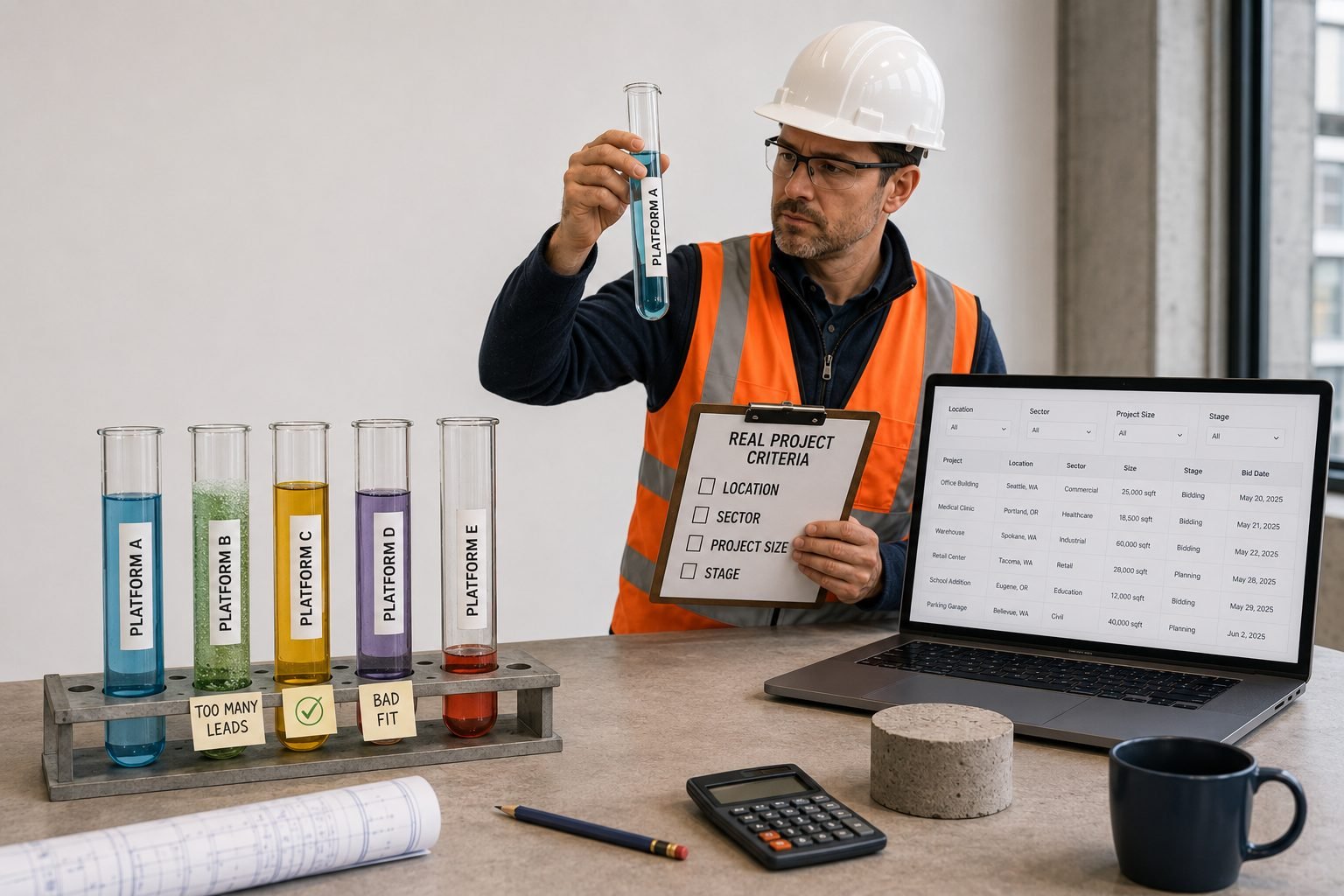
A database can contain hundreds of thousands of projects and still produce little value if only a small percentage match your geography, trade, size, delivery method, bonding, schedule, or client profile. Before buying, run the same qualification filters you would use on a real Monday morning.
2. Nobody owns the platform
Paid intelligence fails when “the team” owns it but nobody owns the next action. Assign one person or role to saved searches, review, qualification, CRM entry, outreach, and reporting. Forty-seven new-project alerts are not a pipeline if nobody is responsible for doing anything with them.
3. They confuse an invitation with a real opportunity
Private GCs invite broadly to improve coverage. Before investing estimating time, determine whether the project fits, whether the GC is a target account, whether the bid list is crowded, whether the documents are complete, and whether you can execute the work.
4. They respond only through the portal
For private work, a clean bid should be paired with human follow-up. The portal is the transaction layer; the relationship still happens between people. Confirm receipt, clarify scope, identify alternates, understand the decision timeline, and ask whether the GC sees any gaps. Do not pressure the estimator. Make the bid easier to evaluate and give them a reason to remember your team.
5. They do not track source-to-win performance
Without source tracking, a contractor cannot tell whether a subscription created revenue or merely touched a project that would have entered the pipeline anyway. Record the original source, first contact, qualification decision, bid cost, outcome, and gross profit potential.
6. They ignore contract terms and renewal timing
Before signing, confirm the subscription term, number of users, geography, modules, data exports, CRM integration, onboarding, price increases, renewal notice, cancellation method, and data access after termination. A useful demonstration does not answer those commercial questions.
How to Test a Construction Bid Site Before You Buy
Do not evaluate a platform using its default dashboard. Use a controlled test with your own market.
Step 1: Define your target profile
Write down:
- counties or metropolitan areas;
- project sectors;
- minimum and maximum contract values;
- public versus private work;
- GC, owner, architect, or agency targets;
- trades and CSI divisions;
- project stages;
- delivery methods; and
- exclusions that make a lead unqualified.
Step 2: Run a live coverage test
Ask the salesperson to search your actual criteria. Review at least 20 records and check:
- Is the stage current?
- Is the project within your territory?
- Are the contacts relevant and reachable?
- Are plans, specifications, and addenda available when promised?
- Is the opportunity already in your CRM or another paid platform?
- Can you identify the original source?
- What action would your team take next?
Step 3: Score the trial
Use a simple scorecard rather than a general impression.
| Trial measure | Question to answer |
|---|---|
| Qualified-opportunity rate | What percentage of reviewed records fit our written target profile? |
| Net-new rate | How many qualified opportunities were not already known to us? |
| Contact accuracy | How often were the listed decision makers correct and reachable? |
| Timing advantage | Did the platform show the project early enough to change our position? |
| Workflow adoption | Did the assigned users actually log in, qualify, and act? |
| Bid conversion | How many platform leads became legitimate go decisions and submitted bids? |
| Relationship conversion | How many produced a call, meeting, walkthrough, prequalification, or bidder-list addition? |
| Revenue potential | Does the weighted gross-profit opportunity justify the annual cost and labor? |
Step 4: Calculate the real cost
The subscription is only part of the expense. Include:
- licensing and implementation;
- estimator and BD review time;
- CRM administration;
- takeoff or proposal cost for additional pursuits; and
- opportunity cost from low-fit bids.
A $3,000 tool that causes $30,000 of wasted estimating effort is not inexpensive. A higher-cost platform that helps a team identify and win one well-aligned project may be a better investment.
Step 5: Set a renewal decision date now
Choose the person responsible, the metrics required, and a review date at least 60 to 90 days before renewal. If the platform cannot be tied to qualified pursuits, relationships, time savings, or wins, change the workflow, reduce the package, or cancel it according to the contract.
Which Construction Bid Sites Should Your Company Use?
Run yourself through this before you renew or sign anything.
If you are a small commercial subcontractor
Start with the invitation networks your target GCs use: a free BuildingConnected profile (mandatory), a free PlanHub profile, and a free Procore Construction Network profile if your top GCs use Procore. Add EZ Subcontractor if your work skews light commercial or residential. Save your money on Dodge and ConstructConnect until your pipeline volume justifies it, and add paid discovery only after you consistently qualify and follow up on existing opportunities.
If you are a growing specialty contractor with dedicated business development
Maintain the major invitation profiles, then test one early-intelligence product in your territory. Compare Dodge or ConstructConnect for broad coverage; Mercator.ai, Construct-A-Lead, ConstructionWire, or Building Radar may make sense for a narrower early-development strategy. Buy one product first and establish a baseline before adding overlap. Add a paid tool only if you can name three projects from the trial that ended in real bids.
If you are a mid-sized commercial GC
Use one strong subcontractor invitation and bid management system (BuildingConnected for most), plus one owner and project intelligence source if negotiated or private work is a growth priority. Pick Dodge or ConstructConnect, not both. If one platform performs both jobs well in your territory, you may not need two subscriptions. You also need a real CRM and a business development function. Platforms feed the funnel; the funnel runs on people.
If you are a public works contractor
Monitor the official portals for your must-win agencies. Use BidNet Direct or Construction Bid Source to broaden discovery, but verify every requirement with the issuer. Track prequalification, licenses, bonds, prevailing wage, forms, mandatory meetings, addenda, and submission rules as part of go/no-go.
If you are entering federal contracting
Begin with SAM.gov, agency forecasts, award history, small business resources, and a narrow NAICS and geography strategy. Add GovWin only after the company has a real capture process, identified target agencies, and enough opportunity volume to use pre-RFP intelligence.
If you are a large GC, national specialty contractor, or manufacturer
Dodge One or ConstructConnect may justify enterprise investment when several users rely on consistent project data. Manufacturers and structured sales teams may also benefit from Building Radar or sector-specific ConstructionWire coverage. Require CRM integration, governance, duplicate control, and reporting from the start.
If you are bidding mostly under $5M projects
Skip the seat fees. Spend on relationships: local GC events, direct outreach, and follow-up systems. At this size the platforms will pay you back less than the in-person network will.
The principle underneath all of this: do not buy a tool until you have earned the leverage to use it. A $10K subscription is a great accelerant for a working sales motion. It is a very expensive way to fund hope.
Platforms feed the funnel. People run it.
If the follow-up is the part your team keeps dropping, that is the part IdealRev runs for commercial GCs and subs. Book a call and see what a working sales motion looks like on your pipeline.
Bonus: What You Still Need to Do After the Bid Site Finds the Project
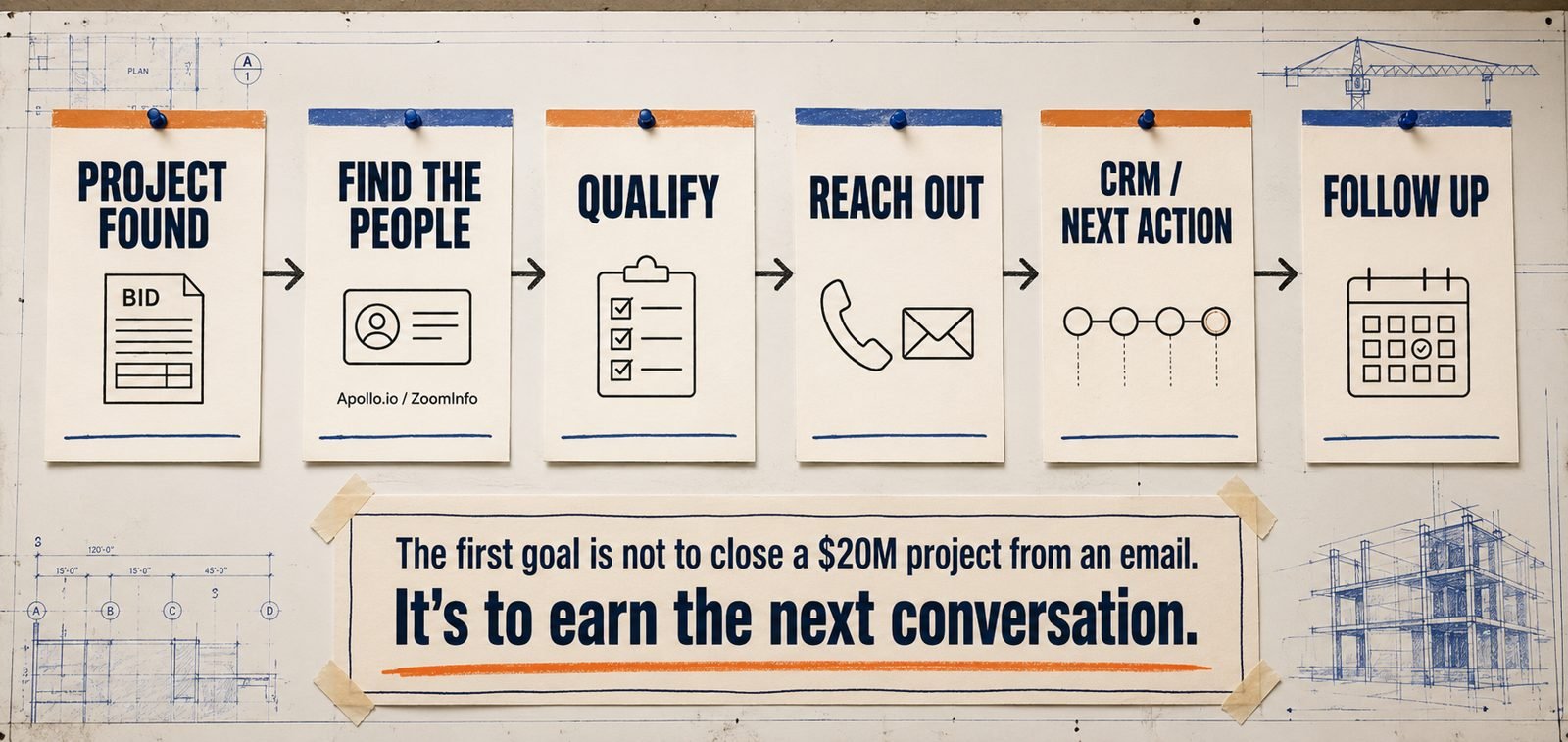
This is the part that gets skipped in most bid platform reviews. Finding a project is only step one. The highest-value teams have a simple process for turning a project record into a qualified sales opportunity.
1. Enrich the project record with better contact data
Bid platforms are built around construction opportunities, but the contact record is not always complete enough for business development. B2B sales intelligence databases such as Apollo.io and ZoomInfo can fill gaps with company information, role data, business email addresses, phone numbers, and additional contacts, depending on the platform, subscription, market, and data coverage.
The goal is not to export hundreds of names and start blasting emails. Use contact data to answer practical questions: Who owns the project? Who influences contractor selection? Who manages facilities or capital planning? Who is the architect, owner’s representative, developer, estimator, or preconstruction lead we actually need to know? Verify critical information before relying on it, and follow applicable outreach and opt-out requirements.
2. Qualify before you spend estimator or sales time
Before a lead becomes a pursuit, someone should be able to answer:
- Does the project fit our geography, sector, size, delivery method, schedule, and capacity?
- Where is the project in the lifecycle, and is there still time for us to matter?
- Who are the decision makers and influencers, and do we have a relationship path to any of them?
- What appears to be driving the project: budget, speed, occupancy, phasing, funding, risk, or something else?
- Who is already involved: architect, owner’s representative, developer, CM/GC, consultants, or key trade partners?
- What is the next useful action: introduction, prequalification, budgeting conversation, project tour, capability follow-up, or a future check-in date?
3. Reach out like a seller, not a software subscriber
A platform alert is not a reason to send “We saw your project and would love to bid.” Strong outreach starts with relevance. Reference the project or market, connect it to experience that actually matters, ask a useful question, and make the next step easy.
The sales mentality is simple: be useful before you are persuasive, qualify out bad-fit work quickly, and follow up consistently until you understand the timing and fit. The first goal is usually not to close a $20 million project from an email. It is to earn the next conversation and learn enough to position intelligently.
4. Put every real opportunity into a follow-up system
Once an opportunity is qualified, move it into the CRM with an owner, next action, and next date. Track the source, relationship history, project stage, decision makers, outreach, meetings, prequalification status, pursuit decision, bid or proposal activity, and outcome. This is what turns a database subscription into an actual business development system.
For the step-by-step version of this, our guide to the construction sales process breaks the path from lead to awarded work into five stages, and our business development guide for construction companies covers target accounts, outreach, and relationship development in more depth.
A bid platform can find the project. Contact data, qualification, outreach, CRM ownership, and follow-up are what turn it into pipeline.
Need help turning project intelligence into consistent sales activity?
IdealRev’s commercial construction sales support builds target account lists, enriches contact data, structures outreach, organizes CRM follow-up, and creates a repeatable process around the opportunities your team actually wants to win. The goal is not more alerts. It is more qualified conversations with the right owners, developers, architects, GCs, and partners.
The Final Verdict
The best construction bid site is not the one with the most listings or the longest feature list. It is the one that consistently gives your team useful information at the right stage and fits the way your company actually pursues work.
For most subcontractors, the right first move is to build complete profiles on the networks their target GCs use and test whether those tools produce qualified invitations or useful project discovery in the territory. For commercial GCs and larger specialty contractors, early intelligence becomes valuable when somebody is accountable for turning signals into research, contacts, conversations, and qualified pursuits. For public contractors, official agency documents remain the source of truth no matter where the opportunity was discovered.
Measure platforms by qualified opportunities, net-new relationships, useful timing advantage, submitted bids, time saved, and profitable wins, not logins, alerts, or raw project counts.
A bid platform can put a project on your radar. A contact database can help you find the people around it. Neither one can decide whether the project is worth your time, build trust, ask the right questions, follow up consistently, prepare a complete number, submit a compliant response, or perform the work. That is still where contractors win, and where a disciplined sales and pursuit process becomes the real competitive advantage.
Frequently Asked Questions
Where can commercial contractors bid on projects in 2026?
It depends on the job. For private commercial work: BuildingConnected, PlanHub, Procore, Downtobid, and EZ Subcontractor. For project intelligence: Dodge One, ConstructConnect, Mercator.ai, Construct-A-Lead, ConstructionWire, and Building Radar. For government work: SAM.gov, BidNet Direct, GovWin IQ, and Construction Bid Source. For directory visibility: The Blue Book.
Are construction bid sites worth paying for?
For subs, the free options (BuildingConnected, PlanHub, Procore Construction Network) are mandatory and cost nothing. The paid project intelligence tools (Dodge, ConstructConnect) are only worth it once you have someone whose job is to hunt early-stage work and a follow-up motion to convert it. Expect $4,800 to $12,000 per seat per year for those.
Which bidding platform is best for small commercial subcontractors?
Free BuildingConnected and free PlanHub profiles cover most of the territory. Add a Procore Construction Network profile if your top GCs use Procore, and EZ Subcontractor if your work skews light commercial. Do not pay for project intelligence tools until your bid volume justifies it.
What is the biggest mistake contractors make with bid sites?
Treating them like a sales engine. They generate awareness and invitations; they do not close work. The contractors who win consistently use bid sites as the top of a relationship-driven pipeline, not as the pipeline itself.
How do I avoid missed bid invitations?
Whitelist platform notification emails, sweep your spam folder weekly, and call your top five GCs once a month to ask what they have coming up. That is the most reliable invitation channel any sub has access to.