
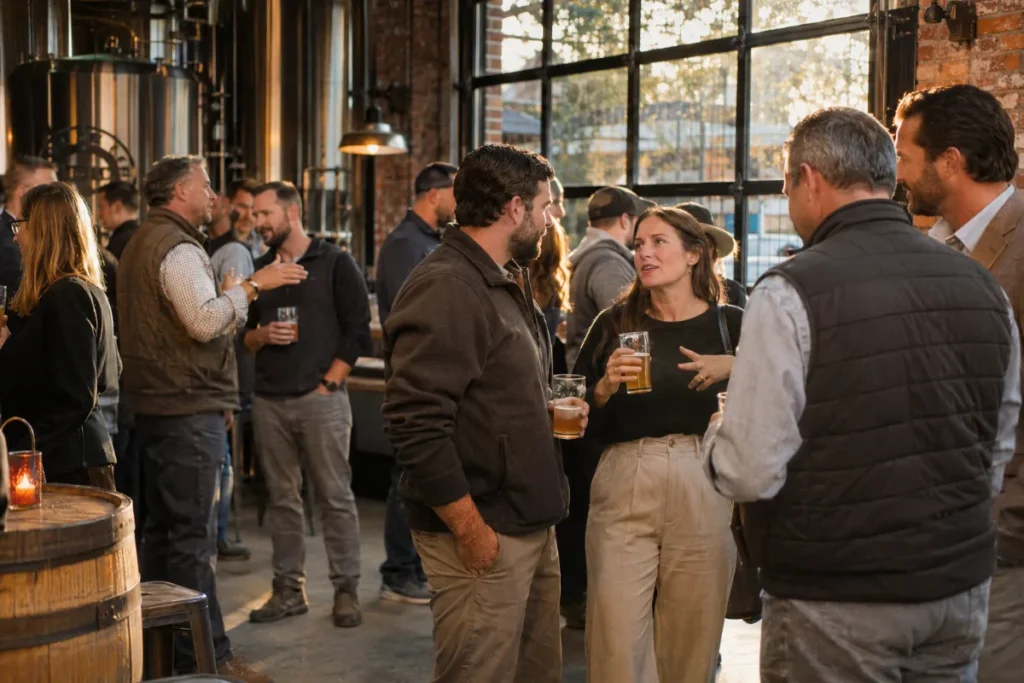
Most work in commercial construction still moves through relationships. You get invited to bid because somebody knows you, and you get the benefit of the doubt on a close number because somebody trusts you. Events are one of the few places you can build those relationships on purpose.
The hard part is the practical stuff. Which events are worth a Tuesday night? Who do you walk up to, and what do you say when you get there? How do you leave a conversation without it getting awkward? What do you send the next day so the person remembers you a month later?
This guide covers all of it in order: what to do before the event, what to do in the room, and what to do after. The examples lean on subcontractors and general contractors, but the same playbook works if you’re an owner’s rep, architect, engineer, designer, or supplier. By the end you’ll have a plan for your next event and scripts you can copy.
Set the right goal before you go
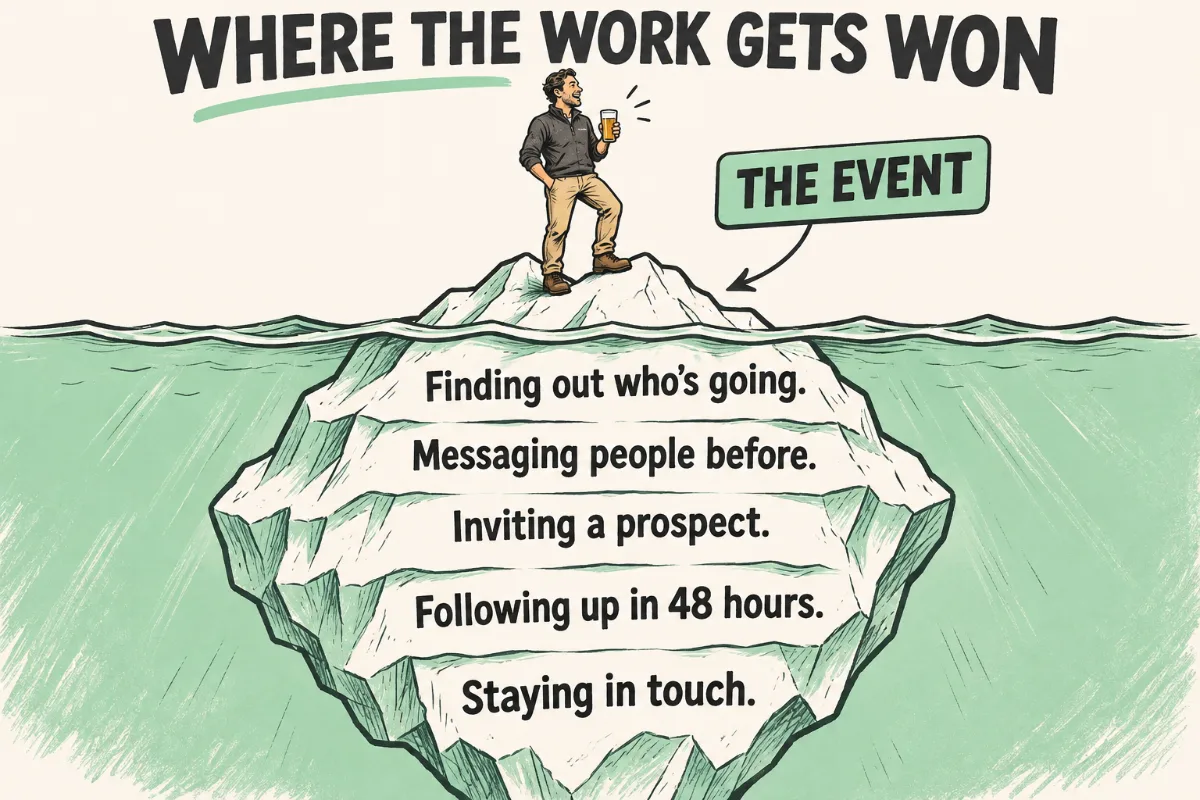
A networking event is not where you win a job. The event is where you earn the next conversation, and the next conversation is where work starts.
So set a goal you can hit:
- 3 to 5 real conversations. A real conversation is one where you learned what the person is working on and they learned what you do. That beats 20 handshakes.
- 1 or 2 follow-up meetings. Coffee, a jobsite walk, a call with their estimator.
- 1 thing you learned about the market. Who’s busy, who’s hiring, what’s breaking ground.
Then decide who you’re there to meet. This depends on where you sit in the food chain.
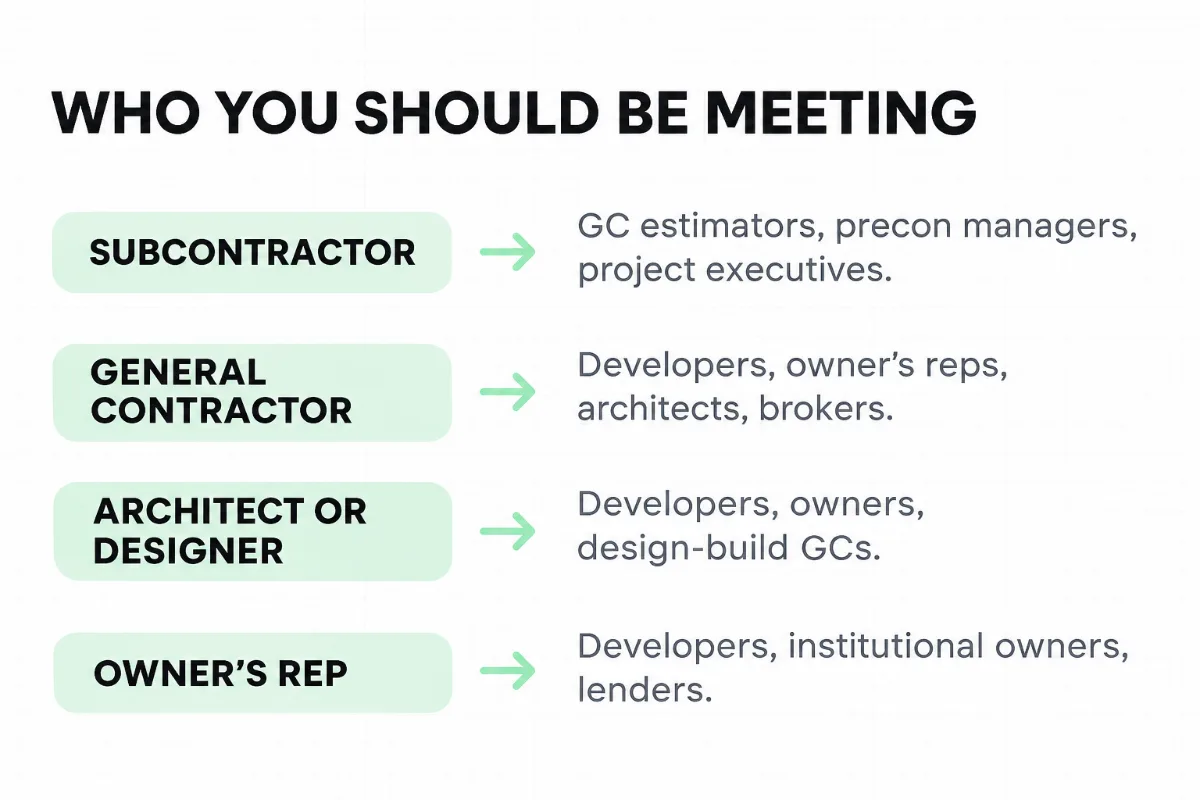
If you’re a supplier or vendor, you want subs in your trade and the purchasing and operations people at GCs. Whatever your role, write your list of target roles down before you leave the office. It changes who you walk toward when you get there.
Pick rooms where your buyers are
The most common mistake is going where your peers go. A mechanical sub at a mechanical contractors’ dinner is mostly meeting competitors. That has value for learning the market and finding labor, but it doesn’t fill the pipeline.
Go one step up the chain:
- Subs: GC-heavy rooms. AGC and ABC chapter events, GC-hosted trade partner nights, prequalification open houses, outreach events for public and institutional work.
- GCs: owner and developer rooms. NAIOP, ULI, CREW, BOMA, IFMA, local real estate mixers, broker events.
- Design and owner’s rep side: developer and institutional rooms, plus AIA and CMAA for peer referrals.
- Everybody: mixed events built to put GCs, subs, and owners in one room. These are the most efficient nights on the calendar.
A few types of events are underrated:
- Topping-out parties, groundbreakings, and ribbon cuttings. Small, and everyone there is tied to a real project.
- Golf outings and charity events. Four hours with three people beats four minutes with thirty.
- Committee work at an association. Showing up to the same committee every month builds more trust than any single mixer.
Before you pay for a ticket, look at the sponsor list and past attendees. If the sponsors are companies that sell to your buyers, your buyers will be there.
Before the event: where most of the value is
Most people register, show up, and hope. The people who get the most out of events do their work in the week before. This is also the easiest part if you’re shy, because it all happens over text, email, and LinkedIn.
Find out who’s going
- Check the event page. Luma, Eventbrite, and LinkedIn events often show the guest list.
- Look at the speakers, sponsors, and host committee. Those people will be there for sure.
- Ask the organizer. “Who’s the crowd usually? Any GCs coming?” Organizers want the event to work and will usually tell you, and many will make an introduction if you ask.
Pick five people
Choose five people or companies you want to talk to. Spend ten minutes on each: what they’re building right now, a recent award or project announcement, anyone you know in common.
Message them before you go
A short note turns a cold approach into a warm one. When you walk up at the event, you’re the person who messaged them, and they already know your name.
“Hey Mike, saw you’re going to the AGC mixer Thursday. I’ll be there too. Would be good to finally meet in person.”
Use the event as a reason to reach out
An event gives you a reason to contact a prospect or an old relationship without it being a sales call. Ask if they’re going.
“Hey Sarah, are you going to the NAIOP event on the 14th? I’m heading over and figured I’d check. If you’re in, I’ll grab us a drink.”
If they say yes, you have a meeting. If they say no, you still had a friendly touchpoint, and you can follow with “no worries, let’s grab coffee next week instead.”
Three groups are worth inviting:
- A prospect you’ve been chasing. It’s a lower-pressure ask than a meeting.
- A past client or a GC you’ve worked with. It keeps the relationship warm, and they’ll introduce you to people in the room.
- Someone you can help. Bringing a sub to a room full of GCs, or an architect to a room full of developers, is a favor they remember.
Prep three things
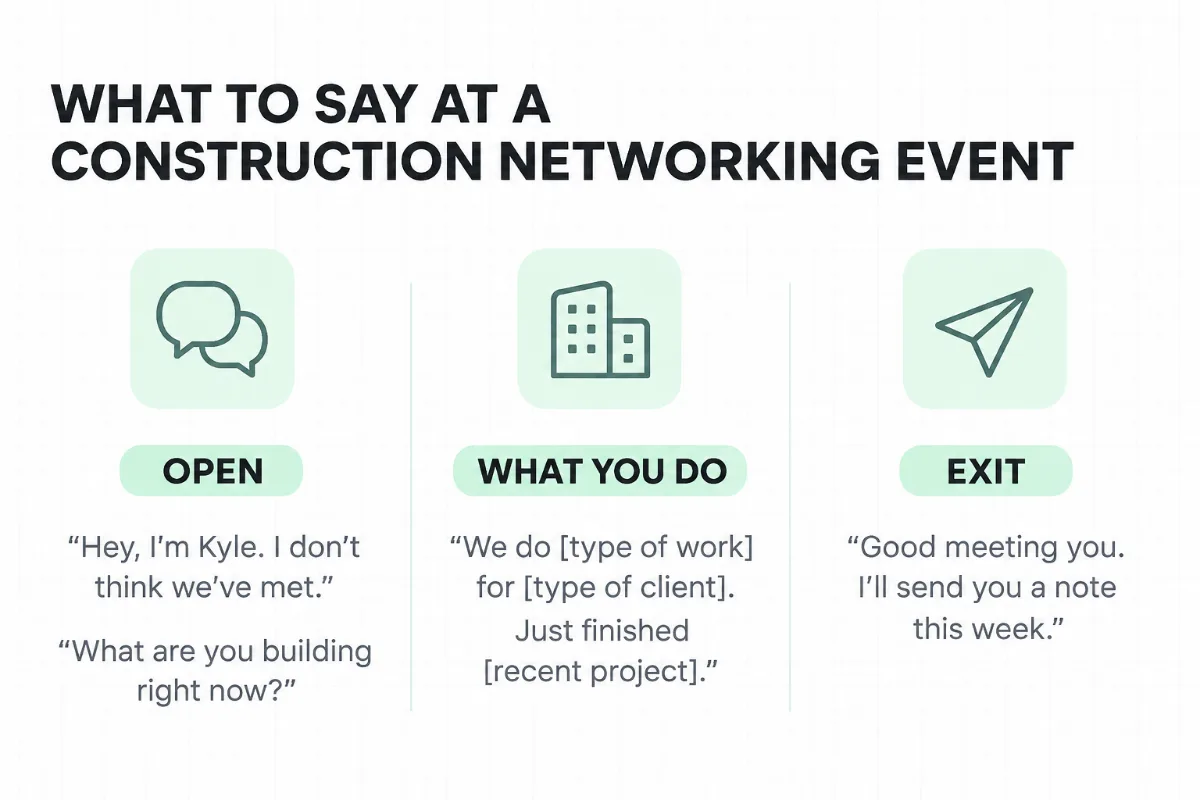
- Your one-liner. What you do, who you do it for, and one recent project. “We do interior fit-outs for office and healthcare tenants, mostly 5,000 to 50,000 square feet. Just wrapped a surgery center in Stamford.” A project gives the other person something to ask about.
- Two or three questions you can ask anyone. There’s a list further down.
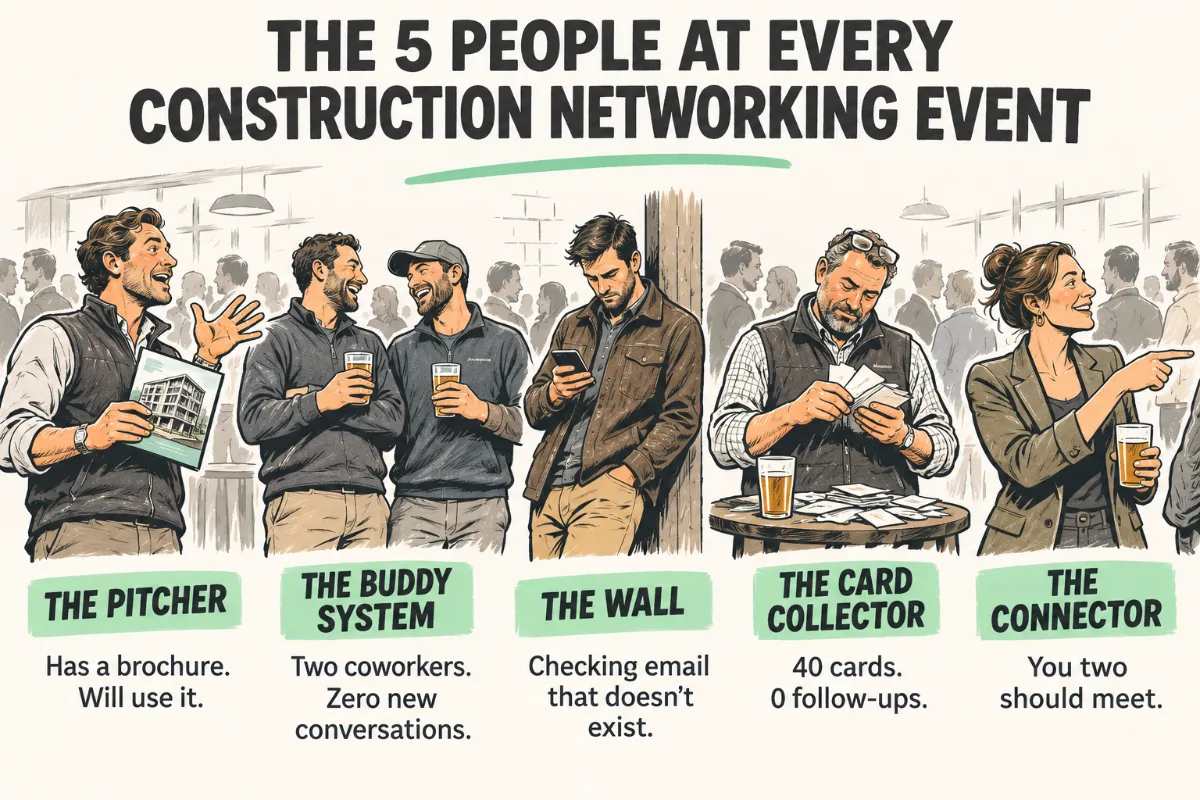
- A way to trade contact info fast. The LinkedIn QR code on your phone works better than a card that ends up in a jacket pocket. Carry a few cards anyway, since plenty of people still like them.
Pre-event checklist: guest list checked, five targets picked, messages sent, two invites out, one-liner ready.
At the event: who to approach and what to say
Get there early
The first 30 minutes are the easiest. The room is small, people are standing alone, and the hosts have time to talk. Walking into a full, loud room an hour in is much harder.
Find the host first
Introduce yourself, thank them, and tell them who you’re hoping to meet. Good hosts will walk you over to someone. It’s the fastest introduction in the building.
Who to walk up to
- Someone standing alone. They’re hoping somebody will come talk to them. You’re doing them a favor.
- Groups of three or more standing in an open shape. If there’s a gap in the circle, you can step into it.
- The bar or food line. You already have something in common and a built-in time limit.
- Skip two people locked in close conversation. That’s a private talk.
What to say first
You don’t need a clever line. A plain introduction works:
“Hey, I’m Kyle. I don’t think we’ve met.”
Then ask a question. These work in any construction room:
- “What do you guys do?”
- “What are you building right now?”
- “What kind of work are you chasing these days?”
- “How’s your backlog looking for next year?”
- “How do you know the host?”
- “Is this your first time at one of these?”
People in this industry like talking about their projects. Ask about the job, the schedule, what went sideways. You’ll learn more from that than from any pitch.
Answer “what do you do?” in one sentence
Use the one-liner you prepped, then hand the conversation back:
“We’re a drywall and ceilings sub, mostly commercial interiors in the city. Just finished a floor for a law firm in Midtown. What about you?”
Short answer, one real project, question back. If they want more, they’ll ask.
Don’t pitch. Find out if there’s a reason to talk again.
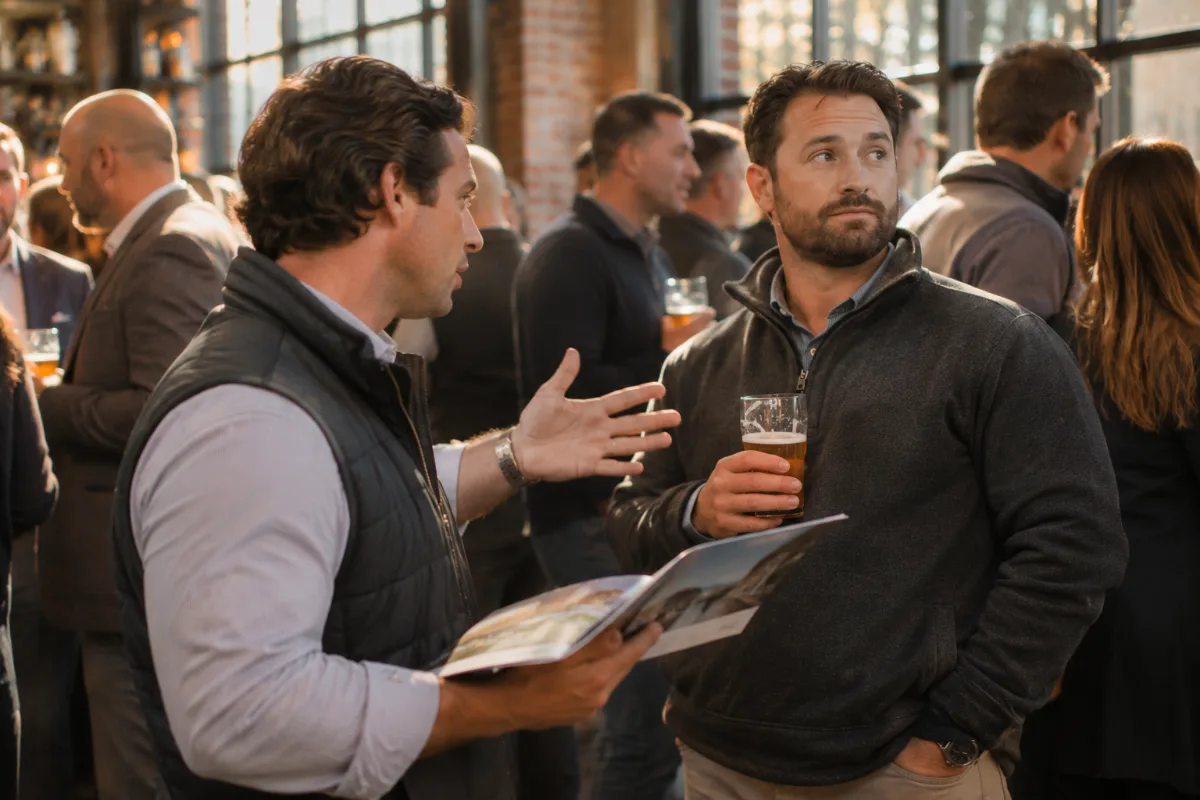
The questions that matter depend on who you’re talking to.
Sub talking to a GC:
- “What trades are hardest for you to get covered right now?”
- “How do you guys add subs to your bid list? Is there a prequal?”
- “Who runs estimating for your interiors work?”
GC talking to a developer or owner’s rep:
- “What do you have coming up in the next year?”
- “How do you usually pick your contractors? Negotiated or hard bid?”
- “What’s been the biggest headache on your last couple of projects?”
Architect or designer talking to a developer or GC:
- “Who do you typically work with on design?”
- “Are you doing any design-build right now?”
These questions tell you whether there’s a fit and what the next step should be. They also show you understand how their side of the business works.
Be useful
If you meet a developer who needs a civil engineer and you know a good one, make the introduction on the spot. If a GC mentions they can’t find a good glazing sub and you know one, say so. People remember who helped them, and connectors get invited back.
Leave conversations cleanly
Five to ten minutes is plenty. Staying too long with one person is the most common way to waste the night. Any of these work:
“I’m going to grab another drink. Good meeting you, I’ll shoot you a note this week.”
“I don’t want to hold you up. Let me get your info and I’ll follow up on that prequal.”
“There’s someone here you should meet. Let me introduce you.”
The third one is the best. You get to move on, and they get a useful introduction.
A few ground rules
- If you bring a coworker, split up. Two people from the same company standing together all night meet nobody.
- Go easy on the drinks. Two is fine. You want to be remembered for the conversation.
- Take notes right after each conversation. Step aside and put it in your phone: name, company, what they’re working on, what you said you’d do. You will not remember it tomorrow.
If you’re shy or hate small talk
Plenty of good builders are. A few things make it easier:
- Set a quota. Three conversations, then you’re allowed to leave. Having an exit makes it easier to start.
- Give yourself a job. Volunteer at check-in or help the host. You’ll meet everyone as they walk in, and you’ll have a reason to be talking to them.
- Do the pre-work. If you’ve messaged three people ahead of time, you’re walking in to find people who expect you.
- Ask questions and listen. You don’t have to be entertaining. The person who asks good questions about someone’s project is the one they enjoyed talking to.
- Bring someone, then separate. Arrive together, split for 30 minutes, regroup, and introduce each other to whoever you met.
It gets easier with repetition. By the third or fourth event with the same group, you’ll know half the room.
After the event: where the work gets won
Most people skip this part. They had good conversations, went home, and never followed up. A month later nobody remembers who was who.
Follow up within 48 hours
Send a LinkedIn connection request with a note the next morning, and an email if you have the address. Mention something specific from the conversation so they can place you.
“Mike, good meeting you at the AGC mixer last night. Hope the pour on the Flushing job goes smoothly this week. I’ll send over our prequal package like we talked about. Would be glad to walk your estimator through a couple of recent projects whenever it’s useful.”
Make a small, specific ask
“Let’s stay in touch” goes nowhere. Ask for a next step that fits where the relationship is:
- Sub to GC: “What’s the best way to get on your bid list?” or “Can I send our prequal to your precon team?”
- GC to developer: “Could I buy you a coffee and hear more about the project on Atlantic?” or “Want to walk one of our jobs?”
- Design or owner’s rep: “I’d like to send over a couple of similar projects. Who else on your team should see them?”
A jobsite walk is one of the best asks in construction. It shows your work without a sales pitch.
Do what you said you’d do
If you promised an introduction, a prequal package, or a referral, send it the next day. Doing the small thing you said you’d do is the first proof of how you’d perform on a project.
Log it
Put every contact in your CRM or a spreadsheet: name, company, role, where you met, what you talked about, next step, and a date for the next touch. Without a date, the follow-up doesn’t happen.
Stay in touch every four to six weeks
One event doesn’t build a relationship. Repeated, low-pressure contact does. Easy reasons to reach out:
- A project of theirs hit the news or broke ground
- You finished a job that’s relevant to their work
- An article, bid opportunity, or introduction that would help them
- The next event: “Are you going to the one in March?”
Each event gives you a reason to contact everyone you met at the last one, and each time they see you again the relationship gets a little stronger.
Once you’re comfortable: get out of the crowd
Attending is the entry level. These get you more out of the same hours:
- Bring a client or prospect as your guest. You get an hour with them and you look connected.
- Join a committee. Monthly face time with the same people, and you stop being a visitor.
- Speak or sit on a panel. Twenty minutes on stage does the work of fifty introductions.
- Sponsor selectively. Pick one event where your buyers are and show up in person. A logo on a banner without a person in the room does very little.
- Host your own. A jobsite tour, a lunch at your shop, a small happy hour for GCs and trade partners. When it’s your event, everyone comes to you.
Scripts you can copy
Pre-event message to someone you want to meet
“Hey [Name], saw you’re going to [event] on [day]. I’ll be there too. Would be good to connect in person.”
Invite to a prospect or old contact
“Hey [Name], are you going to [event] on [date]? I’m heading over and thought of you. If you’re in, first drink’s on me.”
If they can’t make it
“No worries. Let’s grab coffee in the next couple of weeks instead. Does Tuesday or Thursday work?”
Opener
“Hey, I’m [Name]. I don’t think we’ve met. What do you guys do?”
One-liner formula
“We do [type of work] for [type of client], mostly [size or market]. Just finished [recent project].”
Exit
“Good meeting you. I’ll send you a note this week about [specific thing].”
48-hour follow-up
“[Name], good meeting you at [event]. [One specific detail from the conversation]. [The thing you promised]. Would be glad to [small ask] whenever it works for you.”
Four-to-six-week check-in
“Hey [Name], saw [project or news]. Congrats. Are you going to [next event]? Would be good to catch up.”
The short version
- Go where your buyers are, with a goal of three to five real conversations.
- Do the work beforehand: find out who’s going, message five people, invite two.
- In the room, ask about their projects, keep your own answer to one sentence, and move on after ten minutes.
- Follow up within 48 hours with something specific and a small ask.
- Stay in touch every four to six weeks, and use the next event as the reason.
Networking is one piece of business development, alongside outbound calls, email, and a website that backs up what you say in person. If you’re in New York, come meet us at one of our events. And if you want help building the rest of the system for your construction company, book a call with IdealRev.