
Most commercial contractors reach their first $5 million or $10 million the same way. The owner knows people, the work is good, and the phone rings.
Then one year it rings less. A repeat client gets bought. The property manager who loved you takes a job across the country. The developer carrying 40% of your backlog pauses everything until rates come down. That’s when a lot of owners realize they never built a way to find work. They built a way to receive it.
Business development for construction companies means building a way to find work, so your pipeline doesn’t depend on who happens to call.
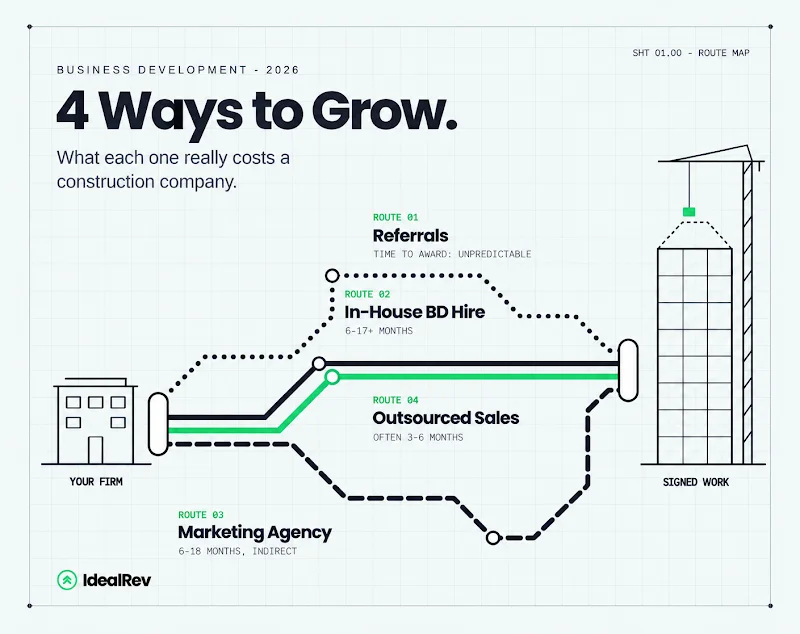
There are only four ways to do it:
- Referrals and repeat clients: The owner’s network does the selling.
- An in-house BD hire: You put a salaried person on it.
- A marketing agency:You pay someone to make you visible.
- Outsourced sales: You pay someone to go get the meetings.
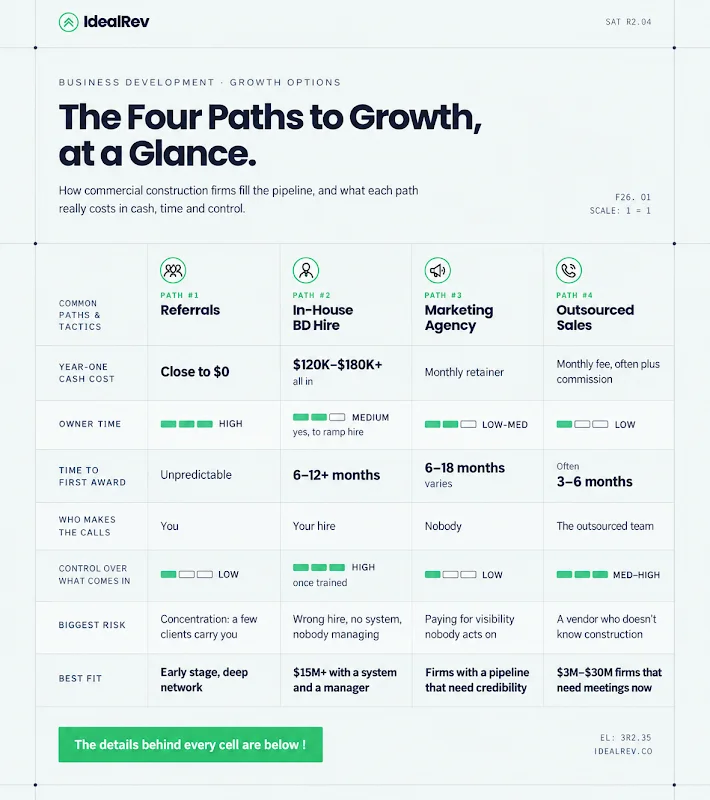
Every contractor is running one of these, or some mix, usually without having picked it on purpose. This guide covers what each path costs in cash, owner time, and months before the first award, and it lays out the BD plan that works whichever path you choose.
We run business development for commercial contractors every week, so what follows comes from what we see work and what we see fail. It’s not theory.
Key takeaways
- Business development is the work that happens before the bid invite. If the ITB is the first you hear of a job, you’re competing on price.
- Referrals are free in cash and expensive in owner time. They also stop the moment you get busy.
- A good in-house BD hire runs $120K-$180K+ in year one, and most won’t produce an award for 6-12 months.
- Marketing makes you credible when someone looks you up. It doesn’t start conversations.
- Outsourced sales is usually the fastest way for a $3M-$50M contractor to get new meetings without a six-figure bet.
- Whatever path you pick, the plan is the same: a defined target, a real list, early outreach, steady follow-up, a go/no-go filter, and a pipeline you actually track.
In this guide:
- What business development in construction actually is
- Why it matters more in 2026 than it did five years ago
- The four paths compared side by side
- Path 1: Referrals and repeat clients
- Path 2: Hiring an in-house business development manager
- Path 3: Hiring a marketing agency
- Path 4: Outsourced sales
- How to choose your path
- How to build a construction business development plan
- Your first 90 days
- Mistakes that kill a BD effort
- FAQ
What Is Business Development in Construction?
Business development in construction is the work of getting known, trusted, and remembered by the people who control the projects you want, before those projects go out to bid.
It comes down to three things:
- Being known by the developers, owners, property managers, owner’s reps, architects, and GCs who build what you build
- Being trusted enough that they take your call, bring you in for budgeting, or put you on a short list
- Staying in touch long enough that when a project moves, you’re already part of the conversation
A project goes through a lot before an invitation to bid shows up in your inbox. The owner has been planning, running numbers, getting financing, and talking internally for months. Somebody has already given them rough budgets. Somebody has already walked the site. If the ITB is the first you’ve heard of the job, you’re late, and you’re competing with everyone else who’s also late. That fight is usually decided on price.
Business development vs. marketing vs. sales vs. estimating
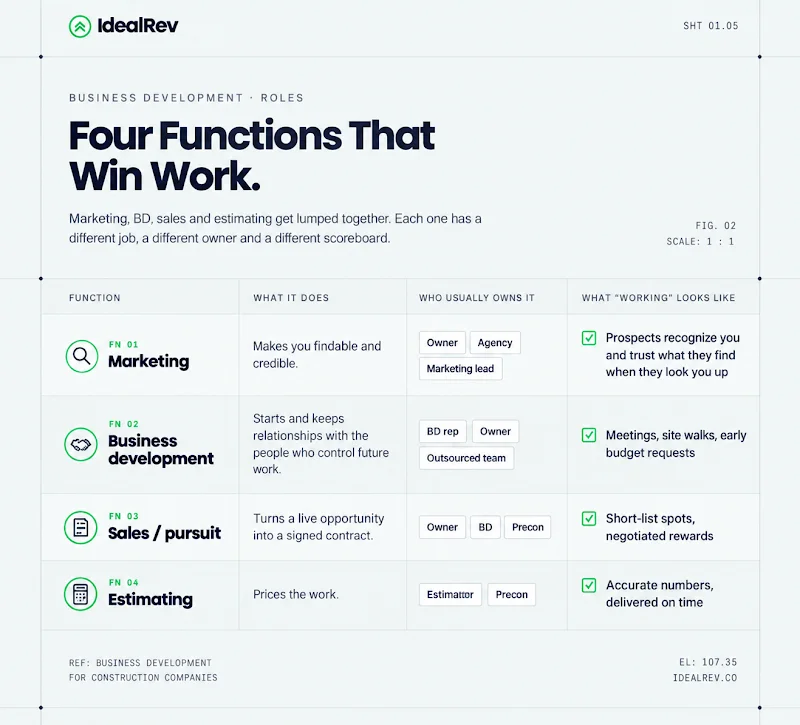
Owners mix these up constantly, and it’s the main reason BD efforts stall. Each one does a different job: A company with great estimators and no BD bids a lot and wins a little. A company with a great website and no BD looks impressive to nobody in particular. Most of the value sits in the business development row, and that’s the row most contractors leave to chance.
Why business development matters more in 2026
Three things changed.
The relationships retired. For a decade the industry talked about a wave of retirements, and it’s here now. The owner’s rep you golfed with for fifteen years is gone. His replacement is 34, came from a different firm, and has never heard of you. Repeat work used to carry itself from one generation of decision-makers to the next. It doesn’t anymore.
Procurement got more formal. More private owners now run structured bid lists, prequalification, and vendor portals. Getting on the list takes work up front, and nobody hands you a spot because your old contact liked you.
The bid-hit math got harder to ignore. Industry guidance for 2026 puts typical win rates at roughly 10-20% on hard-bid public work and 15-25% on competitive private work, with negotiated work considerably higher. Consultants who track negotiated pursuits put those win rates near 75%. Every bid you lose still cost estimating hours. BD is how you shift your mix from four-to-one and ten-to-one odds toward jobs where you’re one of two or three names, or the only one.
Most contractors don’t even know their number. In one survey of 2,000 contractors cited by ENR, only 6% knew and tracked their bid-hit ratio. If you don’t know yours, that’s the first thing to fix.
Path 1: Referrals and Repeat Clients
This is where almost every contractor starts, and there’s nothing wrong with it. Referred work closes faster, argues less about price, and comes from people who already trust you. A healthy company should always get a good share of its work this way.
The problem is when referrals are the only path.
What referrals really cost
Referrals look free because no invoice arrives. The owner’s time pays for them. Every lunch, jobsite walk, holiday call, and “just checking in” email comes out of hours that could go to running the company. That trade works when you’re small. It stops working when the owner is also covering pre-con, fighting a schedule, and chasing a retainage check.
Referral work also has a ceiling. You can only grow as fast as your existing network sends work, and your network doesn’t grow unless someone deliberately grows it.
Where referral-only growth breaks
- Concentration risk. When two or three clients make up most of your backlog, one budget freeze, sale, or personnel change puts payroll at risk.
- No control over timing. You can’t make a referral show up in a slow quarter.
- No control over fit. You take what comes, including jobs that are too small, too far away, or wrong for your crews.
- It stops when you stop. If the owner gets pulled into operations for six months, no new relationships get started, and you won’t feel it until a year later.
- It doesn’t open new markets. Referrals keep you in the circles you’re already in. They won’t get you into healthcare, a new metro, or a national brand’s rollout program.
Signs you’ve outgrown referrals
- One client is more than 25-30% of revenue
- You’ve had a slow stretch and couldn’t do anything about it
- You want to enter a market, sector, or project size where nobody knows you
- The owner is the only person at the company who brings in work
- You’re bidding more hard-bid public work because private work stopped coming
If two or more of those sound familiar, it’s time to add another path.
How to get more out of referrals while you still rely on them
- Ask directly. At closeout, ask the owner or PM who else in their world is planning work. Most people will give you one name if you ask.
- Track them. Put every referral source in a CRM so you know which relationships actually produce work. Our construction CRM guide shows one way to set that up.
- Stay in touch with past clients on a schedule. A quarterly check-in with every past client is BD, and it’s the cheapest BD you’ll ever do.
- Follow people when they change jobs. A former client contact who moves to a new company is the warmest lead you’ll ever get.
Path 2: Hiring an In-House Business Development Manager
The obvious next step is to hire someone whose entire job is finding work. When it works, it’s the strongest long-term setup, because the relationships, the pipeline, and the know-how stay inside your company.
When it doesn’t work, it’s an expensive year.
What does a business development manager do in construction?
A construction business development manager:
- Builds and maintains the target list of owners, developers, property managers, and GCs
- Researches accounts: what they’re building, where, and who decides
- Runs outreach by phone, email, LinkedIn, and in person
- Sets meetings and site walks for the owner or precon team
- Tracks pursuits through the pipeline in a CRM
- Keeps relationships warm between projects
- Represents the company at industry events and associations
- Feeds market intel back to leadership
They don’t estimate, and they shouldn’t be the one negotiating scope and price alone. The best ones bring the right people into the room at the right time.
What a construction BD manager costs in 2026
On salary alone, ZipRecruiter put the average U.S. construction business development manager at about $85,600 as of mid-2026, with most falling between $61,000 and $100,000. Glassdoor’s broader “business development, construction” figure is higher, averaging roughly $123,000, with a typical range of $92,000 to $167,000. Experienced BD people at large GCs are well above both.
Salary is only part of it. Here’s a realistic year-one build-up for a mid-level hire:
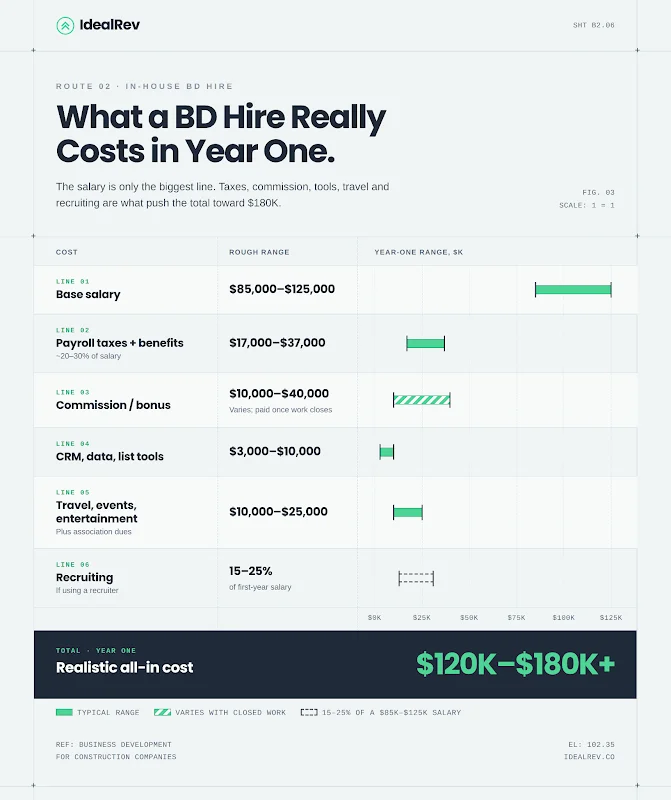
The larger cost is time. Commercial work has long cycles. A new rep needs months to learn your company, build a target list, and start relationships before anything reaches a bid. Six to twelve months before a first award is normal. You pay the full cost through all of it.
The break-even math
A simple way to decide whether an in-house BD role makes sense:
If your average negotiated job is $1.2M at a 10% margin, it produces about $120,000 in gross profit. One extra negotiated award a year roughly covers a mid-level BD hire. Two or three makes it an easy decision.
If your average job is $150K, the math is much harder. That’s usually a sign an outsourced or part-time model fits better for now.
Where in-house BD hires go wrong
- Hiring a Rolodex instead of a process. The candidate who says “I know everyone in this market” usually knows fewer people who’ll take their call than they claimed. Ask what they did every week in their last role, not who they know.
- No system to plug into. Without a defined target, a list, a CRM, and weekly activity goals, even a good rep drifts into “networking” that never produces meetings.
- Nobody manages them. Owners hire BD so they can stop thinking about sales, then stop checking on it. Six months later nobody can say what was done.
- Expecting awards in 90 days. The cycle is the cycle. Judge the first six months on activity and meetings, not revenue.
- A comp plan that pays for the wrong thing. If commission pays on signed contract value regardless of margin, you’ll get signed contracts regardless of margin. Many contractors pay commission on project payment milestones so the rep cares about getting paid, not just signing. Here’s how commission structures break down by company type.
The seller-doer trap
Many firms try to skip the hire by giving BD to a PM, superintendent, or estimator “on the side.” That’s the seller-doer model, and it rarely holds up. Project work is always more urgent than prospecting for a job that might happen next spring. BD becomes the thing they’ll get to once this project settles down, and that never happens.
Your PMs should absolutely feed BD. They hear about the next phase, the sister property, and the new facilities director before anyone else. But somebody has to own business development as their main job.
Questions to ask when hiring a construction BD rep
- Walk me through a normal week in your last role. How many calls, emails, and meetings?
- Tell me about a project you brought in from first contact to award. How long did it take?
- How did you track your pipeline? Show me if you can.
- Who in our target market would take your call next week? Why?
- What did you do in a quarter when nothing was closing?
- How were you paid, and what did that push you to do?
It fits when: you’re past roughly $15M, you have a defined target market, and someone (you or an ops leader) will actually manage the role every week. For a closer look at the hiring process, see our guide to hiring a construction sales rep.
Path 3: Hiring a Marketing Agency
A marketing agency makes your company easier to find and easier to trust: website, SEO, LinkedIn, project photography, capability statements, case studies, and sometimes ads. Our commercial construction marketing guide goes deeper on those pieces.
What a construction marketing agency really costs
Typically a monthly retainer, plus the time it takes you to feed them project details, photos, approvals, and quotes. Most agencies need several months before anything measurable happens. On LinkedIn specifically, it’s often three to six months before people start saying they’ve been seeing your posts.
What marketing does and doesn’t do
Good marketing matters. When a developer gets your intro email or a referral, the first thing they do is look you up. A dated website, an empty LinkedIn profile, or a capability statement from 2017 quietly kills deals you’ll never hear about. We’ve broken down what the best contractor websites do differently here.
But marketing doesn’t make calls. Commercial work isn’t bought the way people buy consumer products. A property manager planning a $2M renovation isn’t searching “commercial contractor near me” and filling out a form. They call someone they know, or someone who reached them first. An agency can make you look ready. It can’t put you in the room.
What to watch for with an agency
- Generalists. An agency that did a dentist last month and a SaaS company before that won’t know the difference between a developer and an owner’s rep, or why a capability statement matters.
- Vanity metrics. Impressions, followers, and “engagement” don’t pay invoices. Ask how their work connects to meetings and bids.
- Content with nothing behind it. Posts that say “quality, safety, on time” read as noise. Real projects, real numbers, and real people are what land.
How marketing and BD work together
The strongest setup is marketing built around a BD effort. Your rep (or outsourced team) is reaching out to 200 property managers. When those property managers look you up, they find a clean website, relevant project photos, and an owner’s LinkedIn profile that shows real work. That’s how marketing pays off in commercial construction. This is how we run LinkedIn for contractors as part of the same pipeline.
It fits when: you already have a way to start conversations (an owner who sells, a BD rep, or an outsourced team), and weak materials are losing deals you should be winning.
Path 4: Outsourced Sales for Construction Companies
Outsourced sales means an outside team does the business development work: building the target list, researching accounts, reaching out to developers, owners, and property managers, following up for months, and handing you qualified meetings and bid opportunities. See how IdealRev’s outsourced sales service handles that work.
You still run the meetings, price the work, and build the job. The team keeps the top of the pipeline full.
How outsourced construction sales works, week to week
A typical setup looks like this:
- Target definition. Project types, size range, geography, and the kinds of owners you want.
- List building. Specific companies and specific people, with verified contact info.
- Messaging. Outreach written around your real projects, your niche, and what the buyer cares about, in your company’s voice.
- Outreach at volume. Calls, emails, and LinkedIn, every week, without gaps.
- Follow-up. Most responses come after several touches. A good team keeps going for months.
- Meeting handoff. Qualified meetings land on your calendar with notes on who they are and what they’re planning.
- Pipeline tracking and reporting. You see activity, conversations, meetings, and bids, not just “we sent emails.”
Why outsourced sales usually moves faster
A good outsourced team starts with the process already built: lists, messaging, cadence, CRM, and reps who already know how commercial work gets awarded. It doesn’t need six months to figure out what works.
The volume is also something most owners never hit on their own. When IdealRev ran outreach for a commercial contractor focused on multifamily renovations, the team made 200 to 300 outreaches a week to property and construction managers at large apartment portfolios. That effort produced $6 million to $12 million in projects in six months. Across other small commercial firms, we’ve seen $2 million to $8 million in awarded work within six months. That’s not every engagement, but it shows what consistent volume does.
What outsourced sales costs
Usually a monthly fee, often paired with commission on awarded work. For most contractors it runs well under the all-in cost of a senior full-time hire, and recruiting, training, tools, and management come included. Owner time goes down but doesn’t go away: you still take the meetings and deliver the estimate.
Questions to ask an outsourced sales provider
- Who have you worked with in commercial construction, specifically in my sector?
- Who exactly will be making the calls, and who manages them?
- How many outreaches per week should I expect?
- How do you define a qualified meeting?
- What will I see in reporting, and how often?
- Who owns the contact list and CRM data if we stop working together?
- How long before I should expect meetings, and how long before bids?
Red flags
- Generic lead-gen shops. A team selling software this week and roofing next week won’t understand the difference between a developer and a GC.
- Meetings without fit. Volume means nothing if the meetings are with owners who don’t build what you build. Agree on the target before outreach starts.
- No handoff plan. The team opens the door. Someone on your side has to show up prepared, follow through on the estimate, and deliver.
- Promises of guaranteed awards. No one controls an owner’s financing or a board vote. Anyone guaranteeing contracts is guessing.
It fits when: you’re roughly $3M to $50M, you need new relationships now, and you’re not ready to spend six figures and a year on an in-house hire. It’s also a low-risk way to test a new market or sector before you put a full-time person there.
See how IdealRev’s outsourced sales for construction companies works →
Which Path Is Right for Your Construction Company?
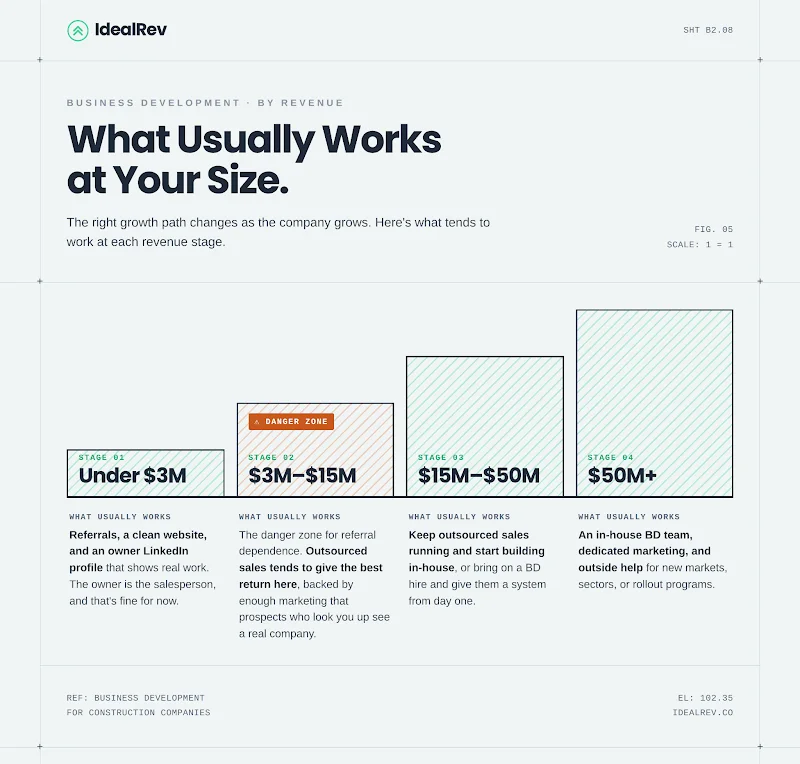
Most contractors end up combining paths. A rough guide by stage:
Revenue is only a starting point. These four questions settle most decisions faster:
- Who is going to manage this every week? If the honest answer is nobody, don’t hire in-house yet.
- How soon do you need new meetings? If it’s this quarter, a new hire won’t get you there.
- Do you know exactly who you’re targeting? If not, fix that before spending on any path.
- Can you deliver more work? More leads don’t help if you don’t have supers and PMs to run the jobs. Make sure operations can absorb growth. If you want to talk through the right path for your company, book a growth strategy call.
How to Build a Construction Business Development Plan
The four paths differ in who does the work. The work itself doesn’t change. This is the construction business development plan we use, and it works whether you, a new hire, or an outsourced team is running it. For a broader walkthrough, read our construction business development guide.
Step 1: Define exactly who you want to work for
“Commercial work” is not a target. Write down:
- Project types: multifamily renovation, retail TI, healthcare, industrial, restaurant rollouts, and so on
- Size range: the jobs you win most often and profit on most
- Geography: how far your crews can realistically travel
- Buyer type: developer, owner-operator, property management firm, national brand, GC
- Delivery method: negotiated, CM, design-build, or hard bid
Start with your last ten profitable jobs. What did they have in common? That’s your target.
Step 2: Build the list and map who decides
You won’t reach the right person on the first try, so know the likely roles going in:
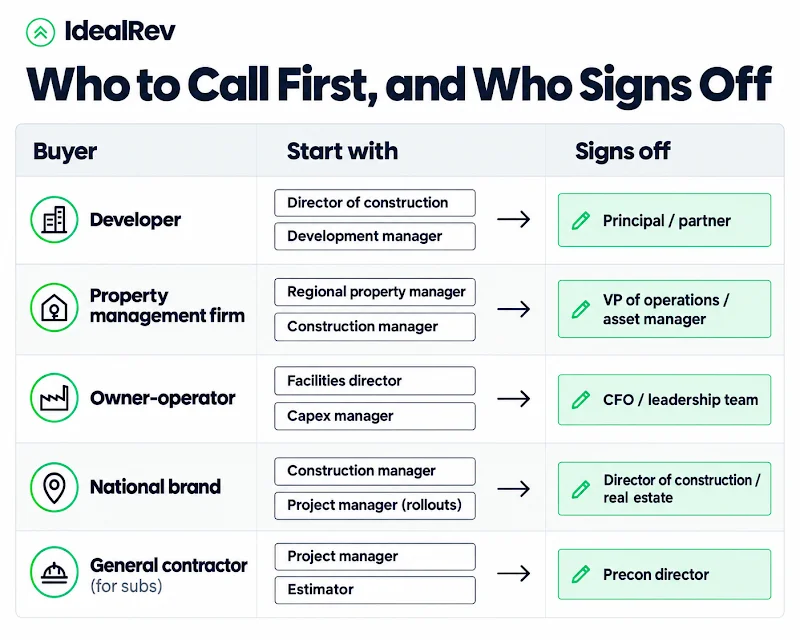
If you reach the wrong person, use it. Ask who handles construction for their properties. Most people will tell you.
Don’t build a pursuit around one contact, either. If your only relationship at a company leaves, so does your pipeline there. Know two or three people at every target account.
Step 3: Find projects before they hit the street
This is where BD earns its keep. Signals that a project is coming:
- Acquisitions. New owners almost always renovate.
- Financing and refinancing news. Capital is lined up, and work follows.
- New leases and tenant announcements. Tenant improvements are on the way.
- Permit filings and zoning applications
- Leadership changes. A new facilities director often brings new vendors.
- Capital improvement plans and budgets for institutional and public owners
- Architects and owner’s reps who keep showing up together. Repeat pairings usually mean more work is coming.
- Phase 2s and sister properties from jobs you’re already on
Your PMs and supers see many of these first. Build a habit of asking them every week what they’re hearing.
Step 4: Write outreach that actually gets answered
Most outreach fails because it reads like outreach: too formal, too long, and all about you. Keep it short and specific:
- Don’t open with your capabilities
- Reference something real about their company, portfolio, or recent news
- Ask about their projects, process, or timing
- Don’t push for a meeting in the first message. Start a conversation. The same approach works on the phone; our construction cold calling guide has examples.
Here’s the kind of first email that gets replies:
Subject: Renovations at [Property Name]
Hi [Name],
Saw [Company] picked up [Property] last month. Congrats.
We’ve done interior renovations on about a dozen occupied multifamily buildings around [City], mostly unit turns and amenity upgrades done while residents stay in place.
Are you planning work there this year, or is it still early?
[Your name] [Company] | [Phone]
It’s about four sentences. There’s no brochure attached, and it asks one easy question. More on how everyone at your company can sell like this.
Step 5: Follow up for months, not days
Most first responses come after several touches. A “not right now” is information about timing, not a no. A workable cadence:
- Weeks 1-3: Initial email, a call, a LinkedIn connection, and a follow-up email
- Month 2: A check-in with something useful, such as a relevant project, a cost trend, or a question
- Every 4-8 weeks after that: Stay in touch until there’s a project or a clear no
Set the reminders in your CRM. Nobody remembers to follow up on their own.
Step 6: Qualify hard with a go/no-go filter
Chasing everything is how BD burns out estimating. Before you commit estimating hours, run every opportunity through the same questions:
- Fit: Is this the type, size, and location we do best?
- Relationship: Do we know the decision-maker, or are we a name on a list?
- Competition: How many others are bidding? More than four or five usually means it’s a price fight.
- Timing: Is it funded and scheduled, or still a wish?
- Capacity: Do we have a PM and super for it when it starts?
- Margin: Can we make our number, or would we be buying the job?
- Client: Do they pay on time and treat contractors fairly?
If you can’t answer “yes” to most of these, pass. Declining politely, with genuine interest in the next one, often earns more respect than a rushed number. Revisit the decision as things change. A go at first contact can become a no once the scope or schedule shifts.
Step 7: Track the pipeline in one place
A CRM is the difference between a pipeline and a memory. It doesn’t need to be fancy. A well-kept spreadsheet beats a CRM nobody updates. If you use HubSpot, our construction CRM setup guide can help. Use clear stages:
- Target: on the list, not contacted
- Contacted: outreach started
- Conversation: they responded, relationship started
- Meeting / site walk: real interest
- Budget / bid: you’re pricing it
- Awarded / lost: record the reason either way
Review it every week with whoever owns BD and pre-con. Fifteen minutes is enough. Our construction sales process guide shows how the stages connect from first contact to award.
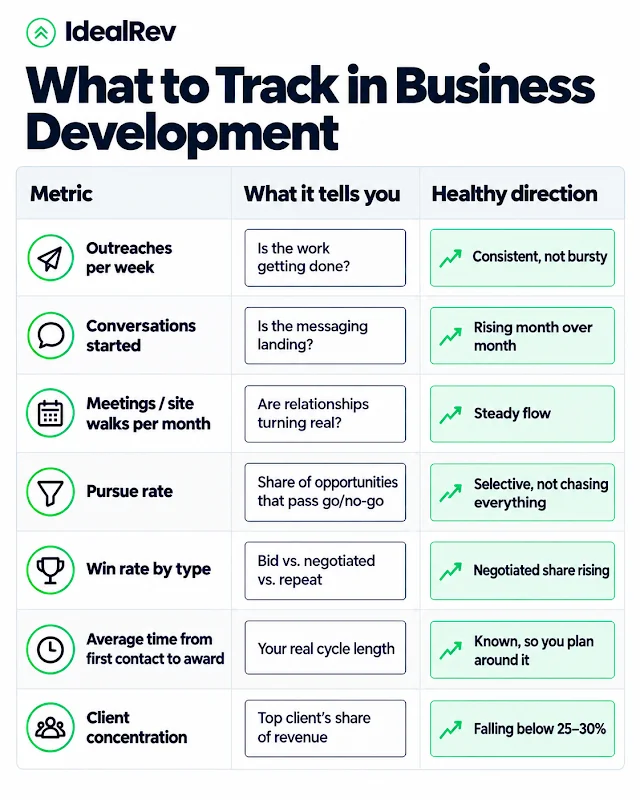
Step 8: Measure what actually predicts revenue
Revenue is a lagging number. By the time it drops, the problem started nine months ago. Track the leading numbers:
Your First 90 Days of Business Development
Whichever path you choose, the first quarter should look roughly like this:
Days 1-30: Set up
- Pick your target (Step 1) and write it down
- Pull your last two years of wins and losses, and calculate your bid-hit ratio
- Build a list of 150-300 target contacts
- Set up a CRM or tracking sheet with the stages above
- Update your website project pages and the owner’s LinkedIn profile
Days 31-60: Start outreach
- Begin consistent weekly outreach
- Contact every past client with a check-in
- Ask PMs and supers what they’re hearing on jobs
- Start the weekly 15-minute pipeline review
Days 61-90: Adjust
- Look at which messages and buyer types respond best, and double down
- Run everything that comes in through go/no-go
- Book site walks and budget conversations
- Decide whether your current path is working or whether you need to add another
Don’t judge the first 90 days on awards. Judge them on conversations and meetings. The awards come in the quarters after.
Mistakes That Kill a Construction BD Effort
- Starting and stopping. Three months of outreach, then silence during a busy season, then starting over from zero. Consistency beats intensity.
- Waiting until backlog is thin. Starting BD in a slow quarter means the work shows up two quarters too late. Start while you’re busy.
- Targeting everyone. “We do all commercial work” means your outreach resonates with no one.
- Leading with capabilities. Nobody cares about your equipment list in the first email.
- Taking bad work out of desperation. A money-losing job to fill a gap makes the next gap worse.
- Not tracking anything. If you can’t say how many conversations you started last month, you don’t have a BD process yet.
- Letting relationships live in one person’s head. When they leave, the relationships leave with them.
FAQ: Business Development for Construction Companies
What is business development in construction?
It’s the work of getting known and trusted by the people who control future projects, such as developers, owners, property managers, and GCs, before those projects go out to bid. It’s different from marketing, which makes you visible, and from estimating, which prices the work.
How do construction companies get more commercial projects?
Pick a clear target, build a list of the specific people who control that work, reach out consistently, follow up for months, and qualify opportunities before you price them. Most contractors who struggle to find work are waiting for invitations to bid instead of starting conversations before the project is public.
How much should a construction company spend on business development?
A common baseline is 10% to 30% of profit on sales and marketing combined. A simpler test: if what you spend brings in more margin than it costs within a reasonable project cycle, it’s working.
How much does a construction business development manager make?
In 2026, averages run from roughly $85,000 to $123,000 in base pay depending on the source, and experienced BD people at large GCs earn well above that. Add benefits, commission, tools, and travel, and year-one cost usually lands between $120,000 and $180,000.
When should I hire my first full-time business development person?
When you have a clear target market, a system for them to run (list, CRM, weekly goals), and someone who will manage them every week. For most commercial contractors that’s somewhere past $15M. Hiring earlier usually means paying a salary for a year while the person figures out what to do.
Can my project managers or estimators do business development?
They can help, and they should. PMs who stay close to clients drive repeat work and hear about new projects early. But BD done in leftover time never happens consistently. Someone has to own it as their main job.
How long before business development starts producing work?
First meetings can happen within weeks. Awarded work usually takes three to twelve months, depending on project size and how early in the owner’s planning you got involved. That’s why starting before you need the work matters.
Is outsourced sales worth it for a small general contractor?
For many firms in the $3M to $15M range, yes. It’s usually the fastest way to start new relationships without a six-figure hire. It isn’t worth it if you can’t take on more work operationally or you don’t know what projects you want.
Should I stop bidding public work and focus on negotiated work?
Not necessarily. Public work can keep crews busy and cash moving, and some of it is very profitable. But hard-bid work is mostly won on price, with lower win rates, and it rarely builds the relationships that lead to negotiated work. Most growing contractors shift the mix gradually instead of switching overnight.
Do I need a CRM for construction business development?
If more than one person is talking to prospects, or you’re following up with more than a few dozen contacts, yes. Without one, follow-ups fall through, and relationships that took months to build go quiet without anyone noticing. Start simple. A CRM that gets used beats a powerful one that doesn’t.
What’s a good bid-hit ratio for a general contractor?
Directionally, hard-bid public work often lands around 10-20% and competitive private work around 15-25%. Negotiated work should be much higher. The more useful move is tracking your own ratio by work type and client, because a single company-wide number hides where you’re wasting estimating hours.
Want more meetings with the developers and owners who build what you build?
IdealRev runs outsourced business development for commercial contractors: target lists, outreach, follow-up, and qualified bid opportunities, run by people who sell construction work every week. Book a growth strategy call →