
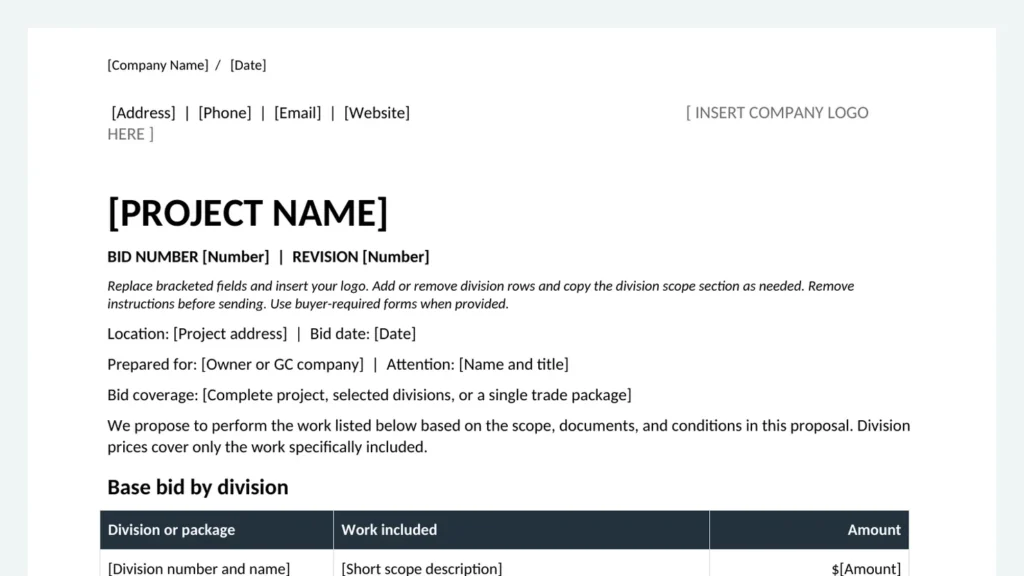
This is a free construction bid template in Word, built for commercial projects. It gives you a base bid broken out by division, a place for alternates and allowances, a scope section for each trade package, and the exclusions, schedule assumptions, and commercial terms a GC or owner needs to evaluate your number.
Download it, replace the bracketed fields, and send it as a full-project proposal or a single trade package. Below the download you will find what each section is for, how to fill it in, and the handful of things that get bids thrown out or argued about after award.
Download the free construction bid template
Word file, three pages, no sign-up. Replace the bracketed fields, add or remove division rows, and delete the instructions before sending.
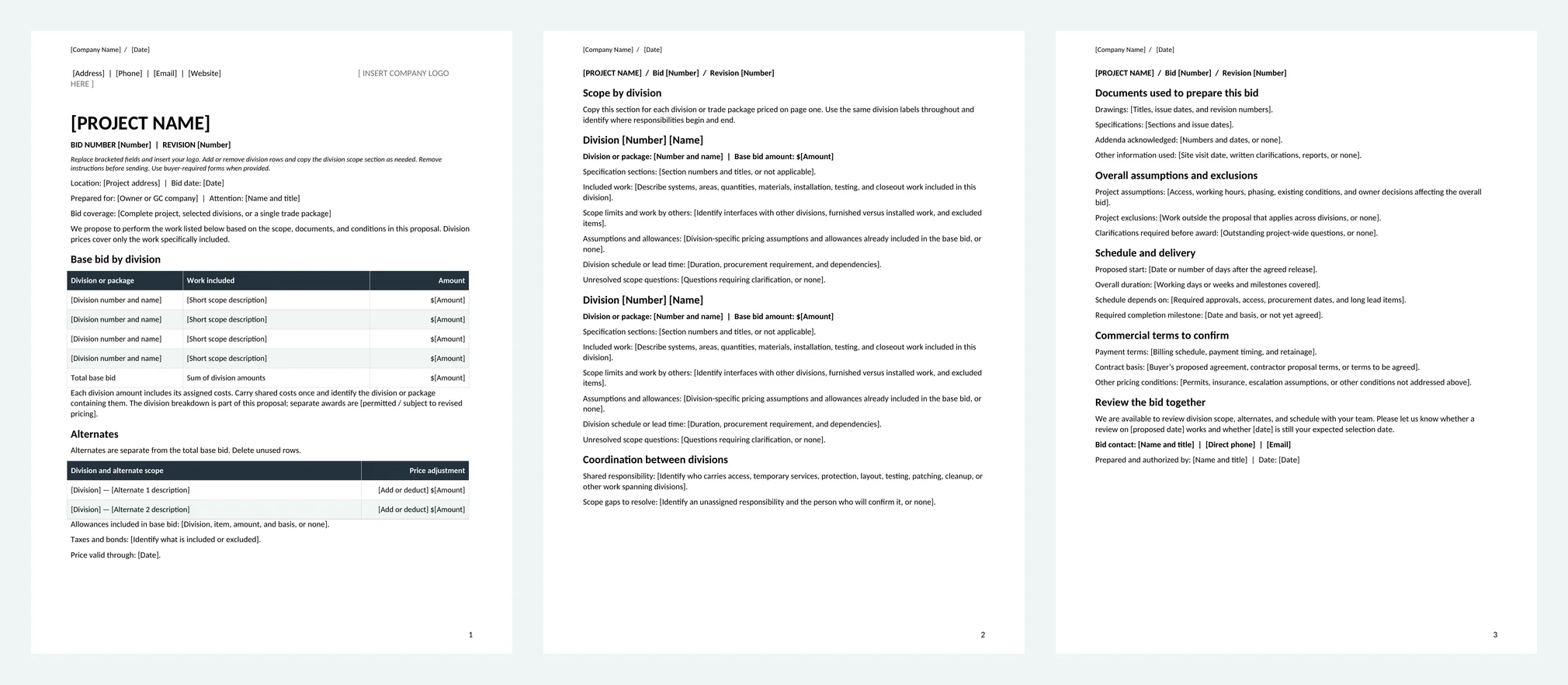
What is in the construction bid template
The template is three pages. Everything a buyer needs to compare your price sits on page one. Everything they need to understand what the price covers sits behind it.
Page 1: Price
- Header block. Company name, contact details, logo, project name, bid number, revision number, bid date, who the bid is prepared for, and whether it covers the complete project, selected divisions, or one trade package.
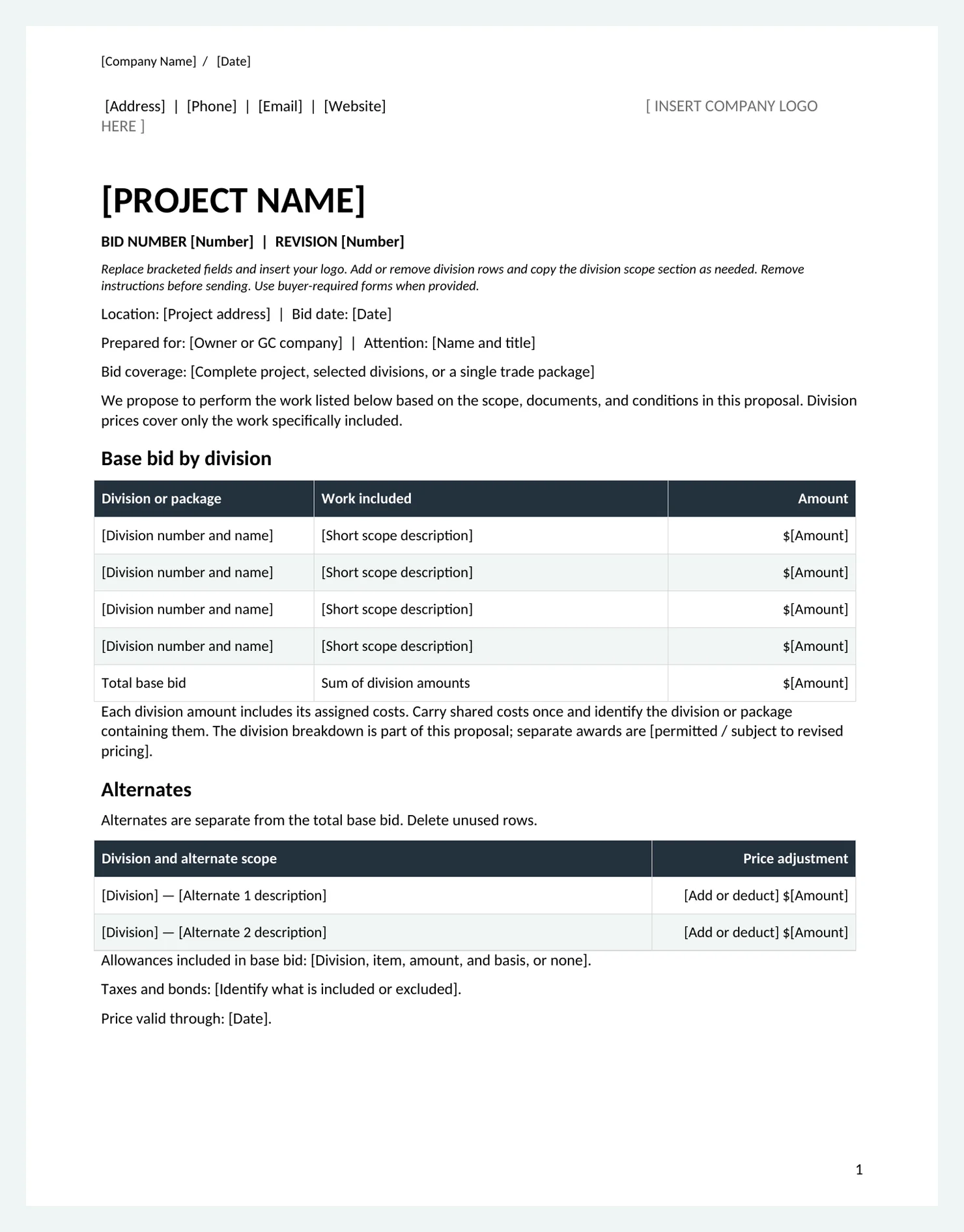
- Base bid by division. A table with one row per CSI division or trade package, a short scope description, and the amount. The total base bid is the sum of the rows, and a note states whether separate awards are permitted or subject to revised pricing.
- Alternates. Each alternate is listed as an add or deduct against the base bid, tied to its division, so the buyer can compare options without recalculating your number.
- Allowances, taxes and bonds, and price validity. Three lines that answer the questions estimators get called about most.
Page 2: Scope by division
- Division block (repeat per package). Specification sections covered, included work, scope limits and work by others, division-specific assumptions and allowances, lead times, and any unresolved scope questions.
- Coordination between divisions. Who carries access, temporary services, protection, layout, testing, patching, and cleanup, plus any scope gap that still needs an owner.
Page 3: Basis of the bid
- Documents used. Drawing titles, issue dates, revision numbers, specification sections, addenda acknowledged, and site visit dates.
- Overall assumptions and exclusions. Project-wide assumptions about access, hours, phasing, and existing conditions, and the exclusions that apply across every division.
- Schedule and delivery. Proposed start, overall duration, what the schedule depends on, and the completion milestone you are committing to.
- Commercial terms to confirm. Payment terms, retainage, contract basis, and pricing conditions such as permits, insurance, and escalation.
- Review the bid together. An offer to walk the buyer through scope, alternates, and schedule before the decision, with a named bid contact.
How to fill out the bid template
Work through it in the order the buyer will read it.
1. Match the coverage line to what was asked for
The “bid coverage” line tells the reader whether they are looking at the whole project or one package. If a GC asked you for Division 9 only, say so there. It keeps your number from being compared against full-scope bids.
2. Price by division, and carry shared costs once
Put general conditions, supervision, and other shared costs in one identified row rather than spreading them across divisions. The template includes a line for this. A buyer who can see where the shared cost sits can award a partial scope without asking you to re-price.
3. Keep alternates separate and specific
An alternate is a change to the base bid with a scope effect and a price effect. Write both. “Add $14,200 to upgrade to the specified rooftop unit, adds 3 weeks to equipment lead time” is an alternate the buyer can use. A lower number for a cheaper system that was never specified is a substitution, and it belongs in a conversation, not in the table.
4. Tie every division scope to the documents
List the specification sections and drawing sheets you priced from. When the GC levels bids, this is what lets them see that your number covers the same scope as the next contractor’s, which is usually the difference between being leveled fairly and being thrown out as incomplete.
5. Write exclusions in plain language
“Excludes temporary power and site fencing” gets read. “Division 01 items by others” gets missed, and then argued about after award. Put exclusions in the division where they apply, and repeat the project-wide ones on page three.
6. State what the schedule depends on
Most schedule disputes trace back to an assumption nobody wrote down: a release date, a permit, site access, or a long-lead delivery. The template has a line for each. Fill them in even when the answer is “none.”
7. Name the bid contact and offer a review
The last section invites the buyer to review the bid with your team before the decision. That conversation is where you learn what matters on the job, correct a leveling mistake, and hear about the next project. It costs nothing and it is the single most skipped step in commercial bidding. Our guide to how to bid on commercial construction jobs covers the pre-bid call and the follow-up in detail.
When to use this template, and when not to
Use it for private commercial work where the GC or owner has not prescribed a bid form: negotiated projects, invitations to bid from a GC you have a relationship with, tenant improvement and build-out work, and subcontractor packages to a GC.
Do not use it as a substitute for a required bid form. Public solicitations, most institutional owners, and many large GCs issue their own forms and instructions. Fill those in exactly as requested. Unrequested exclusions, alternates, or terms can get a public bid rejected on a technicality. You can still attach the scope-by-division pages as a clarification where the instructions allow it.
For subcontractors: the template works as a single-package bid. Set the coverage line to your trade, use one division block, and pay attention to the “scope limits and work by others” line, which is where most sub-to-GC scope gaps live.
Bid template, bid form, and bid proposal: the difference
- A bid form is the buyer’s document. You fill in their blanks and sign.
- A bid proposal is your document. It carries your price, your scope, and your terms, in your format.
- A bid template is the reusable starting point for your proposal, so every bid your company sends is organized the same way and nothing gets left off under deadline pressure.
This download is the third one. Keep a master copy with your company details and standard exclusions filled in, and start each bid from that.
Mistakes this template is built to prevent
- One lump-sum number with no breakdown. It cannot be leveled, so it gets guessed at or set aside.
- Scope that does not reference the drawings or addenda. The buyer cannot tell which set you priced.
- Alternates mixed into the base bid. The buyer cannot compare you to anyone.
- Exclusions buried in a paragraph. They surface as change orders.
- No price validity date. Material escalation becomes your problem.
- No named contact. The estimator with a question calls the contractor who answered first.
Winning the bid is a sales job too
A clean proposal gets you leveled fairly. The pre-bid call, the scope review, and the follow-up are what get you picked. IdealRev runs that business development work for commercial contractors so your estimators can stay on the number.
What to do after you send the bid
A proposal that is sent and never followed up is a number in a stack. Within two days, confirm it was received and ask whether any scope item needs clarification. Before the award date, ask where the decision stands and offer the review the template already promises. If you lose, ask for a five-minute debrief and record where your number landed.
That rhythm, and the rest of the lead-to-award process, is laid out in our commercial construction sales process guide. If you are still looking for projects to bid, start with the best commercial construction bid sites and our guide to getting commercial construction leads without buying lists.
Construction bid template FAQ
What should a construction bid template include?
At minimum: project and contact details, a base price with the breakdown the buyer asked for, alternates listed separately, the scope of work tied to drawings and addenda, exclusions and allowances, schedule assumptions, price validity, and a named contact. This template covers all of those across three pages.
Is this bid template in Word or Excel?
Word (.docx), with a PDF version for reference. The pricing tables are editable in Word. If your estimate lives in Excel, keep it there and carry the division totals into the Word proposal, which is what the buyer reads.
Can subcontractors use this template?
Yes. Set the bid coverage line to your trade package, use a single division block on page two, and fill in the scope limits and work by others line carefully. That is where most sub-to-GC scope gaps come from.
Is this template for residential construction?
It is built for commercial work: division-based pricing, alternates, specification references, and the coordination and commercial terms a GC or owner expects. A residential remodel proposal usually needs a simpler format.
Should I send this instead of the buyer’s bid form?
No. If a bid form or instructions were issued, use them exactly. This template is for private proposals where you control the format, or as an attachment where the instructions allow clarifications.
How do I send the finished bid?
Export to PDF so the formatting holds, name the file with your company, the project, and the bid number, and send it to the named recipient with a two-line email that states the total, the coverage, and your offer to review the scope together.
Get the template
Free Word download. Keep a master copy with your company details filled in and start every bid from it.
Want more invitations worth pricing?
If your team is bidding whatever shows up and losing on price, the fix is usually upstream: better projects, earlier conversations, and follow-up that actually happens. Tell us what work you want more of and we will walk through how to get it.