
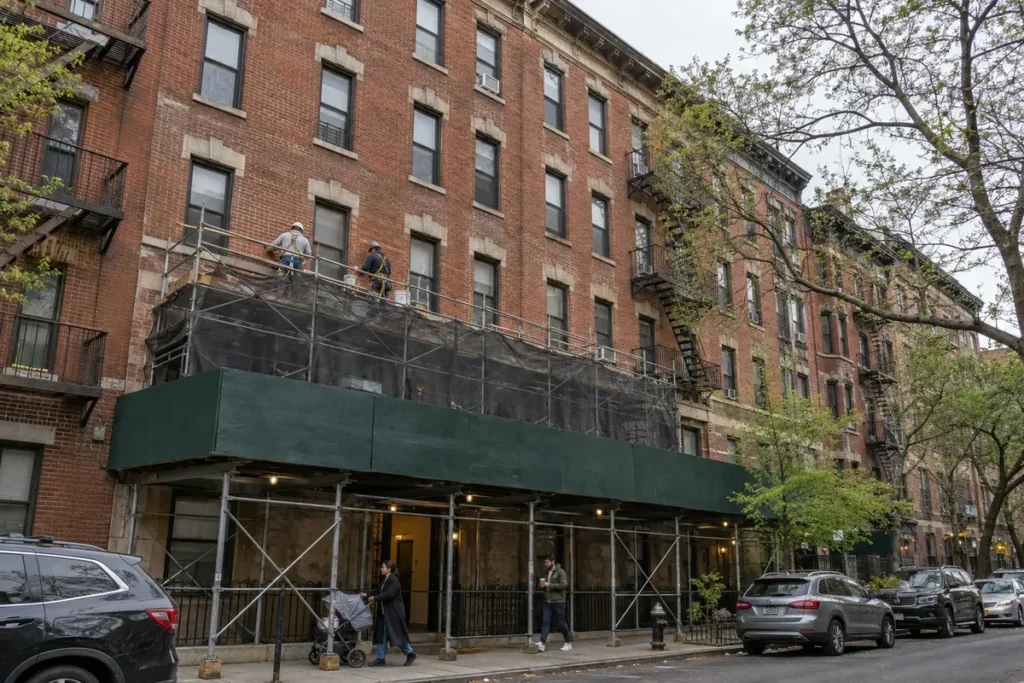
If your building’s block number ends in 4, 5, 6, or 9, your Cycle 10 facade report is due to the Department of Buildings by February 21, 2027. If your engineer finds Unsafe conditions, a sidewalk shed goes up and the clock starts on repairs.
That’s when most boards and owners go looking for a Local Law 11 contractor, usually in a hurry, usually off a Google search full of contractors recommending themselves.
This list is different. Below are 15 NYC contractors that do Local Law 11 and FISP repair work, sorted by the type of building they fit best. After the list: what the work costs in 2026, how the 2025 shed laws changed the timeline, and how to level bids so the low number stays low.
Planning Local Law 11 repairs?
Tell us about your building and scope and we’ll connect you with the vetted NYC contractor best qualified for it. No cost to you.
Local Law 11 in 60 seconds
Local Law 11, now run by DOB as the Facade Inspection & Safety Program (FISP), requires every NYC building taller than six stories to have its exterior walls inspected every five years.
- Who inspects: a Qualified Exterior Wall Inspector (QEWI). That’s a NY-licensed Professional Engineer or Registered Architect approved by DOB. Not the contractor.
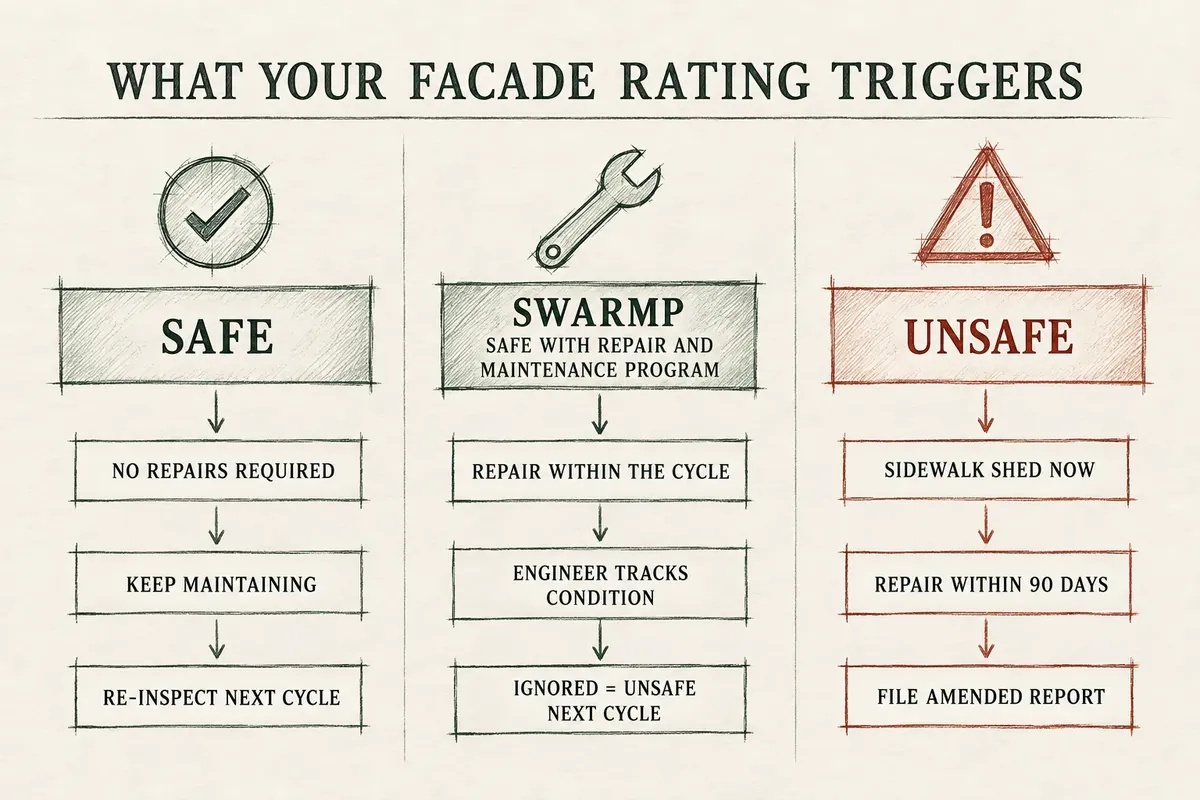
- What they file: a report rating the facade Safe, SWARMP (Safe With a Repair and Maintenance Program, meaning fix it within the cycle), or Unsafe (hazardous, protect the public now and repair).
- Unsafe means: a sidewalk shed immediately, repairs within 90 days of filing (extensions are available), then an amended report once corrected.
- SWARMP you ignore gets reclassified as Unsafe at the next cycle.
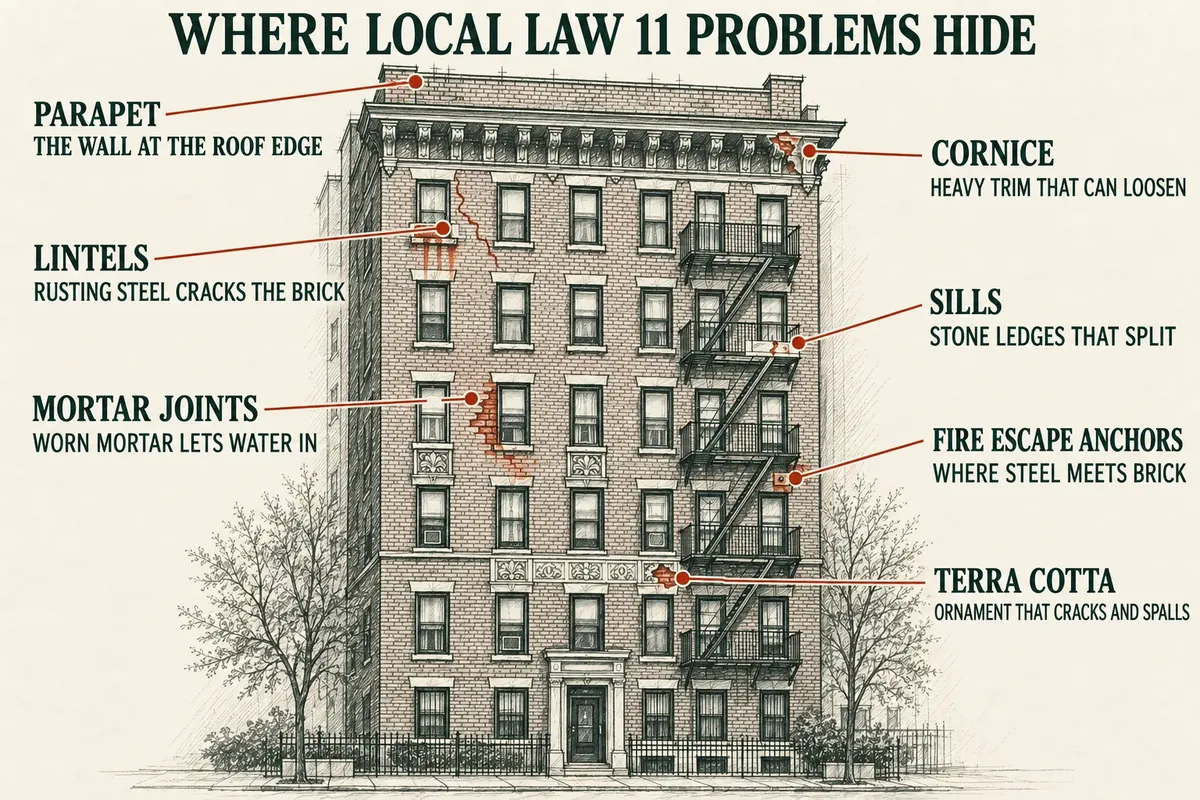
Here’s where the engineer is looking on a typical pre-war building, and where most repair budgets end up going:
Cycle 10 filing windows (by the last digit of your block number):
| Sub-cycle | Block ends in | Filing window |
|---|---|---|
| 10A | 4, 5, 6, 9 | Feb 21, 2025 to Feb 21, 2027 |
| 10B | 0, 7, 8 | Feb 21, 2026 to Feb 21, 2028 |
| 10C | 1, 2, 3 | Feb 21, 2027 to Feb 21, 2029 |
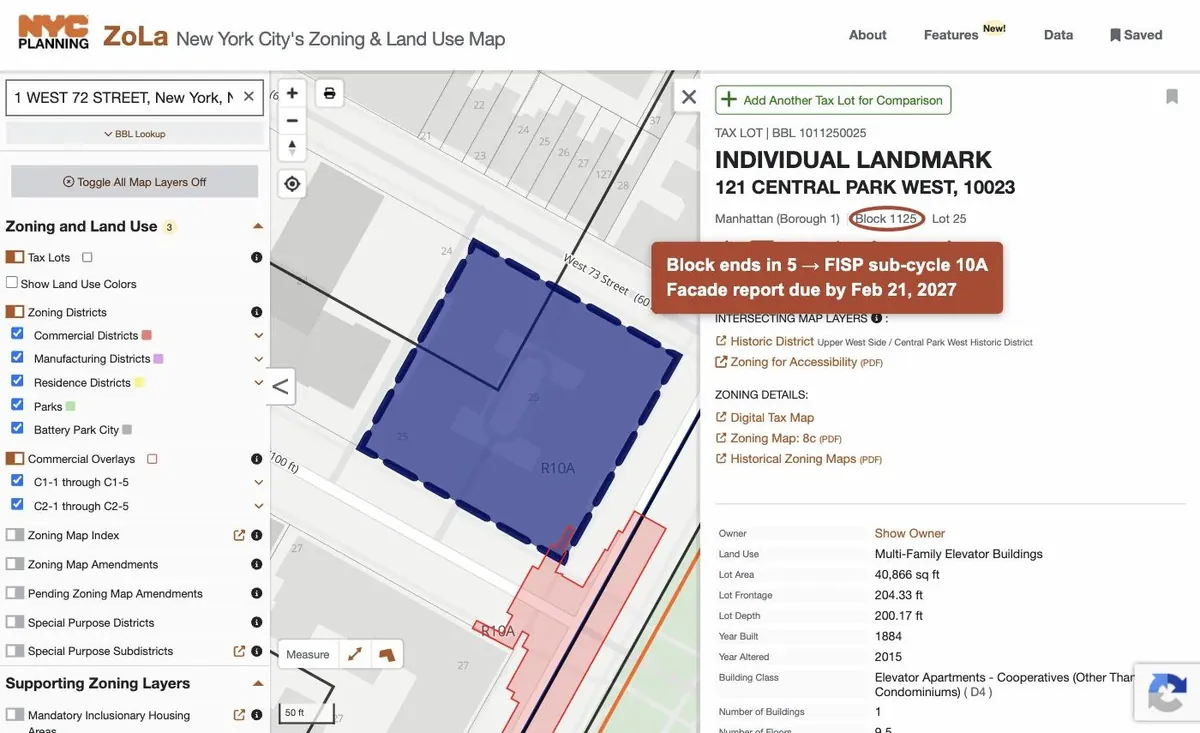
Don’t know your block number? Search your address on the city’s free ZoLa map. The block number shows right under the address. The Dakota at 1 West 72nd Street, for example, is Block 1125, so it files in sub-cycle 10A.
Penalties: $1,000 per month for late filing, $5,000 a year for failure to file, $2,000 for failing to correct SWARMP conditions, and $1,000 a month plus $10 per linear foot of affected facade (or $1,000 per balcony) for leaving Unsafe conditions uncorrected.
How we built this list
We started with the contractors NYC owners and engineers actually put on bid lists: members of the Building Restoration Contractors Association, firms with landmark and preservation awards, and firms with named NYC projects. Then we cut anyone we couldn’t verify: firms with no project history, conflicting claims about how long they’ve been in business, or a website and nothing behind it.
Every firm below was active as of September 2026. Project names come from each firm’s published work. This is not a ranking. A contractor that’s perfect for a 1920s limestone co-op on Park Avenue can be the wrong call for a 12-story brick rental in the Bronx. So the list is grouped by fit.
At a glance
| # | Contractor | Base | Best fit |
|---|---|---|---|
| 1 | Dualcore Construction Management | Manhattan | Occupied multifamily, facade plus capital work |
| 2 | Skyline Restoration | Long Island City | Occupied co-ops and condos |
| 3 | The Grenadier Corporation | Bronx | Large residential, hospitals, institutions |
| 4 | Liberty Construction & Restoration | Brooklyn | Mid-size co-ops and multifamily |
| 5 | Nicholson & Galloway | Glen Head, NY | Landmark and institutional masonry |
| 6 | West New York Restoration | Bronx | High-end pre-war co-ops, churches |
| 7 | Nova Construction Services | Brooklyn | Landmark and pre-war residential |
| 8 | Graciano Corporation | Astoria (NY office) | Historic stone and masonry |
| 9 | Lo Sardo General Contractors | Brooklyn | Schools, hospitals, terra cotta |
| 10 | AM&G Waterproofing | Brooklyn | High-rises, terra cotta, garages |
| 11 | Pullman SST | Manhattan (NY office) | High-rise concrete and structural |
| 12 | Malatesta Paladino | Lynbrook, NY | Facade, sidewalks, vaults, garages |
| 13 | MGR Restoration | Woodside, Queens | Brownstone, limestone, terra cotta |
| 14 | AARCO Contracting | Manhattan | Brownstones, cornices, limestone |
| 15 | Adam’s European Contracting | Brooklyn | Public agency and school exteriors |
Occupied multifamily and co-op buildings
Occupied co-ops, condos, and rental buildings are a logistics problem as much as a masonry problem. Residents complain, windows get blocked, and every week of shed is a week of rent. Plenty of these buildings also need more than facade work in the same cycle, so it pays to hire a team that can run the whole building.
1. Dualcore Construction Management
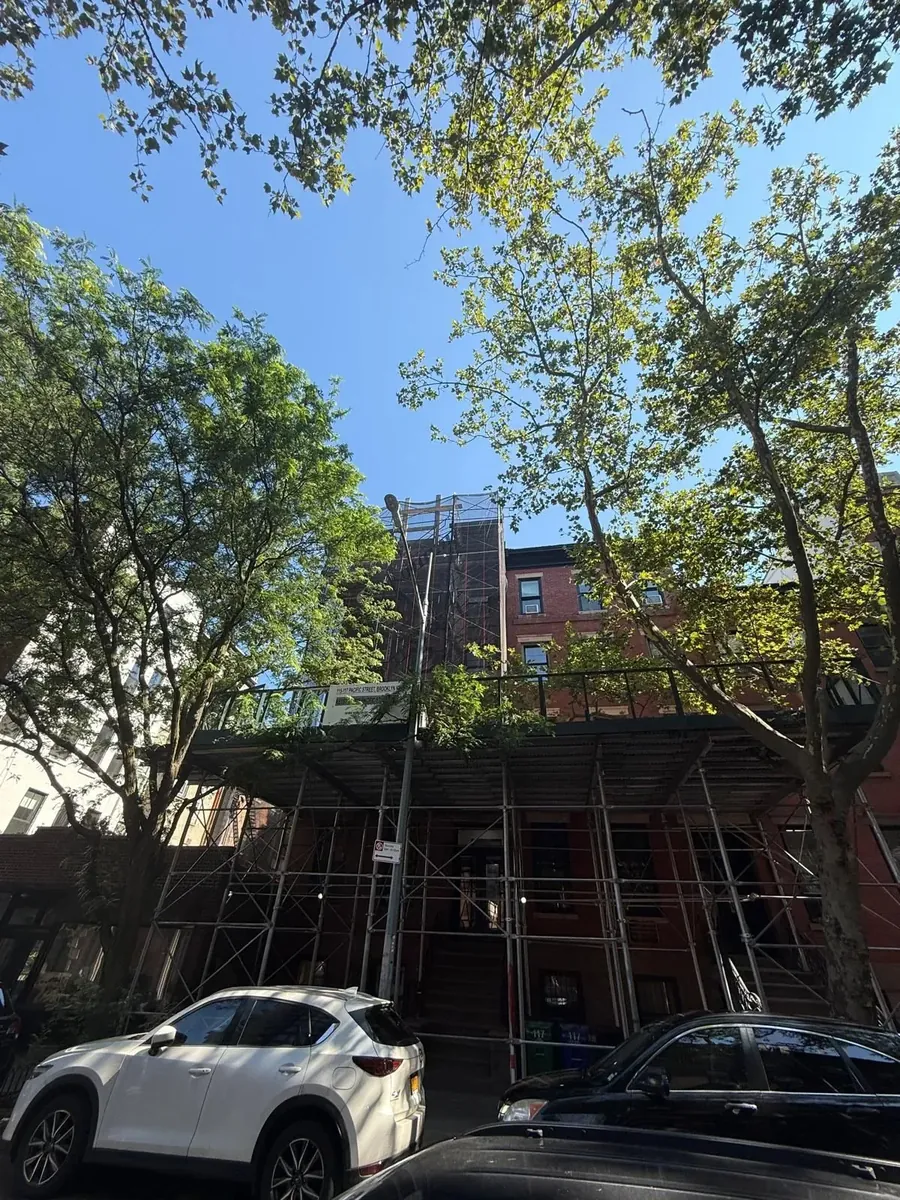
Dualcore completed Local Law 11 facade restoration at 668 President Street in Park Slope: full pipe scaffold and sidewalk protection, localized rebuilding of deteriorated brick and stone, window lintel reinforcement, and repointing and waterproofing to meet FISP standards.
Manhattan-based GC and CM led by principal Conor Moran, with licenses in New York City and Jersey City. Dualcore’s work centers on multifamily and mixed-use buildings: full-building renovations, facade restoration for Local Law compliance, MEP modernization, boiler and HVAC upgrades, and occupied rehabs. Moran holds NYC DOB Licensed Construction Superintendent and Site Safety Manager licenses and previously ran a 48-story ground-up hotel in Midtown as senior PM.
The difference for an owner: one team that runs the facade scope, the building systems work, and the tenant logistics together, tracked in Procore with Matterport scans and Docutrax for insurance compliance. Other recent work: a 26-unit repositioning at 156 2nd Avenue (gut renovations, electrical service upgrade, gas-to-electric conversion, new roof), a boiler plant rebuild serving three connected buildings at 129 2nd Avenue, a sidewalk vault reconstruction at 36 St Marks Place, and a five-story vertical enlargement at 303 East 111th Street.
Best fit: owners and asset managers who are fixing the facade and repositioning or upgrading the building at the same time.
Website: dualcorecm.com
2. Skyline Restoration
Long Island City. Around 200 field workers and 50 office staff covering facade, roofing, waterproofing, concrete, parking structures, and rope access. Member of BOMA NY, ICRI, and the New York Landmarks Conservancy.
Best fit: occupied co-ops and condos, plus commercial and institutional buildings.
Website: skylinerestoration.com
3. The Grenadier Corporation
Bronx. Masonry restoration, waterproofing, and concrete. Clients include Columbia University Medical Center, Memorial Sloan Kettering, NewYork-Presbyterian, and Bloomingdale’s.
Best fit: large residential, hospital, and institutional buildings where the owner has a facilities team and a high bar.
Website: grenadiercorp.com
4. Liberty Construction & Restoration
Brooklyn, on Coney Island Avenue. Focused on co-ops, condos, and multifamily Local Law 11 and Local Law 126 work, with 24/7 emergency response.
Best fit: mid-size co-ops and rental buildings that want one company for shed, scaffold, and repair.
Website: libertyconstructioncorp.com
Landmark and pre-war specialists
If your building is in a historic district or is an individual landmark, your repairs also need Landmarks Preservation Commission approval, and the wrong contractor will lose you months there. These firms do this work every day.
5. Nicholson & Galloway
Based in Glen Head on Long Island, with around 175 field craftsmen and office staff, working as either GC or sub on jobs from a few thousand dollars up to $60M. Their project list reads like a tour of the city’s institutions: the American Museum of Natural History, the Metropolitan Museum of Art, The Peninsula Hotel, and the Brooklyn Public Library.
Best fit: landmark and institutional buildings with ornamental masonry, domes, or complex roofing and sheet metal.
Website: nicholsonandgalloway.com
6. West New York Restoration
Bronx-based, with roughly 200 employees covering masonry, waterproofing, roofing, and emergency repairs. This is one of the names you’ll see on Fifth Avenue and Park Avenue co-op bid lists. Published work includes 825 Fifth Ave, 850 Park Ave, 720 Park Ave, Grace Church, and the Metropolitan Club.
Best fit: high-end pre-war co-ops, churches, and clubs with cornices, slate, copper, and tile.
Website: wnyrct.com
7. Nova Construction Services
Greenpoint, Brooklyn. Nova’s portfolio is heavy on buildings people stop to look at: The Dakota, The Dorilton, the Bayard-Condict Building, and 34 Gramercy Park East. They won a 2025 Lucy G. Moses Preservation Award from the New York Landmarks Conservancy for work on the General Society of Mechanics & Tradesmen building on West 44th Street.
Best fit: landmark and pre-war residential buildings with stone and architectural metal.
Website: novaconstructionservices.com
8. Graciano Corporation
Pittsburgh-based, with a New York office in Astoria. Fourth-generation masons in some cases, working to Department of the Interior preservation standards. NYC work includes St. Bartholomew’s Church, the Naumburg Bandshell in Central Park, Columbia University, and the Oyster Bar at Grand Central.
Best fit: historic stone and masonry where preservation standards drive the spec.
Website: graciano.com
9. Lo Sardo General Contractors
Brooklyn. More than 100 schools and hospitals in its portfolio, plus Lucy G. Moses awards for George Westinghouse High School (2019) and the Sun Building at 280 Broadway (2020).
Best fit: public, institutional, and terra cotta or cast iron facades.
Website: losardo.net
High-rise, concrete, and waterproofing
Taller buildings and concrete frames bring different failure modes: spalling concrete, corroded embeds, and water that has been getting behind the facade for decades.
10. AM&G Waterproofing
Brooklyn. Despite the name, AM&G does full masonry, stone, steel, and sheet metal, plus investigation and probes. Their 7 Gouverneur Slip East job involved replacing about 2,500 terra cotta units.
Best fit: high-rises and landmarks where water intrusion is the root cause of the facade damage.
Website: amgwaterproofing.com
11. Pullman SST
Part of Structural Group, with a New York office on West 38th Street. Pullman brings national-firm engineering depth to concrete repair and structural strengthening. NYC work includes masonry restoration on the Brooklyn Bridge, the Waldorf Astoria, and the 50 Rockefeller Plaza facade.
Best fit: high-rise commercial and concrete-frame buildings with structural repair scope.
Website: pullman-services.com
Small and mid-size buildings, brownstones, and specialty scope
12. Malatesta Paladino
Lynbrook, NY, serving the five boroughs. Masonry and concrete contractor covering Local Law 11 facades, sidewalks and vaults, Local Law 126 garage work, waterproofing, and structural steel. Client list includes Carnegie Hall, the New York Public Library, and NYU Langone.
Best fit: buildings with facade, sidewalk, and garage compliance happening at once.
Website: malatestapaladino.com
13. MGR Restoration
Woodside, Queens. Brownstone, limestone, and terra cotta repair, plus sidewalks, vaults, and garages. Published work includes 350 Henry Street in Brooklyn and Maimonides Medical Center.
Best fit: brownstone and limestone facades on smaller walk-ups and mid-rise buildings.
Website: nyrestoration.com
14. AARCO Contracting
Manhattan. Brownstones, landmarks, limestone, and cornices, with published FISP repair projects at 71 Fifth Avenue and 20 East 17th Street.
Best fit: Flatiron, Chelsea, and Village loft and brownstone buildings with cornice and limestone scope.
Website: aarcocontracting.com
15. Adam’s European Contracting
Brooklyn. A woman-owned business focused on exterior renovation for NYC public agencies, including school work.
Best fit: public and institutional owners, and projects with M/WBE participation goals.
Website: adamseuro.com
Not sure which of these fits your building?
Tell us what your engineer found and we’ll connect you with the vetted NYC contractor best qualified for it. No cost to you.
What Local Law 11 repairs cost in 2026
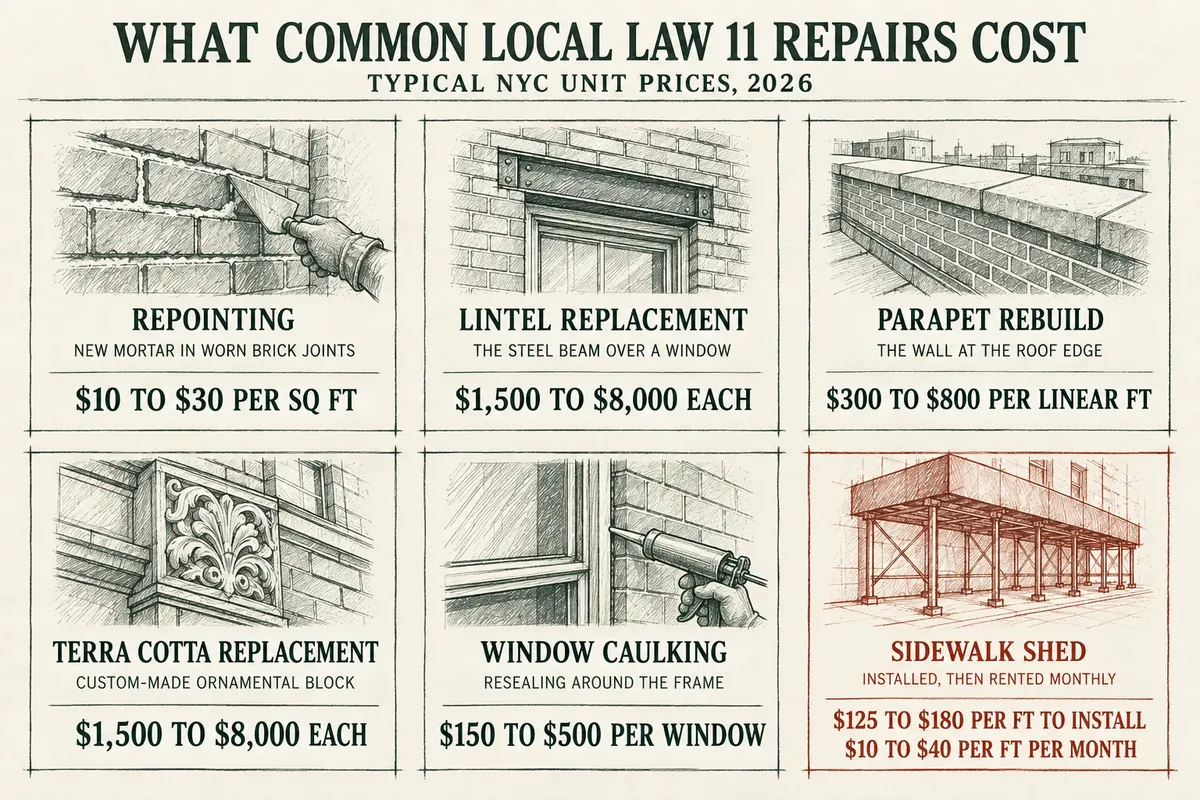
Your engineer’s report won’t say “moderate repairs.” It will list items: so many square feet of repointing, so many lintels, so many feet of parapet. Price it the same way. These are typical NYC unit prices published by restoration contractors, not quotes.
| Repair | What it is | Typical NYC price |
|---|---|---|
| Repointing | New mortar in worn brick joints | $10 to $30 per sq ft |
| Lintel replacement | The steel beam over a window | $1,500 to $8,000 each |
| Parapet rebuild | The wall along the roof edge | $300 to $800 per linear ft |
| Terra cotta replacement | Custom-made ornamental block | $1,500 to $8,000 each |
| Window caulking | Resealing around the frame | $150 to $500 per window |
| Sidewalk shed | Installed, then rented monthly | $125 to $180 per ft installed, then roughly $10 to $40 per ft per month |
| DOB filing fee | Initial or amended FISP report | $425 |
What whole projects cost. Multiply those unit prices across a building and the totals climb fast. Habitat Magazine has reported on a New York co-op whose facade project went from $850,000 one cycle to $1.2 million or more the next, with soft costs (sheds, special inspections, permits) making up about half. Engineers’ inspection fees on that kind of building have climbed too, to $30,000 to $50,000 from $9,000 to $12,000 a few cycles back.
The number that blows up budgets is what’s behind the brick. An Upper East Side condo budgeted $550,000 for its FISP repairs. Once the facade was opened, the contractor found the building had been built without enough brick ties, the metal anchors that hold the outer brick to the wall behind it. The final bill was $1.1 million and the shed stayed up for three years. Nobody can price that from the sidewalk, which is why your contingency and your unit prices matter more than the base bid.
The shed is cheap, which is the problem. A shed’s yearly rent is small next to the repair bill, so plenty of owners have left one up for years instead of doing the work. That’s exactly what the 2025 laws below are built to end.
The 2025 shed laws changed the timeline
In 2025 the City Council passed a package of “Get Sheds Down” laws. The ones that matter for your contractor choice:
- Local Law 48 of 2025: shed permits now run 90 days instead of a year, and renewals get harder. Starting with the second renewal, a registered design professional has to report on work progress. Sheds that stay up long enough get charged per linear foot per month, escalating with age.
- Local Law 51 of 2025: once a shed permit is issued, you have 5 months to file construction documents, 8 months to file an acceptable work permit application, and 2 years to finish repairs. Miss those without an approved extension and fines run $5,000 to $20,000.
- Local Law 49 of 2025: directs DOB to move from a 5-year cycle toward a 6-to-12-year cycle and pushes a new building’s first inspection from year 5 to year 8. Check DOB’s current rule before you assume your building qualifies for a longer cycle.
What this means in practice: the old habit of putting up a shed and “getting to it next year” is now expensive. Your contractor selection has to happen inside that 5-month window, and a contractor who’s slow to mobilize can put you in violation. Ask every bidder for a start date, not just a price.
How to pick a Local Law 11 contractor (and level the bids)
1. Keep the engineer and the contractor separate
The QEWI inspects, writes the scope, and signs off the repairs. The contractor does the work. When the same company does both, nobody independent is checking whether the “Unsafe” findings were real or the repairs were done right. Some contractors market “FISP inspections.” Only a licensed PE or RA can file the report.
2. Make every bidder price the same scope and the same unit prices
Facade scope is never fully known until the scaffold is up and the brick is open. That’s why the unit price schedule matters more than the base bid. A contractor can come in low on the base and win it back at $150 a square foot for brick replacement once quantities grow. Have your engineer build a bid form with unit prices for:
- Brick replacement (per sq ft)
- Repointing (per sq ft)
- Lintel replacement (per unit, by length)
- Terra cotta or stone patching and replacement (per unit or sq ft)
- Probes and investigative openings (per each)
- Shed and scaffold extension (per linear foot per month)
Then compare total cost at the engineer’s estimated quantities, and again at 1.5x those quantities. The ranking often flips.
3. Get the shed and scaffold terms in writing
The shed is the one line item that keeps billing whether work is happening or not. Make every bid state who erects the shed and scaffold, the install date, the monthly rate, and what happens to that rate if the job runs long. A cheap bid with an open-ended shed is not a cheap bid.
4. Plan around the weather
Mortar and masonry work slows down or stops when temperatures drop below about 40°F without heat and enclosure. A contract signed in October often means the real work starts in March, while the shed rents all winter. Either sign in late summer or budget for winter protection.
5. Check the paper
Confirm the contractor’s insurance names your building and managing agent, that they carry the right DOB registrations for the work (and scaffold and rigging licenses for whoever is erecting the scaffold), and that they have LPC experience if you’re in a historic district. Ask for three references from buildings your size, in your borough, from the last two cycles.
6. Know when you need a GC instead of a specialist
If the facade is the only job, hire a facade contractor directly. If the facade is one of four things happening in the building this year, a GC or CM who runs the whole program will usually save more in coordination and schedule than it costs in fee.
Questions to ask on the walkthrough
- What’s your earliest realistic start date, and who’s the superintendent?
- Who erects the shed and scaffold, and what’s the monthly rate if the job runs long?
- What were your quantity overruns on your last three Local Law 11 jobs, and why?
- How do you handle resident complaints and window access in occupied buildings?
- Who files the TR6 and amended report paperwork with the engineer, and how fast?
- How many Local Law 11 jobs will you be running at the same time as ours?
Red flags
- A contractor offering to do the inspection and the repairs
- A lump sum with no unit price schedule
- No named superintendent
- Pressure to sign before the engineer’s scope and bid form are done
- References only from buildings very different from yours
More contractor lists: Top 20 Commercial General Contractors in Boston | Top 20 Healthcare Construction Companies | Top 20 Restaurant Construction Companies
Local Law 11 FAQ
Who can do a Local Law 11 inspection?
Only a Qualified Exterior Wall Inspector (QEWI): a NY-licensed Professional Engineer or Registered Architect approved by DOB. Contractors do the repairs, not the inspection.
Does Local Law 11 apply to a six-story building?
No. It applies to buildings taller than six stories, which means seven or more.
How long do Local Law 11 repairs take?
Minor repointing on a mid-size building can wrap in a few weeks. Moderate lintel and brick replacement usually runs 3 to 6 months. Major restoration on a large or landmark building can run a year or more, which is why the 2025 shed deadlines matter.
What happens if I miss my FISP filing deadline?
DOB charges $1,000 a month for late filing and $5,000 a year for failing to file. Uncorrected Unsafe conditions add $1,000 a month plus $10 per linear foot of affected facade.
How much does Local Law 11 cost?
It depends on what the engineer finds. Unit prices run about $10 to $30 per sq ft for repointing, $1,500 to $8,000 per lintel, and $300 to $800 per linear foot of parapet, plus the sidewalk shed. Full projects on larger co-ops and condos regularly run $500,000 to over $1 million.
Are you a NYC facade or restoration contractor?
IdealRev’s Build Partners Network connects vetted contractors with owners and developers planning real projects. Applying is free. We vet every firm before anything goes live.