

By Kyle Ferguson, IdealRev, with Robert Puharich, IsleFlow
You already know the cheapest number does not always win. You have watched a competitor take a job at a price you could not touch, and you have probably watched a GC hand a $4 million package to a sub they had never used because the owner’s rep knew the guy. In both cases the decision got made somewhere other than the bid tab.
So how does a contractor get to be the one they already trust? Where does that reputation get built when you are not in the room? Does content marketing actually work in construction, or is it something agencies sell you? What do you post, write, or publish, and does any of it reach the people who award work? And how long before any of it turns into a phone call?
This post covers how trust factors into a commercial award, how content builds it, the channels that actually work in this industry (LinkedIn, your website, events, podcasts, and publishing a book, among others), and a step-by-step way to start that fits how you already communicate. Robert Puharich of IsleFlow, who publishes books for construction owners, wrote the book section.
Want this run for you?
IdealRev handles LinkedIn, website, and content for commercial GCs and subs, tied to a real business development pipeline, not vanity metrics.
Why the contractor they trust beats the contractor who’s cheapest
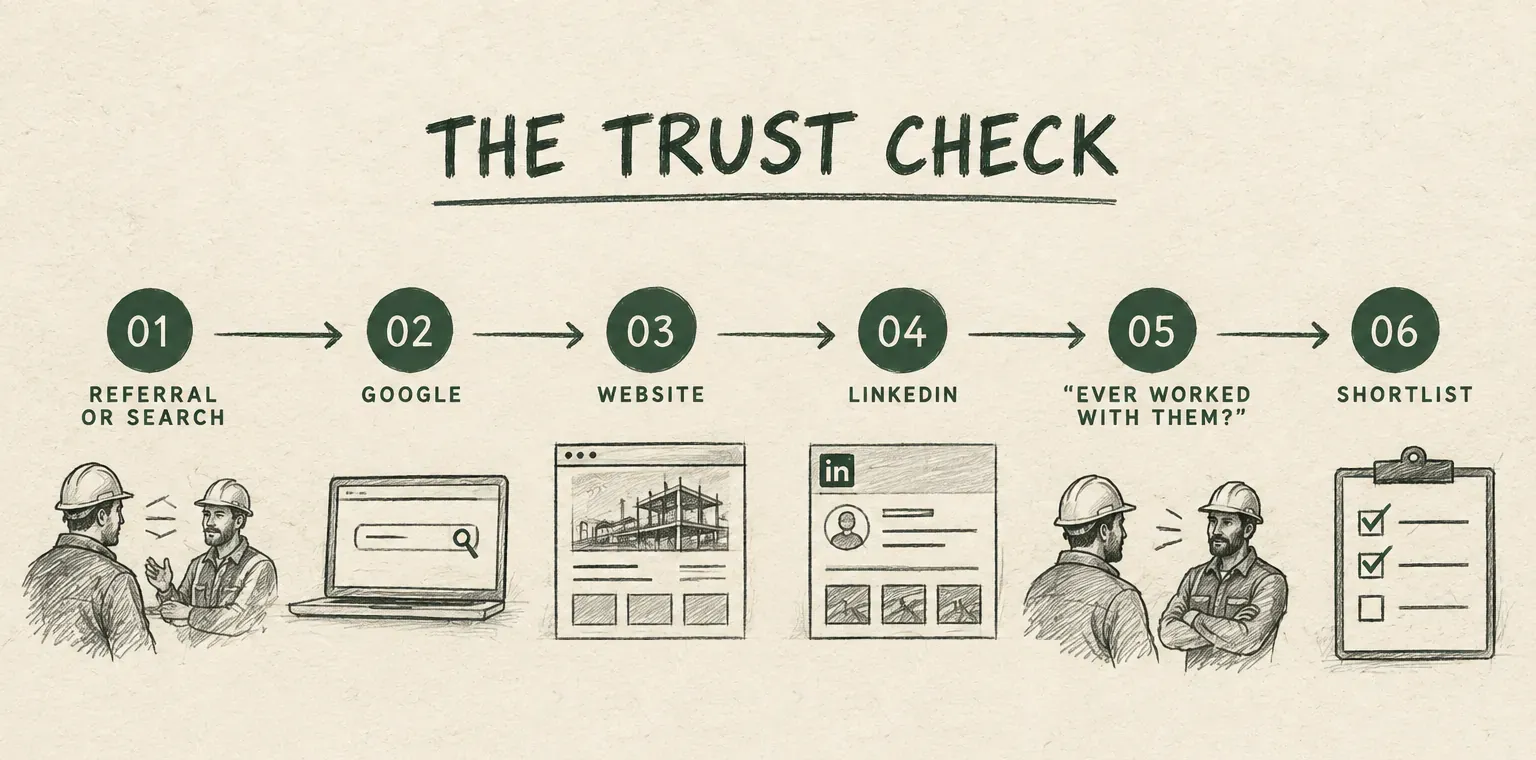
On negotiated work, the trust check happens before you even know the project exists. On hard bid, it happens between the bid opening and the award. Either way, somebody at the GC, the owner, or the owner’s rep does a version of the same thing: Googles your company name, opens the website and looks for projects like theirs and for a real person, checks the owner or BD lead on LinkedIn, and asks one or two people “you ever worked with these guys?”
And a referral does not get you out of that check. It starts it. The owner’s rep who gets your name from a friend still opens LinkedIn and your website before he adds you to the list, and what he finds there either backs up the referral or makes him wonder. Five projects like his and a person who clearly knows the work, and the referral closes. A drone shot and a services list, and he moves on to the next name.
The same thing is now happening inside AI search. When a developer asks ChatGPT “who does ground-up QSR in Dallas,” or gets a Google AI Overview, the answer gets pulled together from whoever has published enough specific, credible material to be worth citing. Named people, real projects, direct answers to the questions buyers ask. Rob wrote a good piece on this, AI Search Optimization for Construction, and it is worth ten minutes.
Here is what that looks like in dollars. A GC that gets invited to negotiate a $6 million TI instead of bidding it against five others is not competing on fee alone anymore. On our client accounts, the deals that close fastest are the ones where the prospect had already read the owner’s posts or a project page before the first call, because they show up with the “who are you” question already answered and we spend the call on scope.
How content builds trust and authority
Content marketing in construction does the same things that win you work in a good first meeting, except it does them in advance, for a lot more people than you could ever sit down with.
It educates the buyer into the sale. A developer doing his first medical office buildout does not know what he does not know. If you have explained, in plain language, why the mechanical scope drives the schedule and what a realistic timeline looks like, you have already done half the work of the first meeting. By the time he calls, he is calling to confirm you are the guy, not to shop.
It handles objections before they come up. Every contractor hears the same handful: you are too small, you have never done this type of project, your number is high, you will be a pain to work with, you might not be around in five years. A post about how you staffed a project that was bigger than anything you had done before takes one of those off the table. A project page with three jobs in the buyer’s sector takes another. A case study with a client quote about how you handled change orders takes a third. He walks into the meeting with fewer reasons to say no.
It shows you are an expert and not just a vendor. Anyone can say “quality and safety are our priorities.” Explaining what your QA/QC walkthrough actually looks like on a Friday afternoon before a Monday inspection is a different thing, and it is the thing an owner’s rep remembers.
It positions you. Publish about hospital work for two years and you become the hospital guy in your market, whether or not you set out to. Pick the work you want more of and talk about that, repeatedly, in public.
It keeps you in front of people between projects. A lot of lost work is not lost to a competitor, it is lost because the GC you did a great job for in 2023 has a new precon manager who has never heard of you. Content keeps your name in that building after you have left it.
It gives your referrals something to point at. When a client recommends you, the other person’s first move is to look you up. Content is what he finds when he does.
A filter for what to publish: would a GC’s precon manager, a developer’s construction lead, or an owner’s rep learn something from it that helps on their next project? If yes, publish it. If it only impresses other contractors, it can wait.
Where trust actually gets built, and why content matters anyway
Trust in construction is earned on the jobsite, in the closeout, in how you handle the change order conversation, at the association lunch, and through the super who has worked for you for twelve years. A LinkedIn post does not replace any of that, and anyone telling you otherwise is selling something.
What content does is take the trust you earned with one client on one project and put it in front of the hundred people who were not there. The owner’s rep who got your name from a friend still goes looking, and the content is what he finds. So the channels below are worth your time even though none of them pour concrete.
The content marketing channels that work in construction
Ordered by how common they are in the industry, not by what works best. Most contractors should start near the top.
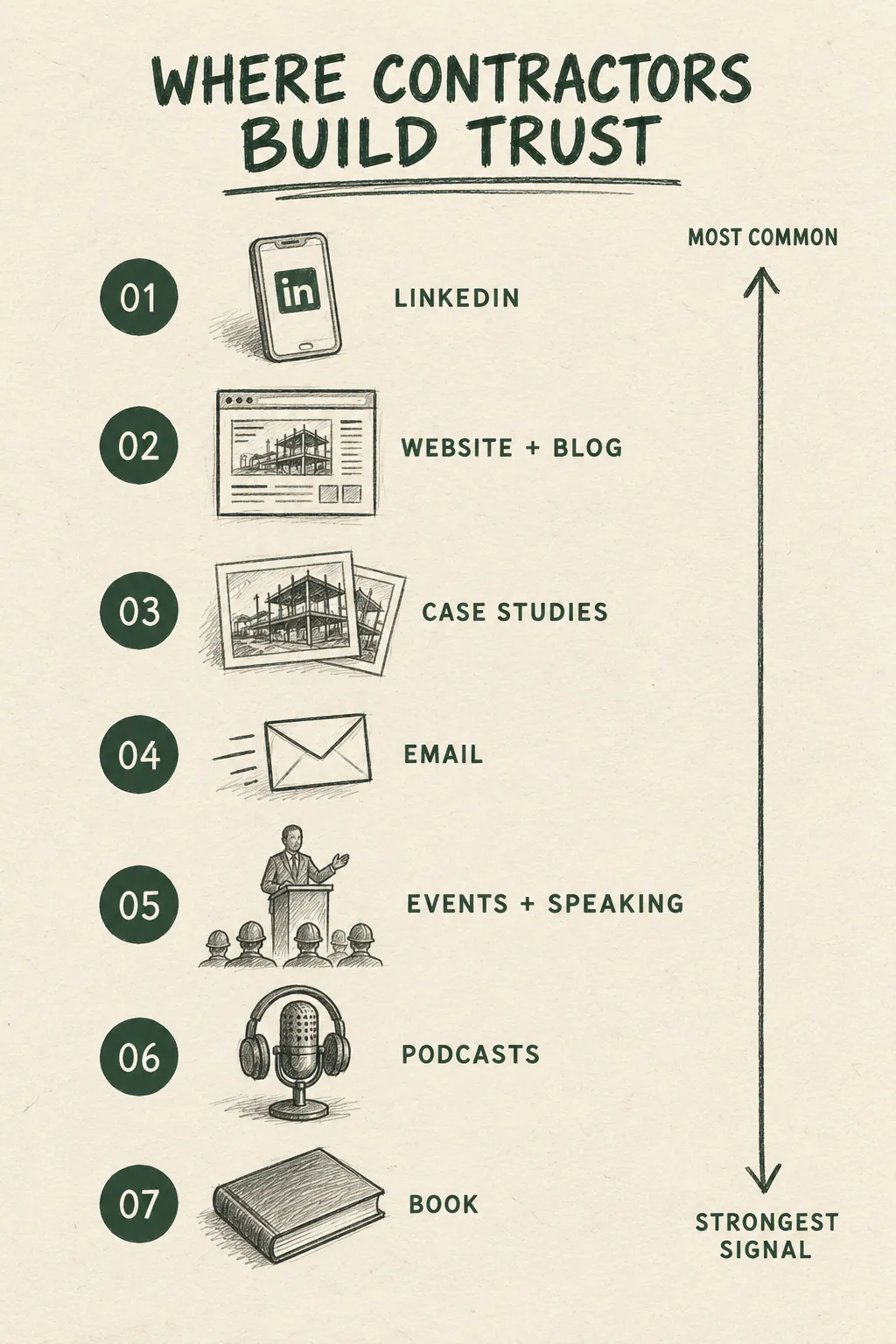
The most common channel and the fastest one to see movement on, because the people who award commercial work are already on it reading. It is also where our own inbound comes from. Once we started posting consistently about construction sales, prospects started showing up having already decided we knew the space, and a few of our clients came in the exact same way for their own businesses.
Post from the owner’s account, not the company page. A company page with 400 followers and a logo does almost nothing. The owner or GM with a real face, posting a few times a week about actual jobs, is what gets screenshotted and forwarded around.
What to post (rotate these):
- Project stories with numbers. Square footage, schedule, what the client needed, one thing that was hard and how you handled it.
- Process. How you run precon. How you handle a change order conversation. What your closeout package looks like.
- Mistakes. The job that ran long and why. This builds more trust than any win, because every buyer has been burned before and wants to know you learned something.
- Market observations. What you are seeing in bid volume, material lead times, or labor in your region. Short, specific, no predictions.
- People. The super with twelve years in. The apprentice who just finished. Buyers want to know who is actually going to show up on their site.
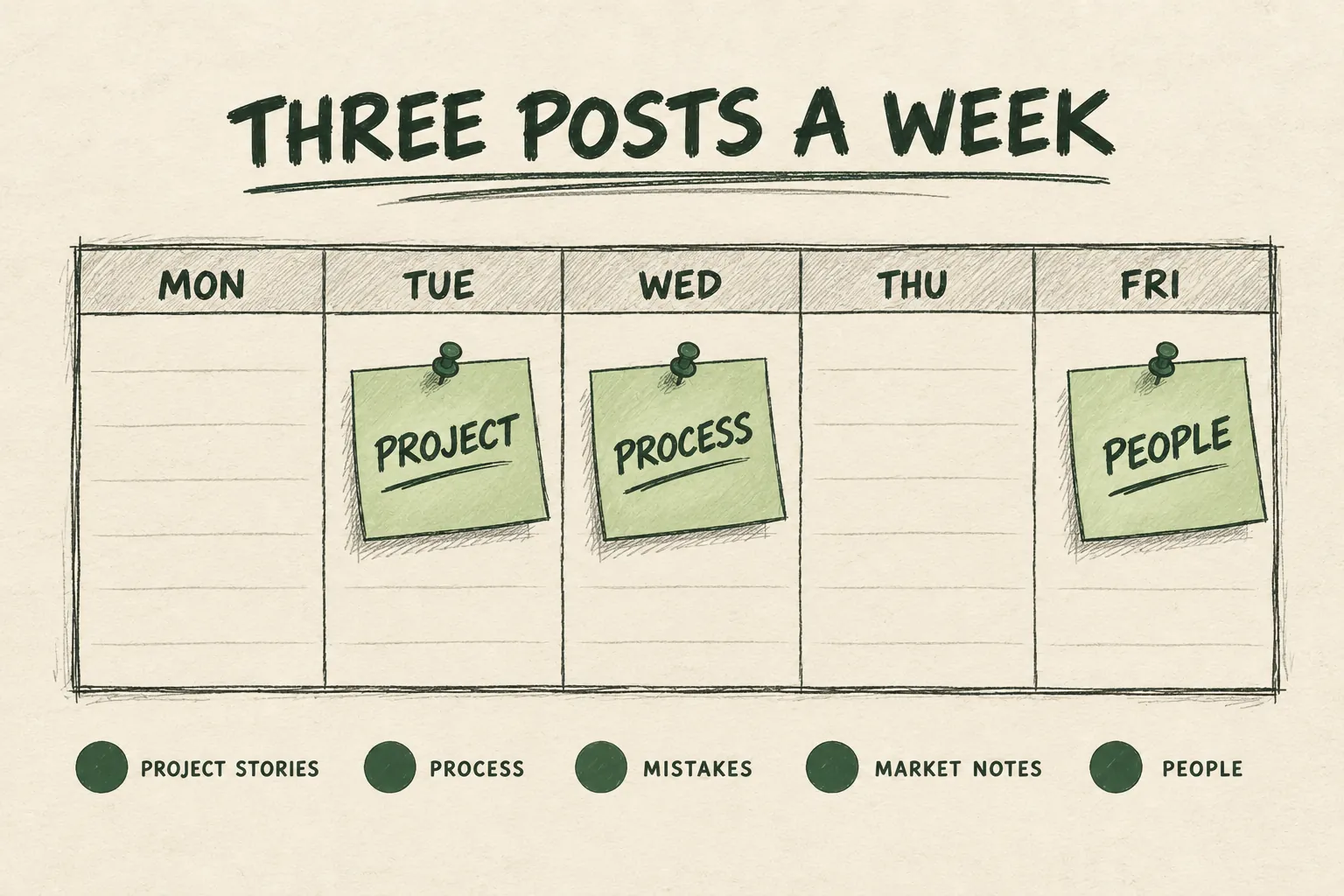
Cadence: two to three posts a week beats one long post a month. Under 200 words is fine. A photo from the site outperforms a designed graphic almost every time.
The alumni play. Go through your connections and find everyone who worked at, or with, one of your best clients and has since moved on. One of our GC clients had spent twelve years working with a single home builder, and when we went looking we found roughly 25 people who had left that builder and were now at other companies, all of whom had seen the work firsthand. Every post he puts up is a reminder to that group, and most contractors never go looking for it.
How it turns into work. The message that says “saw your post on the retail rollout, we have three coming up in Q1.” The GC who opens the first call with “I have been following you for a while.” You will rarely be able to draw a straight line from one post to one job, but somewhere around month six you notice the first calls are warmer than they used to be.
If you want this run for you, that is what our LinkedIn marketing for construction companies service does.
Your website and blog
If LinkedIn is where they notice you, the website is where they go to check. And most commercial construction sites fail that check: a drone shot, a services list that could belong to any contractor in the state, a projects page with photos and no information, and no named person anywhere.
What a site that builds trust has:
- Project pages with real details. Type, location, size, delivery method, schedule, one paragraph on what was hard. Filterable by sector, because a developer looking for a QSR contractor wants to see five QSR jobs, not a gallery of 40 thumbnails.
- A named owner and key people, with photos and a few lines each, linked to their LinkedIn profiles. Google and the AI engines look for this, and so does the human.
- Pages that answer the questions buyers ask. “What does a TI buildout cost per square foot in Phoenix.” “How long does a QSR ground-up take.” Put the answer in the first paragraph, in the words they used.
- A capability statement that can be downloaded. Owners’ reps and GC precon teams still ask for it, and it is often the first thing they read.
On blogging: you do not need 40 posts. You need eight to twelve that answer the questions you get on every first call, written by somebody who has done the work, with a byline.
What to write about. Start with the questions buyers ask you before they hire you, because those are the same things they are typing into Google and ChatGPT. For a commercial GC that usually looks like:
- What a project type costs in your market (“what does a dental office buildout cost per square foot in Phoenix”)
- How long it takes and what drives the schedule
- What the owner needs to have ready before you can start (drawings, permits, landlord approvals)
- How delivery methods differ and when to use each (design-build vs. CM at risk vs. hard bid, explained for someone who has never done this)
- The mistakes you see owners make on their first project in a sector
- What is in a capability statement, a prequal package, or a bid, and what a good one looks like
- Breakdowns of your own projects: what the client needed, what was hard, what you did about it
For a sub, swap in the questions GCs and estimators ask: lead times, what you need from the GC to hit a date, what separates a clean prequal from a messy one, where scope gaps usually hide in your trade.
How to write one that actually works. Put the answer in the first paragraph, in the words the buyer used, and then explain it. Use real numbers from your own jobs, even if they are ranges. Name the delivery method, the square footage, the schedule. One or two photos from the actual project beat stock images. Keep it to what you know firsthand, because an owner’s rep can tell the difference between a contractor explaining his own work and somebody summarizing an industry article. And put a real name on it: the owner, the precon lead, whoever actually knows the subject. Eight hundred to fifteen hundred words is plenty.
The step-by-step version is in Construction Content Marketing: 7 Steps. The site review with examples is in Construction Website Design: 12 Sites That Win Work, and if you want the site built, see construction website design.
Project case studies and photos
Probably the most underused channel in the industry. Almost every contractor has the raw material, since the photos are on a PM’s phone and the story is in the super’s head, and almost none of them ever write it up.
One page per notable project, four parts: the client’s situation and constraint, what you did about it, one number that proves it (schedule, budget, zero lost-time incidents, whatever is true), and one sentence from the client. 300 words and six photos. Put it on the website, cut it into two LinkedIn posts, and drop it into the capability statement.
Ask for the client quote at closeout, not six months later. At closeout they are relieved and happy with you. Six months later they are on to the next thing and you are chasing them for a sentence.
Email to past clients and partners
Cheap, almost nobody in construction does it, and it is the best fix for the “they forgot about us” problem. A short email once a month or once a quarter to every past client, GC contact, architect, and sub you have worked with. One project update, one thing you learned, one photo. It does not need fancy design or a newsletter template, and honestly the plain ones get read more.
The hard part is the list, not the email. Pull every contact from closed projects for the last five years into one place before you write a word. If that list has 300 people on it, that is 300 people who have seen your work and need reminding you exist.
Want this run for you?
IdealRev handles LinkedIn, website, and content for commercial GCs and subs, tied to a real business development pipeline, not vanity metrics.
Speaking, panels, webinars, and association involvement
The oldest form of thought leadership in this industry, and still one of the most effective, because it puts you in a room with the people who award work.

Go where your customers are, not where your peers are. This is the mistake most contractors make with associations. A sub who joins the subcontractors’ association is networking with his competitors. A sub who shows up to AGC or ABC chapter events is in a room full of GCs, which is who hires him. A GC who only goes to AGC is doing the same thing one level up. The GC’s buyers are developers, owners, and brokers, so that means NAIOP, ULI, ICSC, BOMA, CREW, the local real estate council, and the owner groups in whatever sector you want more of (the hospital association if you do healthcare, the restaurant association if you do QSR). Pick two, show up consistently, and skip the rest.
The progression: join and show up for a year. Volunteer for a committee. Offer to moderate a panel, which is easier than speaking and still gets you on stage. Then pitch a 20-minute session on something specific you have actually done, not a trend talk. “How we delivered a 40,000 SF outpatient clinic in 14 weeks” gets a room. “The future of healthcare construction” gets polite nodding.
Webinars work better with a partner. A GC and a sub, a contractor and an architect, a contractor and a lender. Each one brings their list, the audience doubles, and the content is better because there are two perspectives in it. We run a GC and trade partner mixer series for exactly this reason, and honestly the room does more for people than anything that gets said on stage.
Record and transcribe everything. Every panel, every webinar, every podcast appearance, even the lunch-and-learn you ran for a developer’s team. Run the recording through a transcription tool (Otter, Granola, Descript, whatever you already have) and you have the raw material for a month of content. One 40-minute panel becomes six LinkedIn clips, a blog post, and two emails. This is also where AI earns its keep: hand it the transcript and have it pull out the ten strongest points, draft a first pass of the post, and tighten your edits. Just do not let it take over. The transcript is you talking, and the post should still sound like you talking. If a buyer reads it and cannot hear you saying it, it is not doing the job.
Podcasts
Being a guest costs you an hour and gets you in front of an audience somebody else spent two years building. There are more construction podcasts than there are good guests, so hosts are easier to reach than you would think. Pitch a specific story, not your company.
Hosting your own is a bigger commitment, but it does one thing nothing else on this list does: it gives you a reason to call anyone in the industry. “Would you come on the show” gets a yes from developers and GC executives who would never take a sales call. We started a podcast for that reason as much as for the content.
A book
The rarest channel on this list, and the strongest single signal. Financial advisors, doctors, and consultants figured this out decades ago. Construction mostly has not, which is the opportunity.
A post is gone in a day, and a PDF gets deleted. A book sits on a desk, gets handed around the office, and eventually ends up on a bookshelf in plain sight. The digital version adds authority to your name and builds reviews over time. If you’ve done anything for ten years, you have a book in you.
Think about what happens when an owner’s rep gets one. It isn’t a brochure, so he reads it for how you think and what you’ve learned. He shows up to the first meeting already knowing who you are and why you’re the one to hire.
My partner and I ran a construction podcast for years, more than 500 episodes, and the same thing kept coming up. The best operators in this industry are carrying decades of knowledge that never leaves the company. At IsleFlow, we turn that into a published book, the kind an owner can put in a prospect’s hands the way any other professional would. Our book, Building Brilliance, came out of that podcast. When I send it to someone, it gets me into conversations.
Once you have it, use it as a business card. Send a copy directly from Amazon to a prospect before the first meeting. Bring a stack to a speaking event. Hand one to the owner at every kickoff, and give one to the people who refer you so you’re the name they pass along.
One IsleFlow client, a designer who sells to the same owners you do, wanted to emphasize that they had the experience for the biggest jobs. Their book makes them real to people who’d never met them. It builds trust through their experience and accomplishments, and shows how they work with clients from start to finish. They send a copy to every serious prospect and hand it out to decision-makers as a conversation starter.
Our process is built around the fact that you don’t have time to write. We interview you so you’re not writing at eleven at night, and we’re asking about things you already talk about on site. We write it in your voice, use multiple editors, and when it’s done, the book is yours and so is every right to it.
Where to start
Do not try to run six channels. Figure out who you are making this for, start with the one channel that matches how you already communicate, get it working, and then add the next one off the back of it.
Step 1: Map who you are writing for. Before you post anything, get specific about the buyer. Not “developers,” but the construction lead at a regional multifamily developer doing three to five ground-ups a year in your state. Then write down, for that person:
- What he is trying to get done (hit a lease-up date, get a project through the bank, not get burned again)
- What goes wrong for him on projects like yours (the last GC blew the schedule, the sub disappeared after mobilization, nobody told him about the utility lead time)
- What he would actually stop and read (how long a project like his takes, what it costs, what to have ready before he calls a contractor, what a good one looks like vs. a bad one)
- Where he already spends time (which associations, which conferences, which people he follows)
That list is your content plan. Every post, page, email, and talk should answer one of those questions for that person. If you are a sub, do the same exercise for the GC’s estimator or PM, because that is who decides whether you get the call.
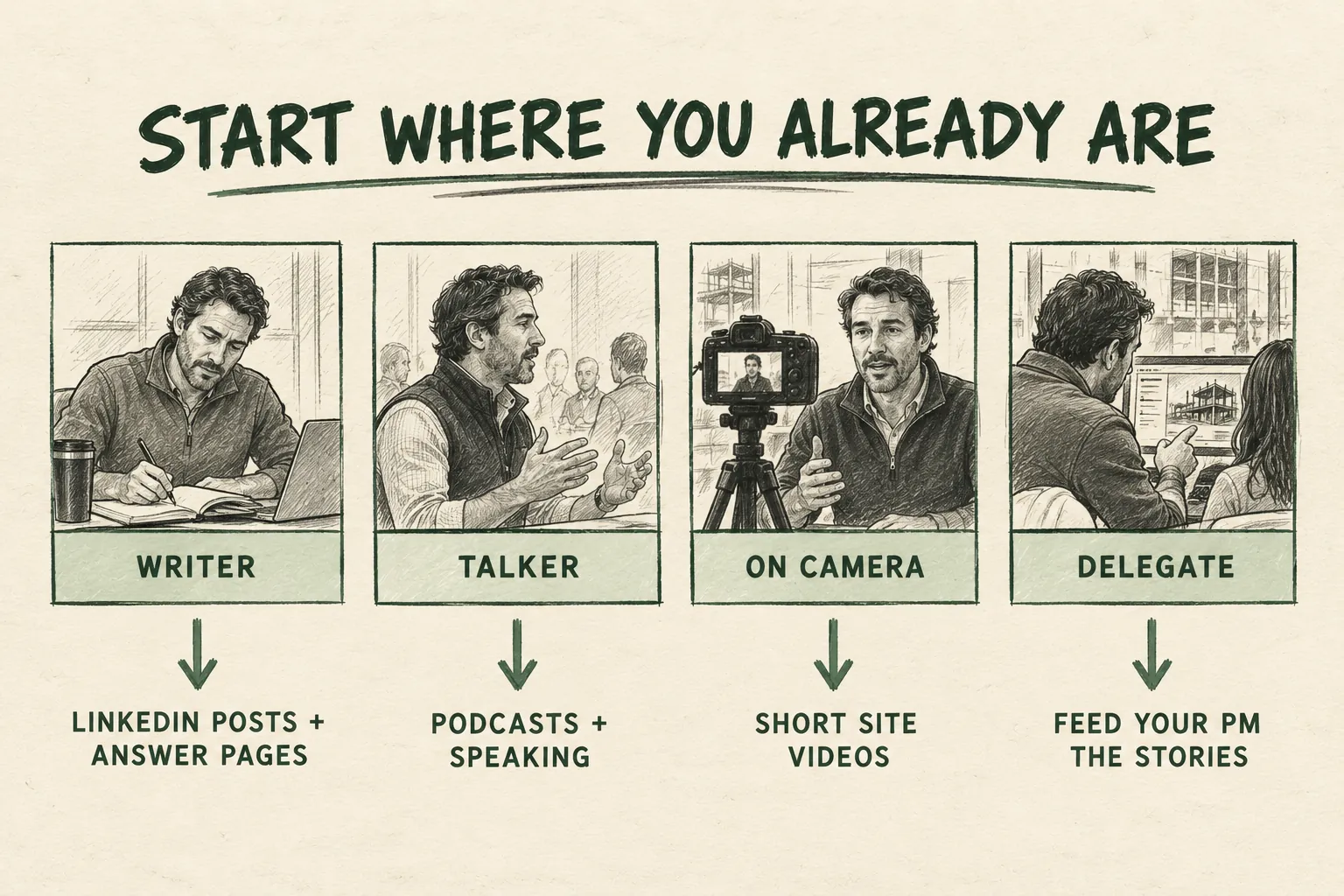
Step 2: Figure out which one you are.
- You write easily (long emails, detailed RFIs, you like explaining things in text): start with LinkedIn posts and the website answer pages.
- You talk easily but hate writing (good in a meeting, tell stories on site): start with podcast guesting and speaking, record everything, and have somebody turn the recordings into posts. Or record a voice memo after each site visit and get it transcribed. A lot of our clients’ best LinkedIn content started as a ten-minute conversation.
- You are comfortable on camera: short site videos on LinkedIn, two a week, phone quality is fine.
- None of the above, but you have a PM or BD person who is one of them: they are your channel, and your job is to feed them the stories.
Step 3: Start with the lowest-effort version of that channel. Two LinkedIn posts a week, or one podcast pitch, or one case study page. You do not need a content calendar yet. Give it 90 days before you judge it, because the first 30 are the awkward ones.
Step 4: Build the foundation while that runs. Project pages with details, a named team, a capability statement, and the past-client email list. None of it is glamorous and all of it is what every other channel points back to.
Step 5: Reuse everything. A panel becomes clips and a post. A case study becomes two posts and a page. A client question becomes an answer page. The guys who seem to be everywhere are usually not producing more than you, they are just cutting the same material more ways.
Step 6: Add the next channel once the first one is a habit. The usual order is LinkedIn, then website and case studies, then email, then speaking or podcasts, then a book. It is not a rule, and a contractor who speaks well might go speaking first and never post. What matters is doing them in some order instead of all at once.
When to skip this: if the owner will not post, will not be interviewed, and will not put his name on anything, none of it works. Ghostwritten content from a company with no visible person behind it reads as exactly what it is. Spend the money on business development and come back to this in a year.
If you want help with the LinkedIn, website, and content side, that is what we do at IdealRev for commercial GCs and subs. Grab a time with Kyle. If the book is the piece you want to explore, Rob at IsleFlow is the person to talk to.
Want this run for you?
IdealRev handles LinkedIn, website, and content for commercial GCs and subs, tied to a real business development pipeline, not vanity metrics.