
Construction Marketing Materials Built to Win Work, Not Just Look Good
Capability statements, sales decks, project sheets, and one-pagers your team can confidently put in front of developers, GCs, and owners
+
+
Most Construction Marketing Materials Are Made to Look Good, Not to Win Work
Most contractors have a capability statement, a deck, and some kind of brochure. They were put together by a designer, and they look fine.
But look at what’s actually in them. A company history. A list of services. Some project photos. The same “on time, on budget, safety first” language every other contractor uses.
None of it was built with the reader in mind. A developer deciding who to invite to bid. A GC deciding whether to prequalify a sub. A property manager picking who to call about the next renovation. They are looking for specific things, and a nice layout doesn’t answer them.
So the materials go out, and nothing changes.
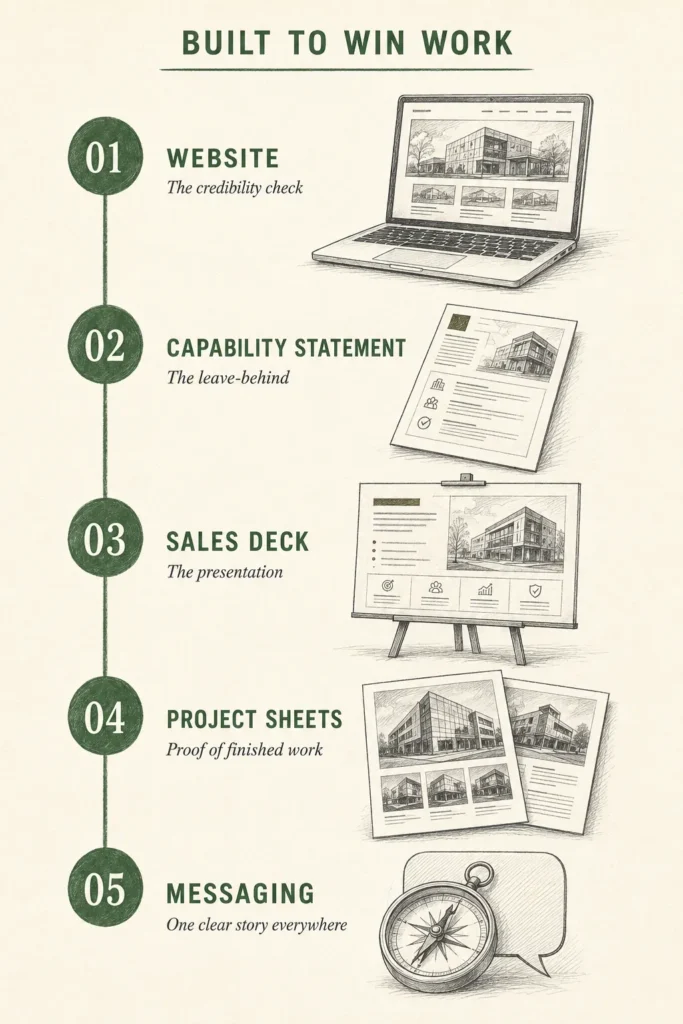
Materials Built Around What Your Clients Actually Need to See
We start with who you’re trying to win and what they care about. Then we build the pieces your team actually uses, so when something goes out, it makes the case for you.
Capability Statements
The one-page document a developer, GC, or property manager can read in a minute and pass along. Markets, project size, delivery methods, bonding, safety, key people, and the projects that prove it.
Sales Decks and Presentations
The deck your team walks through in an interview or a first meeting. Built around what the client is worried about, not your founding year.
Project Sheets and Experience Pages
One page per project, in a consistent format. Market, size, delivery method, schedule, and what you handled well. A stack of these is what makes “we do healthcare” believable.
Brochures and One-Pagers
Leave-behinds for meetings, trade shows, and prequal packets. Short, specific, and current.
Messaging and Positioning
What you want to be known for and how to say it. We get this right first, so everything else is built on it.

Your Team Has Something Worth Sending
- Your reps have a capability statement they can send the same day someone asks
- Your project sheets match the kind of work you’re pitching
- Your deck is built for the client in the room, not a general overview
- Your website, deck, and leave-behinds all tell the same story
- Developers, GCs, and owners can see why you’re the right fit before the first meeting
What Working Together Looks Like
We get clear on your projects, your ideal clients, and how you actually win work
We simplify how you explain what you do so it is clear and consistent across everything
Capability statement, project sheets, deck, and whatever else your team needs in front of clients
We make sure everything is easy to use and actually supports your team in real conversations, and we keep it current as projects finish
Who This Is For
Ideal Fit
- Commercial contractors and subcontractors actively doing business development
- Companies getting on bid lists but not winning the interview
- Subs trying to get prequalified with GCs they haven’t worked with yet
- Owners who know their current materials aren’t helping
Not a Fit
- Residential-only contractors
- Companies looking for design without substance behind it
- Businesses expecting a document to do the follow-up for them
Common Questions About Construction Marketing Materials
What is a capability statement for a construction company?
A one-page summary of what you do, who you do it for, and why you can be trusted with the job. Markets, project size range, delivery methods, bonding and insurance, safety record, key people, and a few representative projects. In government work it’s a formal requirement. In private commercial work it’s what gets you onto the bid list, and very few contractors have one ready to send.
What’s the difference between a capability statement and a statement of qualifications?
A capability statement is one page and gets you considered. A statement of qualifications is long, project-specific, and usually answers an RFQ, with team resumes, detailed project histories, and financials. You use the first to get invited and the second to compete once you are.
What should we bring to a GC interview?
The team that will actually be on the job, a short deck built around the risks on their project, and project sheets for two or three jobs that look like theirs. Leave behind the capability statement and the project sheets. Most contractors bring a company overview and spend the first ten minutes on history.
What goes in a construction project sheet?
Project name and location, owner and architect, building type, square footage, delivery method, schedule, and the value if you’re willing to share it. Then a few sentences on what was hard and how you handled it.
Do we need a capability statement if we don’t do government work?
Yes. A developer or GC comparing three contractors needs something to forward internally. If you’re the only one who makes that easy, you’re the one who gets talked about.
How often should we update our materials?
The capability statement every six to twelve months, or whenever your bonding, safety numbers, or biggest project changes. Project sheets as jobs wrap up. We hand over a template so your team can do that without coming back to us.
If Your Materials Aren’t Helping You Win Work, Let’s Talk
We’ll walk through what you have now, what’s missing, and what would actually help your team in conversations with the right people